Q.How do you explain the presence of five —OH groups in glucose molecule?
🔒You're viewing a preview — the full solution, concept, methods & PYQ mapping are locked.
🔒 Start your 14-day free trial to unlock the full solution →Concept understanding — Glucose Cyclization
Glucose Cyclization: From a Straight Chain to a Ring
Imagine you have a long, flexible chain with a hook at one end and an eyelet at the other. If you swing that chain around, the hook can snap into the eyelet, forming a loop. That's the core idea behind glucose cyclization.
Glucose in its simplest written form is a straight chain of six carbon atoms with an aldehyde group (−CHO) at one end. But in water (like in your blood), this chain doesn't stay straight. The aldehyde group reacts with the alcohol group on the fifth carbon, forming a stable six-membered ring.
Why does this happen?
The aldehyde carbon is electrophilic (electron-poor), and the oxygen on carbon-5 has lone pairs (nucleophilic). They attack each other, forming a new bond. This creates a hemiacetal — a carbon bonded to both an −OH and an −OR group. The ring is more stable than the open chain in solution.
The open-chain form of glucose exists in equilibrium with the cyclic form, but at any given time, over 99% of glucose molecules are in the cyclic form.
The precise statement
Glucose cyclization is an intramolecular nucleophilic addition where the aldehyde group at C1 reacts with the hydroxyl group at C5, forming a six-membered pyranose ring (named after pyran, a six-membered oxygen heterocycle). This reaction creates a new chiral center at C1, giving two possible stereoisomers called anomers: α and β.
The two anomers
When the ring forms, the oxygen from C5 becomes part of the ring. The carbon that was the aldehyde (now C1) becomes a new chiral center. The −OH group at this new center can point:
- Down (relative to the ring plane) → α-D-glucose
- Up → β-D-glucose
The α and β anomers are diastereomers, not enantiomers. They differ only at the anomeric carbon (C1). In solution, they interconvert through the open-chain form — a process called mutarotation.
How to draw it (Haworth projection)
- Draw a hexagon with an oxygen atom at the top-right corner.
- Number the carbons clockwise from the oxygen: C1 is the carbon to the right of oxygen, C2 next, and so on.
- For α-D-glucose, the −OH at C1 points down (opposite to the CH2OH group at C5).
- For β-D-glucose, the −OH at C1 points up (same side as the CH2OH group). …
Why this formula?
Glucose Cyclization: Why the Ring Forms
Glucose cyclization is a classic example of an intramolecular reaction — a molecule reacting with itself. Let's build the understanding step by step.
1. The Starting Point: Open-Chain Glucose
Glucose (C6H12O6) in its open-chain form has:
- An aldehyde group (−CHO) at carbon 1 (C1)
- A hydroxyl group (−OH) at carbon 5 (C5)
The aldehyde is electrophilic (electron-deficient at the carbonyl carbon), and the hydroxyl is nucleophilic (electron-rich oxygen with lone pairs).
2. Why Cyclization Happens: Thermodynamic & Kinetic Favorability
The Key Insight
The molecule is flexible — it can bend so that the C5 hydroxyl oxygen approaches the C1 aldehyde carbon. This brings two reactive groups into close proximity.
- Entropy is favorable: One molecule becomes one ring — no loss of translational entropy (unlike two separate molecules reacting).
- Ring strain is manageable: A 5- or 6-membered ring (furanose or pyranose) has minimal angle strain (close to tetrahedral angles).
Result: The reaction is reversible but strongly favors the cyclic form — in aqueous solution, >99% of glucose exists as the ring.
3. The Reaction: Hemiacetal Formation
The nucleophilic oxygen of the C5 hydroxyl attacks the electrophilic carbonyl carbon of C1:
R-CHO+R’-OH⇌R-CH(OH)(OR’)
This is a hemiacetal — a carbon bonded to both an −OH and an −OR group.
Mechanism (simplified)
- Protonation of the carbonyl oxygen (acid-catalyzed) makes C1 more electrophilic.
- Nucleophilic attack by the C5 oxygen.
- Deprotonation yields the cyclic hemiacetal.
4. The Key Formula(e): Ring Size & Anomeric Carbon
Ring Size Determination
The ring size depends on which hydroxyl attacks:
- C5 hydroxyl → pyranose (6-membered ring: 5 carbons + 1 oxygen)
- C4 hydroxyl → furanose (5-membered ring: 4 carbons + 1 oxygen)
For D-glucose, the C5 attack is overwhelmingly favored, giving the pyranose form.
The Anomeric Carbon
The new chiral center formed at C1 is called the anomeric carbon. Two stereoisomers arise:
- α-anomer: −OH at C1 is trans to the −CH2OH group (axial in the chair conformation)
- β-anomer: −OH at C1 is cis to the −CH2OH group (equatorial in the chair conformation)
Why two forms? The attack can occur from either face of the planar carbonyl group — leading to two possible configurations at the new stereocenter.
5. The Equilibrium Constant & Mutarotation
The interconversion between α and β anomers is called mutarotation:
α-D-glucopyranose⇌open chain⇌β-D-glucopyranose
At equilibrium (in water at 20°C):
- β-D-glucopyranose: ~64%
- α-D-glucopyranose: ~36%
- Open chain: <0.1% …
The key idea is that glucose exists primarily as a cyclic hemiacetal, not as a straight-chain aldehyde. In the open-chain form, glucose has four chiral carbons and one aldehyde group — but the aldehyde reacts with the C5 hydroxyl to form a six-membered pyranose ring.
Reasoning:
- The open-chain structure of glucose is CHO–(CHOH)4–CH2OH, which contains four secondary alcohols and one primary alcohol — that’s five —OH groups in total.
- In solution, the aldehyde group (–CHO) at C1 reacts intramolecularly with the –OH at C5, forming a cyclic hemiacetal. This reaction does not change the number of hydroxyl groups: the aldehyde oxygen becomes a ring oxygen, and a new –OH appears at the anomeric carbon (C1). …
The five —OH groups in glucose arise because its open-chain form is an aldohexose (a six-carbon aldehyde sugar), and when it cyclizes into a pyranose ring, the aldehyde group reacts with the C5 hydroxyl to form a hemiacetal, leaving all other hydroxyls intact — so the cyclic structure still shows five —OH groups, one of which is the anomeric —OH.
Glucose is an aldohexose — that means it has six carbons and an aldehyde group. In its open-chain (Fischer projection) form, each carbon except the first (the aldehyde carbon) carries a hydroxyl group. That gives you five —OH groups straight away: one on each of C2 through C6. The aldehyde group at C1 is a carbonyl, not an —OH.
But here’s the twist: glucose in solution is almost entirely cyclic, not open-chain. The cyclization happens when the aldehyde group at C1 reacts with the hydroxyl on C5, forming a six-membered ring (a pyranose ring). This reaction creates a new —OH group at C1 (the anomeric hydroxyl), while the —OH on C5 is now part of the ring oxygen bridge. So the cyclic structure still has five —OH groups: one at each of C1, C2, C3, C4, and C6. The C5 oxygen is now an ether linkage, not an —OH.
Let’s walk through it step by step.
-
Open-chain glucose has five —OH groups.
In the straight-chain form, glucose is written as:
CHO–(CHOH)4–CH2OH
Carbons 2, 3, 4, and 5 each carry one —OH, and carbon 6 carries a primary alcohol group (—CH2OH). That’s 4+1=5 hydroxyls. The aldehyde at C1 has no —OH.
-
Cyclization creates a hemiacetal at C1.
The aldehyde group (C1) reacts with the —OH on C5. The oxygen of the C5—OH becomes part of the ring, and the hydrogen from that —OH moves to the carbonyl oxygen of the aldehyde. This forms a new —OH group at C1 (the anomeric —OH). The C5 oxygen is now an ether bridge, so C5 no longer has an —OH.
-
Count the —OH groups in the cyclic form.
After cyclization:
- C1: one —OH (anomeric)
- C2: one —OH
- C3: one —OH
- C4: one —OH
- C5: no —OH (now part of the ring)
- C6: one —OH (primary alcohol) That’s still five —OH groups. The ring oxygen is at C5, but the hydroxyl count remains unchanged.
A quick way to remember: an aldohexose always has five —OH groups in both open-chain and cyclic forms. The cyclization just relocates one —OH from C5 to C1 — it doesn’t change the total number.
- Why doesn’t the ring reduce the count? …
Method: Open-Chain to Cyclic Conversion (Hemiacetal Formation)
This method explains how the five —OH groups in glucose arise from its cyclic structure, not from the open-chain form.
Step 1 – Recall the open-chain structure
- Glucose has the molecular formula C6H12O6.
- In the open-chain (Fischer projection) form, it contains:
- One aldehyde group (−CHO) at C1
- Four secondary alcohol groups (−OH) on C2, C3, C4, C5
- One primary alcohol group (−CH2OH) on C6
That gives five —OH groups in the open chain.
Step 2 – Understand why cyclization happens
- The aldehyde group at C1 reacts with the —OH group on C5 (which is five atoms away).
- This is an intramolecular nucleophilic addition forming a hemiacetal (cyclic ether).
Step 3 – Count the —OH groups in the cyclic form
- When the ring closes, the C1 aldehyde oxygen becomes a new —OH group (called the anomeric hydroxyl).
- The original —OH on C5 is now part of the ring (oxygen bridge), so it is no longer a free —OH.
- The remaining —OH groups on C2, C3, C4 stay as they are.
- The —CH2OH on C6 remains a primary alcohol.
So in the cyclic form:
- C1: one —OH (new)
- C2, C3, C4: three —OH groups
- C6: one —OH
Total = 5 —OH groups in the cyclic structure.
Step 4 – Key exam point …
Common Mistakes: Explaining Five —OH Groups in Glucose
Students often struggle to connect the open-chain structure of glucose with its cyclic form. Here are the most frequent errors and how to avoid them.
✗ Mistake 1: Counting —OH groups from the open-chain formula only
The error:
Students write glucose as C6H12O6 and say "there are 5 OH groups because the formula has 6 oxygens, one is in the aldehyde group, so 5 are OH." This is incomplete — it doesn't explain why the cyclic form also has 5 OH groups.
Why it's wrong:
In the cyclic (pyranose) form, the aldehyde carbon (C1) becomes a hemiacetal carbon and still carries an —OH group. So the total number of —OH groups remains 5, but the explanation must account for the ring closure.
✓ How to avoid:
Always draw both forms side-by-side:
-
Open chain:
CHO at C1, then CHOH at C2 through C5, and CH2OH at C6 → 5 OH groups (one on each of C2, C3, C4, C5, and C6).
-
Cyclic (pyranose):
C1 now has an —OH (hemiacetal), C2, C3, C4 each have one —OH, and C6 still has CH2OH → still 5 OH groups.
Key point: The —OH on C5 is used to form the ring (oxygen bridge), so it disappears as an —OH, but a new —OH appears on C1. Count remains 5.
✗ Mistake 2: Forgetting the hemiacetal —OH
The error:
Students say "in the ring, C5 loses its OH to form the ring, so there are only 4 OH groups left."
Why it's wrong:
The oxygen of the C5 —OH becomes the ring oxygen, but the hydrogen from that —OH and the carbonyl oxygen of C1 combine to form a new —OH on C1. So no net loss.
✓ How to avoid:
Memorise the hemiacetal formation mechanism:
Aldehyde+Alcohol→Hemiacetal
In glucose:
- C1 (aldehyde) + C5 —OH (alcohol) → ring closes
- C1 gets a new —OH (hemiacetal OH)
- C5 —OH is now part of the ring (O atom)
Visual trick: Write the open chain, then draw an arrow from C5 —OH to C1 =O. The =O becomes —OH, the —OH becomes O in ring.
✗ Mistake 3: Confusing —OH count with —CH2OH
The error:
Some students count the CH2OH group at C6 as "one OH" but then also count the carbon it's attached to separately, leading to double-counting or missing it.
Why it's wrong:
C6 has a CH2OH group — that's one —OH group (on a primary carbon). It is not two OH groups.
✓ How to avoid:
List the five carbons that carry —OH explicitly:
| Carbon | Group | Type of —OH |
|---|---|---|
| C1 | —OH (hemiacetal) | Secondary (in ring) |
| C2 | —OH | Secondary |
| C3 | —OH | Secondary |
| C4 | —OH | Secondary |
| C6 | CH2OH | Primary |
Total = 5. Never count C5 — it has no free —OH in the ring.
--- …
Showing the 12 most recent of 19 on this concept.
- AP EAPCET 2026Set eng-2026-05-13-AN1 markMCQQ.The number of secondary alcoholic groups present in the end product 'Y' of the given reaction sequence is C6H12O6HCNXH2O ∣ H+Y (A) 4 (B) 3 (C) 5 (D) 6
›Reveal solutionSolution
This tests the Kiliani–Fischer chain-extension sequence (aldose + HCN → cyanohydrin → hydrolysis → one-carbon-longer aldonic acid) and careful counting of secondary alcohol groups in the product. The answer is 5.
Concept and Intuition
Glucose's open-chain form has an aldehyde at C1. Adding HCN to an aldehyde forms a cyanohydrin: the carbonyl carbon becomes a new stereocentre bearing both −OH and −CN, and crucially the −CN carbon becomes a new carbon added to the chain. When that nitrile is hydrolysed (H2O/H+) it becomes a carboxylic acid carbon. So overall, a 6-carbon aldose becomes a 7-carbon acid with one extra −CH(OH)− unit inserted next to the original carbonyl position — this is exactly how sugar chains are lengthened in the Kiliani–Fischer synthesis.
Step-by-Step Solution
- Write glucose's open-chain structure: C1(CHO)−C2(CHOH)−C3(CHOH)−C4(CHOH)−C5(CHOH)−C6(CH2OH).
- HCN addition at the carbonyl (C1): the carbonyl carbon becomes −CH(OH)(CN)−, i.e. a new nitrile carbon is attached to old C1. So X: NC−CH(OH)[oldC1]−CH(OH)[C2]−CH(OH)[C3]−CH(OH)[C4]−CH(OH)[C5]−CH2OH[C6].
- Hydrolysis (H2O/H+) converts the terminal −CN to −COOH: Y: HOOC[new carbon]−CH(OH)[old C1]−CH(OH)[C2]−CH(OH)[C3]−CH(OH)[C4]−CH(OH)[C5]−CH2OH[C6] — a 7-carbon chain. …
- AP EAPCET 2026Set eng-2026-05-15-FN1 markMCQQ.Observe the following reactions I. D-GlucoseNH2OH II. D-Glucose(i) (CH3CO)2O(ii) NH2OH Correct statement regarding the reactions I and II is (A) Oxime is formed in both the reactions I, II (B) Oxime is not formed in both the reactions I, II (C) Oxime is formed in reaction I but oxime is not formed in reaction II (D) Oxime is not formed in reaction I but oxime is formed in reaction II
›Reveal solutionSolution
This is the classic experiment proving glucose's cyclic hemiacetal structure: plain
glucose reacts with hydroxylamine (free −CHO), but glucose pentaacetate does
not (no free −CHO left to react). Answer: (C).
Concept and Intuition
D-Glucose is not fixed as a straight chain — it exists mainly as a cyclic hemiacetal
(pyranose) in equilibrium with a small amount of the open-chain aldehyde form. Reagents
that test for a free carbonyl (like NH2OH, Schiff's reagent, or NaHSO3) react via
this open-chain minority form, so plain glucose behaves as if it has a free −CHO.
If, however, glucose is first acetylated with excess acetic anhydride, every −OH group gets esterified — including the anomeric −OH that would otherwise open up to
expose the aldehyde. The resulting glucose pentaacetate is locked in the cyclic
form with no accessible carbonyl, so it fails to react with hydroxylamine or Schiff's
reagent. This experiment is one of the classical pieces of evidence for the cyclic
(not open-chain) structure of glucose.
Step-by-Step Solution
- Reaction I: D-GlucoseNH2OHoxime — plain glucose's open-chain aldehyde tautomer reacts normally, forming the oxime.
- Reaction II: D-Glucose(i) (CH3CO)2Oglucose pentaacetate — this step acetylates all −OH groups, including the anomeric one, locking the ring closed. …
- AP EAPCET 2026Set ap-2026-05-20-AN1 markMCQQ.D-Glucose does not react with which of the following reagents? I. NaHSO3 II. NH2OH III. (CH3CO)2O IV. Schiff's reagent (A) II, III only (B) I, II, III only (C) I, II only (D) I, IV only
›Reveal solutionSolution
Glucose fails to react with sodium bisulphite and Schiff's reagent — the classic evidence that its carbonyl exists mainly as a cyclic hemiacetal, not a free aldehyde.
Concept and Intuition
Glucose behaves like a typical aldehyde in many respects (oxidation to gluconic acid, cyanohydrin formation, oxime formation, acetylation of its five -OH groups), which is used to establish its structure. But it notably FAILS the two classic 'free aldehyde' spot tests — the bisulphite addition reaction and the Schiff's test — because in solution glucose exists overwhelmingly in the cyclic hemiacetal (pyranose) form, and the small equilibrium amount of open-chain aldehyde isn't sufficient/fast enough for these particular fast, stoichiometric addition reactions, even though it's enough to drive the slower oxidation and condensation reactions via Le Chatelier's principle.
Step-by-Step Solution
- I. NaHSO3: Glucose does NOT form the expected bisulphite addition compound — a key piece of evidence against a simple free-aldehyde structure.
- II. NH2OH: Glucose DOES react, forming an oxime, confirming the presence of a carbonyl group (via the open-chain tautomer).
- III. (CH3CO)2O: Glucose DOES react, undergoing acetylation to give glucose pentaacetate (confirms 5 -OH groups). …
- AP EAPCET 2025Set eng-2025-05-21-AN1 markMCQQ.A carbonyl compound X(C8H8O) gives yellow precipitate with NaOI. Hemiacetal of X with methanol/dry HCl is (A) C6H5−CH2−CH(OH)−OCH3 (drawn as a benzene ring with a −CH2CH(OH)OCH3 substituent) (B) C6H5−CH2−CH(OCH3)2 (drawn as a benzene ring with a −CH2CH(OCH3)2 substituent) (C) C6H5−C(OH)(CH3)(OCH3) (drawn as a benzene ring whose ring carbon bears a central carbon substituted with -OH, -CH_3 and -OCH_3) (D) C6H5−C(OH)(OCH3)2 (drawn as a benzene ring whose ring carbon bears a central carbon substituted with -OH and two -OCH_3 groups)
›Reveal solutionSolution
X is acetophenone (C6H5COCH3, iodoform-positive, C8H8O); its hemiacetal with methanol is C6H5−C(OH)(CH3)(OCH3).
Concept and Intuition
The iodoform (yellow precipitate with NaOI, i.e. I2/NaOH) test is positive for any compound with a CH3−CO− group (methyl ketones) or that can be oxidised to one (like ethanol/secondary alcohols bearing a CH3CH(OH)− group). Given the molecular formula C8H8O and an aromatic-sized carbon count, the methyl ketone that fits is acetophenone, C6H5−CO−CH3. A hemiacetal forms when one equivalent of alcohol adds across a carbonyl (catalysed by dry HCl): the carbonyl oxygen picks up the proton to become −OH, while the alcohol's oxygen bonds to the former carbonyl carbon as −OR — all substituents originally on that carbon (here, the phenyl and the methyl) remain attached to the same, now sp3, carbon.
Step-by-Step Solution
- Identify X: C8H8O, gives iodoform test ⇒ a methyl ketone. Acetophenone C6H5COCH3 fits (6 (ring)+1 (C=O)+1 (CH3)=8 carbons; one O).
- Hemiacetal formation mechanism: methanol's OH oxygen attacks the electrophilic carbonyl carbon of C6H5−C(=O)−CH3, protonated by dry HCl. …
- AP EAPCET 2025Set eng-2025-05-22-FN1 markMCQQ.Which of the following contain α-D-glucose units ?a) cane sugar b) milk sugar c) cellulose d) amylose (A) a, d (B) a, b (C) b, c (D) c, d
›Reveal solutionSolution
Tests recognising which common carbohydrates are actually built from α-D-glucose units, as opposed to β-D-glucose or a non-glucose sugar.
Concept and Intuition
A saccharide "contains α-D-glucose units" only when a glucose unit's anomeric carbon is tied down in the α configuration by a glycosidic bond (as in a polysaccharide chain, or in sucrose where glucose's anomeric carbon links to fructose), or the free sugar is drawn/crystallised as its α anomer feeding a fixed linkage.
Step-by-Step Solution
- (a) Cane sugar = sucrose = α-D-glucose (1→2) β-D-fructose. The glucose unit's anomeric carbon (C1) is locked in the α configuration by this glycosidic bond — contains α-D-glucose. ✓
- (b) Milk sugar = lactose = β-D-galactose (1→4) D-glucose. Here it is galactose, not glucose, that supplies its anomeric carbon to the bond; the glucose unit's own anomeric carbon is FREE (this is why lactose is a reducing sugar and shows mutarotation) — not fixed as α-D-glucose. ✗
- (c) Cellulose is a linear polymer of β-D-glucose units joined by β(1→4) linkages — glucose, but the WRONG anomer (β, not α). ✗ …
- AP EAPCET 2025Set ap-2025-05-20-AN1 markMCQQ.Sucrose when boiled with dilute HCl gives two functional isomers X and Y. X gives monocarboxylic acid with bromine water but not Y. The number of –OH groups in cyclic structure of X is (A) 6 (B) 4 (C) 5 (D) 3
›Reveal solutionSolution
X (from sucrose hydrolysis) is glucose, identified because bromine water oxidises only aldoses; its cyclic pyranose form carries 5 free −OH groups.
Concept and Intuition
Sucrose is a non-reducing disaccharide of glucose and fructose joined through their anomeric carbons. Acid hydrolysis (dil. HCl, heat) breaks the glycosidic bond, releasing free glucose and fructose — this equimolar mixture is called invert sugar. Bromine water is a mild, selective oxidant: it oxidises the free aldehyde group of an aldose (like glucose) to a carboxylic acid, but it does not oxidise ketoses (like fructose), because ketones are far more resistant to this kind of mild oxidation than aldehydes.
Step-by-Step Solution
- Sucrose dil. HCl,Δ glucose + fructose (invert sugar) — these are the two isomeric monosaccharides X and Y (C6H12O6 each).
- Bromine water oxidises the aldehyde of glucose to gluconic acid (a monocarboxylic acid), but does not react with fructose's ketone group. So X = glucose, Y = fructose.
- Draw the cyclic (pyranose, 6-membered) ring of glucose: ring atoms are the ring-O, C1, C2, C3, C4, C5, with C6 (CH2OH) exocyclic on C5. …
- AP EAPCET 2025Set eng-2025-05-27-FN1 markMCQQ.Which of the following represents the correct structure of β−D−(−)-Fructofuranose ? (A) [FIGURE] (Haworth furanose ring with O at the top vertex; upper-left ring carbon carries an exocyclic HOH2C− group, with H outside and H just inside it; upper-right ring carbon carries an exocyclic −CH2OH group, with HO inside and OH outside; bottom-left ring carbon carries OH outside; bottom-right ring carbon carries H outside) (B) [FIGURE] (Haworth furanose ring with O at the top vertex; upper-left ring carbon carries an exocyclic HOH2C− group, with H outside and H inside; upper-right ring carbon carries OH directly, with H inside and CH2OH outside; bottom-left ring carbon carries OH outside; bottom-right ring carbon carries OH outside) (C) [FIGURE] (Haworth furanose ring with O at the top vertex; upper-left ring carbon carries an exocyclic HOH2C− group, with H outside and H inside; upper-right ring carbon carries OH directly, with HO inside and CH2OH outside; bottom-left ring carbon carries OH outside; bottom-right ring carbon carries H outside) (D) [FIGURE] (Haworth furanose ring with O at the top vertex; upper-left ring carbon carries H directly, with H inside; upper-right ring carbon carries OH directly, with HO inside; the exocyclic HOH2C− and −CH2OH groups instead sit on the bottom-left and bottom-right ring carbons respectively, which also carry OH outside and H outside)
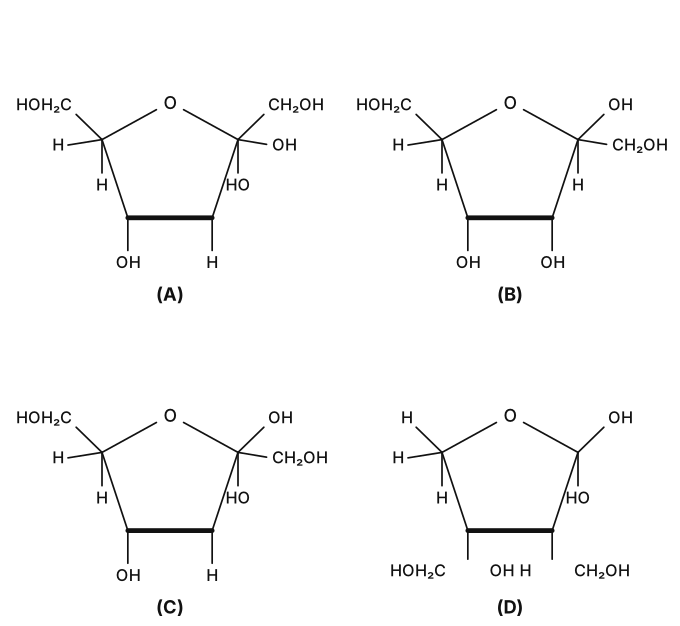
›Reveal solutionSolution
This tests the Haworth structure of β-D-fructofuranose — the 5-membered ring form of D-fructose found in sucrose. Matching each option's substituent placement to the known structure gives option (C).
Concept and Intuition
D-Fructose is a ketohexose; its furanose (5-membered) ring forms between the carbonyl carbon C2 and the C5-oxygen, releasing C1 (CH2OH) and C6 (CH2OH) as exocyclic groups on C2 and C5 respectively. The anomeric carbon here is C2 (not C1, since fructose's carbonyl is a ketone at C2). The α/β distinction refers to the orientation of the new OH generated at C2 upon ring closure, relative to the reference (C5) configuration — exactly analogous to the α/β distinction at C1 in glucopyranose.
Step-by-Step Solution
- Identify the ring: 5-membered furanose ring = O, C2, C3, C4, C5 (C1 and C6 are exocyclic CH2OH groups).
- C5 (derived from a D-sugar's terminal configuration) carries its CH2OH (C6) group "up" in the standard Haworth convention for D-sugars — matching the exocyclic CH2OH shown at the upper-right ring carbon in the options.
- C2 (anomeric) carries the exocyclic HOH2C− (C1) group at the upper-left ring carbon, plus its anomeric OH; for the β-anomer this OH sits on the same face as the C5→C6 reference substituent. …
- AP EAPCET 2025Set eng-2025-05-27-FN1 markMCQQ.Which of the following statement is not correct for glucose ? (A) Glucose does not give Schiffs test. (B) Glucose exists in two crystalline forms α- and β-. (C) The pentaacetate of glucose does not react with NH2OH. (D) Glucose forms addition product with NaHSO3.
›Reveal solutionSolution
This tests the classic NCERT evidence for glucose's cyclic (not open-chain aldehyde) structure. Glucose does NOT react with Schiff's reagent and does NOT form a bisulphite addition product with NaHSO3 — so the statement claiming it forms the NaHSO3 adduct is false.
Concept and Intuition
Glucose's open-chain structure has a free −CHO at C1, which would be expected to give positive tests for aldehydes (Schiff's test, bisulphite addition, reaction of the pentaacetate with hydroxylamine). But glucose predominantly exists as a cyclic hemiacetal (pyranose ring, mostly α and β anomers), so the free aldehyde is largely "masked" — and several classic experiments confirm this:
- Glucose does not restore the pink colour of Schiff's reagent.
- Glucose does not form the expected addition product with saturated NaHSO3 solution.
- Glucose pentaacetate does not react with hydroxylamine (NH2OH) — showing no free −CHO remains even when all −OH groups are blocked.
Step-by-Step Solution
- (A) "Glucose does not give Schiff's test" — matches the known fact; true statement.
- (B) "Glucose exists in two crystalline forms, α- and β-" — matches mutarotation/anomer facts; true statement.
- (C) "The pentaacetate of glucose does not react with NH2OH" — matches the standard evidence for absence of free −CHO; true statement. …
- AP EAPCET 2024Set ap-2024-05-17-AN1 markMCQQ.Identify the anomers from the following. A. [FIGURE] (Haworth projection: six-membered pyranose ring with a CH2OH group at C5 and H/OH substituents at the other ring carbons as drawn) B. [FIGURE] (Haworth projection: six-membered pyranose ring with a CH2OH group at C5 and H/OH substituents as drawn, differing from A at the carbon adjacent to the ring oxygen) C. [FIGURE] (Haworth projection: six-membered pyranose ring with a CH2OH group at C5 and H/OH substituents as drawn, differing from A at the carbon adjacent to the ring oxygen) D. [FIGURE] (Haworth projection: five-membered furanose ring with HOCH2/CH2OH and OH/H substituents as drawn) (A) A, B (B) B, D (C) A, C (D) C, D
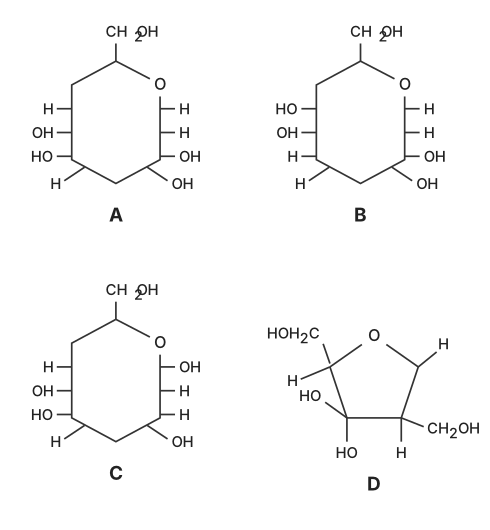
›Reveal solutionSolution
Anomers differ only in configuration at the anomeric carbon (the ring carbon next to the ring oxygen); structures A and C differ exactly there, making them the anomeric pair.
Concept and Intuition
When a monosaccharide cyclizes, the carbonyl carbon (aldehyde carbon C1 in an aldose) becomes a new stereocentre because it can bond to the ring oxygen from either face, generating two spatial arrangements: α (OH trans to the reference CH2OH group) and β (OH cis to it). These two forms are called anomers, and the carbon where they differ (C1, sitting right next to the ring oxygen) is the anomeric carbon. Anomers are a special subset of epimers — while epimers can differ at any single stereocentre, anomers specifically differ only at C1.
Step-by-Step Solution
- Locate the anomeric carbon in each Haworth structure: it is the ring carbon immediately adjacent to the ring oxygen on the side away from the CH2OH-bearing carbon (i.e., not C5, but C1).
- Compare A and B: they differ at the carbon adjacent to the CH2OH-bearing carbon (i.e., C4), not at C1 — this is a C4-epimer relationship (like glucose vs. galactose), not an anomeric one. …
- AP EAPCET 2024Set ap-2024-05-17-FN1 markMCQQ.Sucrose is a disaccharide of which of the following? [FIGURE] (four Haworth-type ring structures labelled I, II, III, IV, each a six-membered pyranose-type ring drawn with CH2OH/HOH2C at the top and stereochemical H/OH substituents around the ring, differing in the arrangement of OH/H groups at each ring position) (A) I, III (B) I, II (C) II, III (D) II, IV
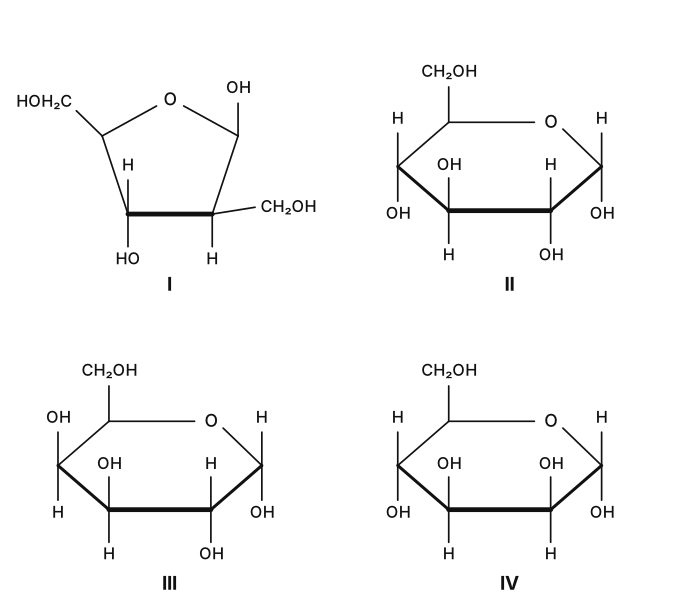
›Reveal solutionSolution
Sucrose is composed of one α‑D‑glucopyranose unit and one β‑D‑fructofuranose unit.
The figure shows a furanose ring (I) and three pyranose rings (II, III, IV).
The correct pair is the furanose (fructose) and the pyranose with the glucose stereochemistry — that is I and II.
The correct option is (B).
Sucrose (table sugar) is a disaccharide formed from α‑D‑glucopyranose and β‑D‑fructofuranose. The key to identifying the correct structures in the figure is to recognize which ring is a five‑membered furanose (fructose) and which six‑membered pyranose has the correct stereochemistry for glucose.
-
Identify the furanose ring (fructose).
- Fructose in sucrose exists as a furanose (five‑membered ring).
- In the figure, structure I is drawn as a pentagon — that is the furanose ring.
- It carries an exocyclic –CH₂OH group on the left of the ring oxygen and another –CH₂OH on the lower right, which matches the fructose structure.
- So I is the β‑D‑fructofuranose unit.
-
Identify the pyranose ring with glucose stereochemistry.
- Glucose in sucrose is α‑D‑glucopyranose (six‑membered pyranose ring).
- Among the three hexagons (II, III, IV), we need the one where the –OH groups at positions 2, 3, and 4 are all equatorial (down in the standard Haworth projection for D‑glucose).
- In the standard α‑D‑glucopyranose Haworth structure:
- C1: –OH down (α)
- C2: –OH down
- C3: –OH down
- C4: –OH up (because the –CH₂OH at C5 is up)
- Checking the figure:
- II has all three OH groups on the right side of the ring (down in the usual drawing) and the –CH₂OH up — this matches α‑D‑glucose. …
-
- AP EAPCET 2024Set eng-2024-05-20-FN1 markMCQQ.When glucose is oxidized with nitric acid the compound formed is (A) Gluconic acid (B) n-hexanoic acid (C) Sacharic acid (D) Cyanohydrin
›Reveal solutionSolution
Glucose oxidation with a strong oxidant like nitric acid oxidises both terminal groups to give the dicarboxylic acid, saccharic acid — not gluconic acid (that needs a milder oxidant).
Concept and Intuition
Glucose is HOCH2(CHOH)4CHO, an aldohexose with an aldehyde at C1 and a primary alcohol at C6. The product of oxidation depends entirely on how many of these two functional groups the reagent can attack:
- Bromine water (a mild, selective oxidant) attacks only the more easily oxidised aldehyde, leaving the primary alcohol untouched ⇒ gluconic acid, HOCH2(CHOH)4COOH.
- Concentrated nitric acid is a strong, non-selective oxidant and oxidises both the −CHO and the terminal −CH2OH to −COOH ⇒ a dicarboxylic acid, HOOC(CHOH)4COOH, called saccharic acid (glucaric acid).
Step-by-Step Solution
- Identify the two oxidisable groups in glucose: −CHO (C1) and −CH2OH (C6).
- Concentrated HNO3 is a strong oxidising agent, strong enough to oxidise the primary alcohol too, not just the aldehyde. …
- AP EAPCET 2024Set eng-2024-05-22-AN1 markMCQQ.The number of –OH groups in open chain and ring structures of D-glucose are respectively (A) 4, 5 (B) 5, 5 (C) 5, 4 (D) 6, 5
›Reveal solutionSolution
Careful oxygen bookkeeping through hemiacetal ring closure shows both the open-chain and cyclic (pyranose) forms of D-glucose carry exactly 5 –OH groups — option (B).
Concept and Intuition
It's tempting to think cyclization "uses up" a hydroxyl group and reduces the OH count, but that's not quite right: ring closure is an intramolecular hemiacetal formation, and hemiacetal formation redistributes an OH rather than destroying one. Mechanistically, the C5–OH's oxygen (as a nucleophile) attacks the C1 carbonyl carbon; in the process, this oxygen becomes the bridging ring (ether) oxygen and loses its H, while that same H effectively ends up on the former carbonyl oxygen at C1, turning C1's C=O into a brand-new C1–OH (the anomeric hydroxyl). Total oxygen count and total hydrogen count are conserved (both forms are the same molecule, C6H12O6) — only the location of one OH moves from C5 to C1.
Step-by-Step Solution
- Open-chain form: OHC−CHOH−CHOH−CHOH−CHOH−CH2OH. C1 is an aldehyde (no OH); C2, C3, C4, C5 each carry one –OH; C6 (CH₂OH) carries one –OH. Total = 5 –OH groups.
- Ring closure (pyranose): the C5–OH oxygen attacks C1, forming the six-membered ring C1–C2–C3–C4–C5–O(ring)–back to C1.
- C5's original OH oxygen becomes the ring's bridging ether oxygen — it no longer bears an H (it's now doubly bonded to two carbons, C1 and C5, i.e. an ether linkage), so C5 itself has no free OH any more.
- C1's original carbonyl oxygen gains a proton and becomes a new –OH (the anomeric hydroxyl, which can be α or β). …
🎓Unlock everything free for 14 days
- ✓Full step-by-step solutions
- ✓Concept-first explanations
- ✓Methods, shortcuts & mistakes
- ✓PYQ mapping + timed mock tests
Full access for 14 days. No credit card required.