Q.Assertion (A): D(+)-Glucose is dextrorotatory in nature.
Reason (R): 'D' represents its dextrorotatory nature.
🔒You're viewing a preview — the full solution, concept, methods & PYQ mapping are locked.
🔒 Start your 14-day free trial to unlock the full solution →Concept understanding — De Broglie Wavelength
De Broglie Wavelength: When Particles Start Acting Like Waves
Imagine you're holding a cricket ball. You know exactly where it is, and if you throw it, you can predict its path. That's a particle — localised, definite, following Newton's laws. Now think of light. You can't "hold" a beam of light; it spreads out, bends around corners, creates interference patterns. That's a wave — spread out, not localised.
For centuries, physics kept these two worlds separate. Particles were particles. Waves were waves. Never the twain shall meet.
Then came a young French physicist, Louis de Broglie, in 1924. He asked a question that seemed almost absurd: If light — which we thought was a wave — can behave like a particle (the photoelectric effect), then why can't a particle — say, an electron — behave like a wave?
That question turned physics upside down.
The Core Idea
De Broglie proposed that every moving particle has a wave associated with it. The wavelength of that wave depends on the particle's momentum. The faster or heavier the particle, the shorter the wavelength.
λ=ph=mvh
Where:
- λ = de Broglie wavelength (in metres)
- h = Planck's constant (6.626×10⁻³⁴ J⋅s)
- p = momentum of the particle (mv for non-relativistic speeds)
This is not a mathematical trick. It's a physical reality. An electron moving through a crystal actually behaves like a wave of this wavelength — it can diffract, interfere, and form patterns just like light does.
Why You Don't See It in Daily Life
Here's the crucial point: the de Broglie wavelength is incredibly tiny for everyday objects.
Take a cricket ball of mass 0.16 kg moving at 30 m/s. Its de Broglie wavelength is:
λ=0.16×306.626×10−34≈1.38×10⁻³⁴ m
That's about a hundred trillion trillion times smaller than the nucleus of an atom. No experiment can detect such a wave — it's effectively zero for all practical purposes.
Now take an electron (mass 9.1×10⁻³¹ kg) accelerated through 100 volts. Its speed is about 5.9×10⁶ m/s. Its de Broglie wavelength:
λ=9.1×10−31×5.9×1066.626×10−34≈1.23×10⁻¹⁰ m
That's about 0.12 nanometres — comparable to the spacing between atoms in a crystal. This is measurable. And indeed, in 1927, Davisson and Germer fired electrons at a nickel crystal and observed diffraction — the unmistakable signature of a wave.
The de Broglie wavelength is only observable when it is comparable to the size of objects the particle interacts with. For macroscopic objects, it's far too small to matter. For subatomic particles, it's the key to understanding their behaviour.
What This Means Physically
The wave is not a physical wave in space like a water wave. It's a probability wave — its amplitude at any point tells you the probability of finding the particle there. Where the wave amplitude is large, you're likely to find the particle; where it's zero, you won't.
This wave-particle duality is not a compromise. It's the actual nature of reality. An electron is neither a pure particle nor a pure wave — it's something that shows particle-like behaviour in some experiments (like hitting a screen at a point) and wave-like behaviour in others (like passing through two slits and interfering with itself). …
Why this formula?
De Broglie Wavelength: Why the Formula Holds
Let's build this from the ground up — understanding why matter has a wavelength, not just memorizing λ=ph.
The Core Insight: Nature's Symmetry
Before de Broglie, physics had two separate worlds:
- Light — showed wave behaviour (diffraction, interference) but also particle behaviour (photoelectric effect)
- Matter — showed particle behaviour (momentum, collisions) but no wave behaviour yet
De Broglie asked a daring question in his 1924 PhD thesis:
If light (a wave) can behave like a particle, why can't a particle (like an electron) behave like a wave?
Nature should be symmetric — what applies to one should apply to the other.
Step 1: Start with Light (What We Already Knew)
For a photon, Einstein had given us two key relations:
- Energy: E=hf (Planck's relation)
- Momentum: p=λh (from E=pc for light, combined with c=fλ)
So for light:
λ=ph
This was experimentally verified for photons.
Step 2: De Broglie's Bold Hypothesis
De Broglie said: This relation is not special to light. It is universal.
For any particle with momentum p:
λ=ph
Where:
- λ = de Broglie wavelength
- h = Planck's constant (6.626×10⁻³⁴ J⋅s)
- p = momentum of the particle
Step 3: Why Momentum and Not Velocity?
This is crucial. The formula uses momentum (p=mv), not just velocity.
For a non-relativistic particle (slow compared to light):
λ=mvh
For a relativistic particle (like an electron at high speed):
p=γmvwhereγ=1−v2/c21
λ=γmvh
Why momentum? Because momentum is the more fundamental quantity — it's conserved, it's frame-independent in a deeper sense, and it connects directly to the wave's phase.
Step 4: The Deeper Reasoning — Wave-Particle Duality
De Broglie didn't just guess. He reasoned:
- Every moving particle has an associated wave — called the "matter wave" or "pilot wave"
- The frequency of this wave comes from energy: f=hE
- The wavelength comes from momentum: λ=ph
These two relations are linked by the phase velocity of the wave:
vphase=fλ=hE⋅ph=pE
For a free particle with kinetic energy E=2mp2:
vphase=2mp=2v
This is half the particle's speed — a strange but mathematically consistent result.
Step 5: Experimental Confirmation (Why We Believe It)
De Broglie's idea was confirmed when electrons showed wave behaviour: …
The key idea here is that the D in D(+)-Glucose refers to the configuration at the chiral carbon farthest from the aldehyde group (based on Fischer projection), not to the direction of optical rotation. Dextrorotatory (+) means it rotates plane-polarized light to the right, which is a separate experimental observation.
- Assertion (A) is true: D(+)-Glucose is indeed dextrorotatory (rotates light right). …
The assertion is true (D(+)-glucose is dextrorotatory), but the reason is false — the 'D' in D-glucose refers to the configuration at the chiral carbon farthest from the aldehyde group, not to its optical rotation. The correct option is (C).
Understanding the Concept: Dextrorotatory vs. D-Configuration
This question tests a classic confusion in carbohydrate chemistry. You need to separate two ideas that sound similar but are completely independent:
- Optical rotation — whether a compound rotates plane-polarised light to the right (dextrorotatory, +) or left (laevorotatory, −). This is a physical property measured experimentally.
- D/L configuration — a naming convention based on the orientation of the −OH group on the chiral carbon farthest from the carbonyl group (the penultimate carbon). This is a structural assignment, not a measurement of rotation.
The 'D' in D-glucose has nothing to do with dextrorotation. It comes from the Fischer projection: if the −OH on the bottom-most chiral centre points to the right, the sugar is D; if it points left, it is L. The actual optical rotation is indicated separately by a (+) or (−) sign.
Many students assume 'D' stands for dextrorotatory. This is the single most common mistake in carbohydrate nomenclature. D-glucose happens to be dextrorotatory, but D-fructose is laevorotatory — proving the D/L label and rotation are unrelated.
Step-by-Step Analysis
1. Check the Assertion (A): D(+)-Glucose is dextrorotatory in nature.
D(+)-Glucose is the naturally occurring form of glucose. The (+) sign explicitly tells us it rotates plane-polarised light to the right. This is a well-established experimental fact. So Assertion (A) is true.
2. Check the Reason (R): 'D' represents its dextrorotatory nature. …
Method: Conceptual Analysis of D/L and (+)/(−) Nomenclature in Carbohydrates
Relevant Concept
In carbohydrate chemistry, D and L refer to the absolute configuration at the chiral carbon farthest from the carbonyl group (the penultimate carbon), based on Fischer projection orientation of the −OH group.
The symbols (+) and (−) denote optical rotation — the direction in which the compound rotates plane-polarized light (dextrorotatory = clockwise, levorotatory = anticlockwise).
These two systems are independent — a D-sugar can be either dextrorotatory or levorotatory.
Steps to Solve
-
Check Assertion (A):
- D(+)-Glucose is indeed dextrorotatory (rotates light clockwise).
- This is a fact — glucose has a specific rotation of +52.7°.
- Therefore, A is true.
-
Check Reason (R):
- The statement says: 'D' represents its dextrorotatory nature. …
Here are the common mistakes students make with this Assertion-Reason question, along with how to avoid each.
Mistake 1: Confusing ‘D’ with Dextrorotatory
The Mistake:
Students assume that the ‘D’ in D(+)-Glucose stands for dextrorotatory (i.e., it rotates plane-polarized light to the right). They then think the Reason (R) is correct, leading them to choose option (A) or (B).
Why it’s wrong:
- The ‘D’ in carbohydrate nomenclature refers to the configuration at the chiral carbon farthest from the aldehyde group (C-5 in glucose). It indicates that the -OH group on that carbon is on the right in the Fischer projection.
- The ‘(+)’ sign (or ‘+’) is what actually denotes dextrorotatory (clockwise rotation of light).
- So, ‘D’ does not mean dextrorotatory — it is a configurational label.
How to Avoid:
- Memorise the distinction:
- D/L = configuration (relative to glyceraldehyde).
- (+)/(-) = observed optical rotation (experimental).
- Always check the symbols in the question: D(+)-Glucose has both a configurational label (D) and a rotation sign (+). They are independent.
Mistake 2: Thinking the Reason Explains the Assertion
The Mistake:
Even if a student knows that D(+)-Glucose is dextrorotatory (Assertion is true), they might still think the Reason correctly explains why it is dextrorotatory — because they confuse ‘D’ with rotation.
Why it’s wrong:
- The Assertion (A) is true: D(+)-Glucose is indeed dextrorotatory (it rotates light to the right).
- The Reason (R) is false because ‘D’ does not represent dextrorotatory nature.
- Since R is false, it cannot be the correct explanation of A.
How to Avoid:
- In Assertion-Reason questions, first independently check the truth of each statement.
- A: True (D(+)-Glucose is dextrorotatory).
- R: False (D does not mean dextrorotatory).
- Then check if R explains A — if R is false, it cannot explain anything.
- The correct answer here is (C) A is true but R is false.
Mistake 3: Forgetting that ‘D’ and ‘L’ are Configurational, Not Rotational
The Mistake: …
Showing the 12 most recent of 21 on this concept.
- AP EAPCET 2026Set eng-2026-05-12-AN1 markMCQQ.When two electrons A and B are accelerated through potential difference VA and VB respectively, their deBrogli wave lengths are in the ratio of 2:3, then the ratio of potential differences VBVA is (A) 3:2 (B) 2:3 (C) 4:9 (D) 9:4
›Reveal solutionSolution
Since λ∝1/V for an accelerated electron, a wavelength ratio of 2:3 inverts and squares to give a potential-difference ratio of 9:4.
Concept and Intuition
An electron accelerated through a potential difference V gains kinetic energy eV=2mp2, so its momentum is p=2meV, and its deBroglie wavelength is λ=ph=2meVh. Wavelength is thus inversely proportional to the square root of the accelerating voltage.
Step-by-Step Solution
- λ∝V1 (same charge and mass for both electrons).
- λBλA=VAVB=32 (given).
- Squaring: VAVB=94. …
- AP EAPCET 2026Set eng-2026-05-15-AN1 markMCQQ.If the potential difference used to accelerate electrons at rest is increased from 150 V to 600 V, then the percentage decrease in the de-Broglie wavelength associated with the electron is (A) 25 (B) 75 (C) 50 (D) 40
›Reveal solutionSolution
The de Broglie wavelength scales as 1/V; quadrupling the accelerating voltage halves the wavelength, i.e. a 50% decrease.
Concept and Intuition
An electron accelerated from rest through a potential difference V gains kinetic energy eV=2mp2, so its momentum is p=2meV, and its de Broglie wavelength is λ=ph=2meVh∝V1.
Step-by-Step Solution
- λ1λ2=V2V1=600150=41=21.
- So the new wavelength is half the original: λ2=0.5λ1. …
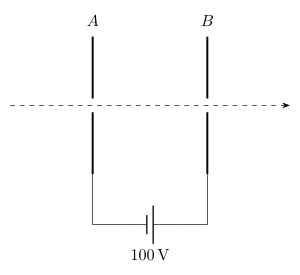
- AP EAPCET 2026Set ap-2026-05-19-FN1 markMCQQ.Two identical parallel metal plates A and B, having fine holes at their centers are connected to a power supply as shown in the figure. An electron having energy 200 eV is directed to pass through these holes from A to B. The de Broglie wavelength of the electron when it comes out of plate B is [FIGURE] (two parallel metal plates A and B, each with a small central hole, connected across a 100 V power supply; an electron travels horizontally through the aligned holes from A to B) (A) 0.713 Å (B) 2.012 Å (C) 1.754 Å (D) 1.227 Å
›Reveal solutionSolution
The electron's kinetic energy changes by exactly the 100 eV set by the plate-to-plate potential difference; working out its final energy (100 eV) and applying λ=h/p gives 1.227 Å.
Concept and Intuition
An electron's de Broglie wavelength is λ=ph=2mEh, where E is its kinetic energy. When an electron of charge −e moves through a region with potential difference V, its kinetic energy changes by eV (gaining energy if accelerated, losing energy if decelerated by the field). Here, an electron already carrying 200 eV of kinetic energy passes between two plates connected across a 100 V supply; crossing this potential difference changes its energy by exactly 100 eV=eV.
Step-by-Step Solution
- Initial kinetic energy of the electron: E1=200 eV.
- The field between A and B (100 V across the plates) does work eV=100 eV on the electron as it crosses from A to B; here it acts to decelerate the electron, so the final kinetic energy is E2=E1−eV=200−100=100 eV.
- Use the standard relation for an electron's de Broglie wavelength in terms of its kinetic energy expressed as an equivalent accelerating voltage Veq (numerically equal to the energy in eV): λ(A˚)=Veq12.27. …
- AP EAPCET 2026Set ap-2026-05-19-AN1 markMCQQ.Two particles of masses 'm' and '2m' are falling from same height. Then the ratio of the de Broglie wavelengths on reaching ground is (A) 1 : 2 (B) 2 : 1 (C) 1 : 4 (D) 4 : 1
›Reveal solutionSolution
Free-fall speed is mass-independent, so momentum (and hence de Broglie wavelength) scales directly with mass, giving a 2:1 wavelength ratio.
Concept and Intuition
A classic point of free-fall kinematics: acceleration due to gravity is the same for all masses, so both particles hit the ground with identical speed v=2gh. But momentum p=mv does depend on mass, so the heavier particle has twice the momentum — and since de Broglie wavelength λ=h/p is inversely proportional to momentum, the lighter particle has the longer wavelength.
Step-by-Step Solution
- Both fall through height h: v=2gh for each, independent of mass.
- Momentum of mass m: p1=mv. Momentum of mass 2m: p2=2mv.
- λ1=h/p1, λ2=h/p2. …
- AP EAPCET 2026Set ap-2026-05-19-AN1 markMCQQ.The kinetic energy of a sub atomic particle is increased by 8 times. The de Broglie wavelength of it becomes x times the initial wavelength. The value of x is (A) 81 (B) 41 (C) 221 (D) 21
›Reveal solutionSolution
De Broglie wavelength varies as 1/KE; an 8-fold increase in kinetic energy shrinks wavelength to 1/(22) of its original value.
Concept and Intuition
The de Broglie wavelength is λ=h/p, and kinetic energy relates to momentum via KE=p2/(2m), so p=2mKE. This means λ is inversely proportional to the square root of kinetic energy — doubling KE doesn't halve the wavelength, it divides it by 2.
Step-by-Step Solution
- λ=2mKEh.
- If KE′=8KE: λ′=2m(8KE)h=82mKEh=8λ. …
- AP EAPCET 2025Set eng-2025-05-22-AN1 markMCQQ.The de Broglie wavelength of an electron in the third Bohr orbit of H-atom is (A) 3π×5.29 pm (B) 4π×52.9 pm (C) 6π×52.9 pm (D) 2π×5.29 pm
›Reveal solutionSolution
This tests Bohr's quantization condition connecting orbit circumference to the de Broglie wavelength. For the third orbit of hydrogen, λ=6π×52.9 pm.
Concept and Intuition
Bohr's postulate that angular momentum is quantized, mvr=2πnh, is equivalent (via the de Broglie relation λ=h/mv) to saying that exactly n de Broglie wavelengths fit around the orbit's circumference: 2πrn=nλ. So once the orbit radius rn is known, the electron's wavelength in that orbit follows directly from the circumference divided into n equal parts.
Step-by-Step Solution
- Bohr quantization ⇒ standing-wave condition: 2πrn=nλ ⇒ λ=n2πrn.
- Bohr radius of H-atom: rn=52.9n2 pm (since Z=1).
- Substitute:
λ=n2π(52.9n2)=2π(52.9)n
- For the third orbit, n=3:
λ=2π(52.9)(3)=6π×52.9 pm
Common Mistakes …
- AP EAPCET 2025Set ap-2025-05-19-AN1 markMCQQ.If A, B and C represent Planck's constant, mass and velocity respectively, then the dimensional formula of BCA is (A) [M0L0T1] (B) [M1L0T0] (C) [M0L1T0] (D) [M1L1T−1]
›Reveal solutionSolution
This tests dimensional analysis of Planck's constant combined with mass and velocity. The answer is (C) [M0L1T0].
Concept and Intuition
Dimensional formulas let us combine physical quantities symbolically without worrying about units, by tracking powers of mass [M], length [L], and time [T]. Planck's constant appears in E=hν, so its dimension is energy divided by frequency. Since energy has dimension [ML2T−2] and frequency has dimension [T−1], Planck's constant h has dimension [ML2T−1]. Dividing this by mass times velocity systematically cancels out mass and one power of length-per-time, leaving a pure length dimension.
Step-by-Step Solution
- Dimension of Planck's constant A=h: from E=hν, [h]=[ν][E]=T−1ML2T−2=[ML2T−1].
- Dimension of mass B=[M].
- Dimension of velocity C=[LT−1]. …
- AP EAPCET 2025Set ap-2025-05-19-AN1 markMCQQ.An electron of specific charge me enters an electric field, E=−E0i^ at a time t = 0 with an initial velocity vi^. If λ0 is its initial de Broglie wavelength, then its de Broglie wavelength at a time 't' is (A) (1+mveE0t)λ0 (B) λ0[1+mveE0t] (C) (1−mveE0t)λ0 (D) mvλ0E0
›Reveal solutionSolution
The electric field accelerates the electron in the same direction it is already moving, so its speed and hence its de Broglie wavelength change as λ=λ0/(1+eE0t/mv).
Concept and Intuition
The de Broglie wavelength is λ=h/(mv) — inversely proportional to speed. To find λ(t) we need v(t), which requires knowing whether the field speeds up or slows down the electron. The electron carries charge −e (with e>0 the elementary charge), and the field is E=−E0i^. The force is F=qE=(−e)(−E0i^)=+eE0i^ — pointing along +i^, the same direction as the initial velocity vi^. So the electron accelerates (speeds up), and its wavelength must shrink.
Step-by-Step Solution
- Initial wavelength: λ0=mvh.
- Force on electron: F=(−e)E=(−e)(−E0i^)=eE0i^, so acceleration a=meE0 along +i^.
- Velocity at time t (uniform acceleration, initial velocity v along +i^):
v(t)=v+meE0t=v(1+mveE0t)
- New wavelength: λ(t)=mv(t)h=mv(1+mveE0t)h=1+mveE0tλ0 …
- AP EAPCET 2025Set ap-2025-05-19-FN1 markMCQQ.If the kinetic energy of a particle having wavelength x Å is increased to three times, its de Broglie wavelength (in Å) is : (A) 3x (B) 3x (C) 3x (D) 3x
›Reveal solutionSolution
Since λ∝1/KE, tripling the kinetic energy shrinks the de Broglie wavelength by a factor 3.
Concept and Intuition
The de Broglie wavelength of a particle is λ=h/p, and kinetic energy relates to momentum via KE=p2/2m, so p=2m⋅KE. Hence
λ=2mKEh∝KE1
Larger kinetic energy means larger momentum, and larger momentum always means a shorter wavelength.
Step-by-Step Solution
- Initially λ1=x at kinetic energy KE1.
- New kinetic energy KE2=3KE1.
- λ1λ2=KE2KE1=31=31.
- So λ2=3x.
Common Mistakes …
- AP EAPCET 2025Set eng-2025-05-26-AN1 markMCQQ.The ratio of de Broglie wavelengths associated with thermal neutrons at temperatures 127°C and 352°C is (A) 5:3 (B) 3:2 (C) 3:4 (D) 5:4
›Reveal solutionSolution
The de Broglie wavelength of a thermal particle scales as 1/T; converting to Kelvin and taking the ratio gives 5:4.
Concept and Intuition
A 'thermal' neutron's kinetic energy comes from thermal agitation, so on average E∝kBT. Since the de Broglie wavelength is λ=h/p=h/2mE, and E∝T, we get λ∝1/T — hotter neutrons move faster and so have shorter wavelengths.
Step-by-Step Solution
- Convert both temperatures to Kelvin: T1=127+273=400 K, T2=352+273=625 K.
- Since λ∝1/T: λ2λ1=T1T2=400625. …
- AP EAPCET 2025Set eng-2025-05-27-FN1 markMCQQ.The de Broglie wavelength associated with an electron accelerated through a potential difference of 3200 V is nearly (A) 25 A∘ (B) 2.5 A∘ (C) 15 A∘ (D) 1.5 A∘
›Reveal solutionSolution
This tests the de Broglie wavelength formula for an electron accelerated through a potential difference; the answer is about 1.5 Å.
Concept and Intuition
An electron accelerated through potential V gains kinetic energy eV=2mp2, giving momentum p=2meV. Its de Broglie wavelength is λ=h/p. Substituting the constants gives the handy numerical formula λ(A∘)=V12.27 when V is in volts — this is the standard shortcut used for electron-diffraction-type problems.
Step-by-Step Solution
- Accelerating potential: V=3200≈66.67V.
- V=66.67≈8.165. …
- AP EAPCET 2024Set eng-2024-05-20-FN1 markMCQQ.An electron of mass 'm' with initial velocity vˉ=v0i^ (v0>0) enters in an electric field Eˉ=−E0i^ [E0 is constant > 0] at t = 0. If λ is its de-Brogli wavelength initially, then the de-Brogli wavelength after time 't' is (A) 1+mv0eE0tλ (B) (1−mv0eE0t)2λ (C) (1+mv0eE0t)λ (D) (1+mv0eE0t)2λ
›Reveal solutionSolution
The field accelerates the electron in the direction it's already moving, increasing its speed
(and hence decreasing its de Broglie wavelength) by a linear factor in time.
Concept and Intuition
The electron carries charge −e. In a field Eˉ=−E0i^, the force is Fˉ=qEˉ=(−e)(−E0i^)=+eE0i^ — pointing in the +i^ direction, which is the same
direction as the electron's initial velocity v0i^. So the electron is accelerated forward
(sped up), not decelerated.
Step-by-Step Solution
- Acceleration: a=F/m=eE0/m, directed along +i^ (same as v0).
- Velocity at time t: v(t)=v0+at=v0+meE0t=v0(1+mv0eE0t).
- De Broglie wavelength λ=h/(mv), so λ∝1/v.
- Initially λ=h/(mv0). At time t: λ(t)=mv(t)h=1+mv0eE0th/(mv0)=1+mv0eE0tλ.
Common Mistakes
- Getting the sign of the force wrong (thinking the electron's negative charge in a −i^ …
🎓Unlock everything free for 14 days
- ✓Full step-by-step solutions
- ✓Concept-first explanations
- ✓Methods, shortcuts & mistakes
- ✓PYQ mapping + timed mock tests
Full access for 14 days. No credit card required.