Q.For the given cell, Mg∣Mg2+∥Cu2+∣Cu (Two or more than two options may be correct.)
🔒You're viewing a preview — the full solution, concept, methods & PYQ mapping are locked.
🔒 Start your 14-day free trial to unlock the full solution →Concept understanding — Cell Representation Nernst Equation
Cell Representation and the Nernst Equation: From Intuition to Precision
Imagine you have a Daniell cell — a zinc rod in zinc sulphate solution connected by a salt bridge to a copper rod in copper sulphate solution. You know it produces a voltage. But what happens if you dilute the copper sulphate solution? Or if you change the temperature? The voltage changes. The Nernst equation is the tool that tells you exactly how much it changes.
The Intuition First
A battery works because the two half-cells "want" to react — zinc wants to lose electrons, copper ions want to gain them. This "want" is measured as a tendency, or potential. But the strength of that tendency depends on how crowded the ions are.
Think of it like this: If you have a room full of people who all want to leave (like zinc ions wanting to form), the push to get out is stronger when the room is packed. If the room is nearly empty, the push is weaker. Similarly, for copper ions wanting to enter the metal (gain electrons), the pull is stronger when there are many copper ions around, and weaker when there are few.
The Nernst equation quantifies this: the actual cell potential depends on the concentrations (or activities) of the ions involved.
The Precise Statement
For a general cell reaction:
aA+bB→cC+dD
The cell potential E under non-standard conditions is given by:
E=E∘−nFRTlnQ
Where:
- E = cell potential under the given conditions (in volts)
- E∘ = standard cell potential (when all reactants/products are at 1 M, 1 atm, 25°C)
- R = universal gas constant (8.314 J/mol·K)
- T = temperature in Kelvin
- n = number of moles of electrons transferred in the balanced half-reactions
- F = Faraday constant (96,485 C/mol)
- Q = reaction quotient = [A]a[B]b[C]c[D]d (using concentrations for dilute solutions)
At 25°C (298 K), the equation simplifies to a very practical form:
E=E∘−n0.0591log10Q
The 0.0591 comes from F2.303RT at 298 K. Notice it uses log10 (common log), not natural log.
Cell Representation: How We Write It
In electrochemistry, we represent a cell with a shorthand notation. For the Daniell cell:
Zn(s)∣Zn2+(aq)∥Cu2+(aq)∣Cu(s)
The single vertical line ∣ represents a phase boundary (solid electrode | solution). The double line ∥ represents the salt bridge.
The anode (oxidation) is written on the left, the cathode (reduction) on the right. Electrons flow from left to right in the external circuit.
Applying the Nernst Equation to a Cell Representation
For the Daniell cell, the half-reactions are:
- Anode (oxidation): Zn(s)→Zn2+(aq)+2e−
- Cathode (reduction): Cu2+(aq)+2e−→Cu(s)
Overall: Zn(s)+Cu2+(aq)→Zn2+(aq)+Cu(s)
Here n=2 (two electrons transferred). The reaction quotient is:
Q=[Cu2+][Zn2+]
So the Nernst equation becomes:
E=E∘−20.0591log10[Cu2+][Zn2+]
Solids (Zn, Cu) do not appear in Q because their concentrations are constant (activity = 1).
A Worked Example
Suppose you have a Daniell cell where [Zn2+]=0.1 M and [Cu2+]=1.0 M at 25°C. E∘ for the cell is 1.10 V.
E=1.10−20.0591log101.00.1 …
Why this formula?
Cell Representation & the Nernst Equation: Why It Works
The Core Question
Why does a cell's voltage change when concentrations change? The Nernst equation answers this — but the reason lies in the link between chemical free energy and electrical work.
1. The Fundamental Link: Gibbs Free Energy & Cell Potential
A galvanic cell does electrical work. The maximum useful work a cell can do equals the change in Gibbs free energy (ΔG):
ΔG=−nFEcell
Where:
- n = moles of electrons transferred
- F = Faraday constant (96,485C mol−1)
- Ecell = cell potential (volts)
Why negative? A spontaneous reaction has ΔG<0 and Ecell>0 — the negative sign makes this consistent.
2. The Chemical Side: ΔG Depends on Concentration
For a general redox reaction:
aA+bB→cC+dD
The Gibbs free energy under non-standard conditions is:
ΔG=ΔG∘+RTlnQ
Where Q is the reaction quotient:
Q=[A]a[B]b[C]c[D]d
Why this form? It comes from the relationship between chemical potential and concentration — the entropy of mixing drives concentration dependence.
3. Combining Both Sides: The Derivation
Set the electrical work equal to the chemical free energy change:
−nFEcell=−nFEcell∘+RTlnQ
Divide both sides by −nF:
Ecell=Ecell∘−nFRTlnQ
This is the Nernst equation.
4. The "Why" in Plain Terms
| Concept | Physical Meaning |
|---|---|
| Ecell∘ | Voltage when all species are at 1 M (standard state) |
| −nFRTlnQ | Correction factor — adjusts voltage for real concentrations |
| Q | Tells you how far the reaction is from equilibrium |
Key insight: When Q=K (equilibrium), Ecell=0 — the battery is dead because no net reaction occurs.
5. The Common Form (log base 10)
At 25∘C (298K):
FRTln10≈0.0592V
So:
Ecell=Ecell∘−n0.0592log10Q
Why convert to log? Exam convenience — most concentration values are powers of 10.
--- …
Concept: Cell Representation & Nernst Equation – In a standard cell notation, the anode (oxidation) is written on the left and the cathode (reduction) on the right. The salt bridge ∥ separates the two half-cells.
Step 1 – Identify electrodes
Left side: Mg∣Mg2+ → oxidation occurs here, so Mg is the anode.
Right side: Cu2+∣Cu → reduction occurs here, so Cu is the cathode.
Step 2 – Determine cell reaction
At anode: Mg→Mg2++2e−
At cathode: Cu2++2e−→Cu
Overall: Mg+Cu2+→Mg2++Cu
Step 3 – Identify oxidising agent …
In a galvanic cell, oxidation occurs at the anode (negative) and reduction at the cathode (positive). For the cell Mg∣Mg2+∥Cu2+∣Cu, magnesium is the anode (oxidised) and copper is the cathode (reduced). The cell reaction is Mg+Cu2+→Mg2++Cu, and Cu2+ is the oxidising agent. Therefore, options (ii) and (iii) are correct.
The key to this question lies in understanding the standard cell representation and the Nernst equation's conceptual foundation — but here, we don't even need numbers. The cell diagram itself tells us everything.
In a galvanic (voltaic) cell, the anode is written on the left and the cathode on the right. The single vertical line | represents a phase boundary, and the double vertical line || represents the salt bridge. So the cell Mg∣Mg2+∥Cu2+∣Cu tells us:
- Left side: Mg electrode in contact with Mg2+ ions — this is the anode (oxidation occurs here).
- Right side: Cu electrode in contact with Cu2+ ions — this is the cathode (reduction occurs here).
Now let's go through each option step by step.
-
Option (i): Mg is cathode
This is false. In the cell diagram, magnesium is on the left, which is the anode. At the anode, oxidation happens: Mg→Mg2++2e−. The anode is the negative electrode in a galvanic cell, not the cathode.
-
Option (ii): Cu is cathode
This is true. Copper is on the right side of the diagram, which is the cathode. At the cathode, reduction occurs: Cu2++2e−→Cu. The cathode is the positive electrode.
-
Option (iii): The cell reaction is Mg+Cu2+→Mg2++Cu
This is true. Combine the half-reactions:
- Anode (oxidation): Mg→Mg2++2e−
- Cathode (reduction): Cu2++2e−→Cu Adding them gives the overall cell reaction: Mg+Cu2+→Mg2++Cu. The electrons cancel out. …
Method: Standard Cell Notation Interpretation
This method uses the IUPAC convention for cell representation to identify electrodes, the cell reaction, and the roles of species.
Step 1: Understand the cell notation
The given cell is:
Mg∣Mg2+∥Cu2+∣Cu
- The left side of the salt bridge (∥) is the anode (oxidation occurs here).
- The right side of the salt bridge is the cathode (reduction occurs here).
So:
- Anode (left): Mg∣Mg2+
- Cathode (right): Cu2+∣Cu
Step 2: Identify the electrodes
- At the anode, Mg metal loses electrons:
Mg→Mg2++2e−
Hence, Mg is the anode, not the cathode.
→ Option (i) is incorrect.
- At the cathode, Cu2+ gains electrons:
Cu2++2e−→Cu
Hence, Cu is the cathode.
→ Option (ii) is correct.
Step 3: Write the overall cell reaction
Add the half-reactions: …
✗ Mistake 1: Confusing anode and cathode
What students do wrong:
They see Mg∣Mg2+ on the left and assume it's the cathode (because "left = cathode" in some diagrams).
In reality, the left side is always the anode in standard cell notation.
How to avoid:
Remember the mnemonic:
Anode on the Left — An Loss (oxidation).
Cathode on the Right — Reduction.
So here:
- Left: Mg∣Mg2+ → Anode (oxidation: Mg→Mg2++2e−)
- Right: Cu2+∣Cu → Cathode (reduction: Cu2++2e−→Cu)
✓ Correct: Option (ii) — Cu is cathode.
✗ Option (i) is false.
✗ Mistake 2: Writing the cell reaction backwards
What students do wrong:
They write Mg2++Cu→Mg+Cu2+ because they think "left to right" means reactants to products in the same order.
How to avoid:
Always derive the reaction from half-reactions:
- Anode (oxidation): Mg→Mg2++2e−
- Cathode (reduction): Cu2++2e−→Cu
Add them:
Mg+Cu2+→Mg2++Cu
✓ Correct: Option (iii) is true.
✗ Mistake 3: Saying the metal itself is the oxidising agent
What students do wrong:
They see the option "Cu is the oxidising agent" and, because they know copper's couple is doing the oxidising in this cell, mark the statement as true — silently reading it as "the Cu²⁺/Cu couple" instead of what it actually says.
How to avoid:
Oxidising agent = the species that itself gets reduced (gains electrons) and causes oxidation in the other reactant.
Here:
- Cu2+ (the ion in solution) gains electrons → gets reduced → this is the true oxidising agent. …
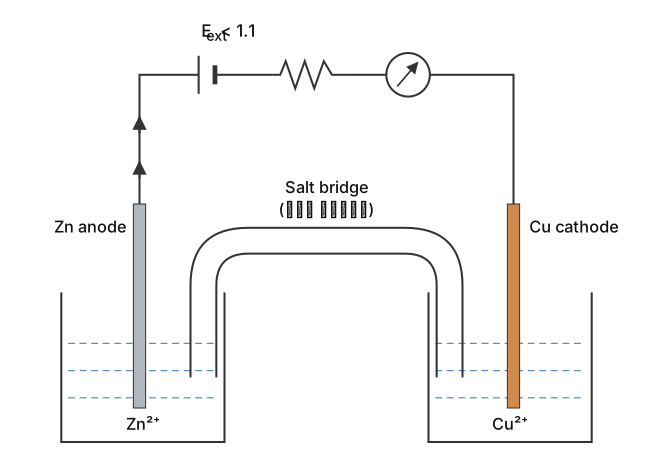
- AP EAPCET 2026Set ap-2026-05-19-AN1 markMCQQ.Observe the following galvanic cell. Two statements are given about this cell Statement I: Electrons flow from Cu electrode to Zn electrode. Statement II: With increase in time, the weight of Zn electrode decreases and weight of Cu electrode increases [FIGURE] (galvanic cell diagram: a Zn anode dipped in a Zn2+ solution beaker connected via a salt bridge to a Cu cathode dipped in a Cu2+ solution beaker; the external circuit connecting the electrodes has a resistor and an ammeter, with an opposing external source marked Eext<1.1) Correct answer is (A) Both Statements I and II are correct (B) Both Statements I and II are not correct (C) Statement I is correct but statement II is not correct (D) Statement I is not correct but statement II is correct
›Reveal solutionSolution
The cell is a Daniell cell (Zn|Zn²⁺||Cu²⁺|Cu) with an external opposing voltage Eext<1.1 V. Since the opposing voltage is less than the cell’s standard emf (1.1 V), the cell still drives electrons from Zn (anode) to Cu (cathode) — so Statement I is correct. As the cell operates, Zn dissolves (weight decreases) and Cu deposits (weight increases) — so Statement II is also correct. Hence the correct option is (A).
Concept and Intuition
This is a Daniell cell — the classic Zn–Cu galvanic cell. Normally, without any external source, electrons flow spontaneously from the Zn electrode (anode, oxidation) to the Cu electrode (cathode, reduction). The standard cell potential is about 1.1 V.
Here, an external voltage source Eext is inserted in the external circuit, but it is less than 1.1 V. That means the external source is trying to oppose the cell’s natural electron flow, but it is too weak to reverse it. The cell still operates as a galvanic cell (not an electrolytic cell), because the net driving force remains from Zn to Cu.
The Nernst equation helps us understand that even if concentrations change slightly, the cell potential remains positive as long as the reaction quotient Q is less than the equilibrium constant K. Since Eext<Ecell, the cell continues to discharge.
Step-by-step reasoning
- Identify the spontaneous direction In a Zn–Cu cell, the standard reduction potentials are:
Cu2++2e−Zn2++2e−→CuE∘=+0.34 V→ZnE∘=−0.76 V
The cell reaction is:
Zn+Cu2+→Zn2++Cu
with Ecell∘=0.34−(−0.76)=1.10 V.
Electrons flow from Zn (anode) to Cu (cathode) in the external circuit.
-
Effect of the external source Eext<1.1 V
The external source is connected opposing the cell’s natural polarity. However, because its voltage is less than the cell’s emf, the net potential difference still drives electrons from Zn to Cu.
TipThink of it like two batteries in series opposing: the larger one (the cell) wins, so current flows in its direction. Here the cell is the “larger” battery.
-
Evaluate Statement I: “Electrons flow from Cu electrode to Zn electrode.”
The statement claims the opposite of the spontaneous direction. But as argued, the external source is too weak to reverse the flow. Therefore electrons still flow from Zn to Cu, not from Cu to Zn.
Statement I is false as written — wait, careful: The statement says “from Cu electrode to Zn electrode”. That is the reverse of the actual direction. So Statement I is incorrect. …
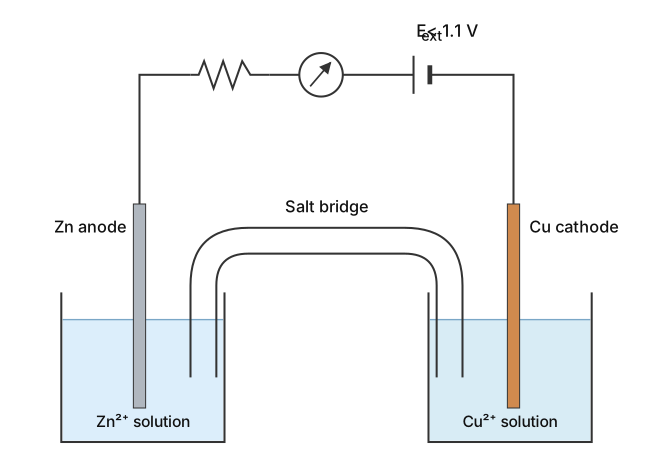
- AP EAPCET 2026Set ap-2026-05-20-AN1 markMCQQ.Two statements are given about the galvanic cell shown below Statement I: Current flows from Cu electrode to Zn electrode Statement II: With increase in time the mass of Zn electrode increases and mass of Cu electrode decreases Correct answer is [FIGURE] (galvanic cell apparatus diagram: a Zn anode dipped in Zn2+ solution and a Cu cathode dipped in Cu2+ solution, the two beakers connected by a salt bridge; the electrodes are connected via an external circuit containing an ammeter/galvanometer and a variable opposing voltage source labelled Eext<1.1 V) (A) Both statements I and II are correct (B) Both statements I and II are not correct (C) Statement I is correct and statement II is not correct (D) Statement I is not correct and statement II is correct
›Reveal solutionSolution
In a standard Zn–Cu galvanic cell, electrons flow from the Zn anode (oxidation) to the Cu cathode (reduction), so conventional current flows from Cu to Zn. The Zn electrode loses mass (Zn → Zn²⁺) and the Cu electrode gains mass (Cu²⁺ → Cu). Therefore Statement I is correct, Statement II is incorrect, and the answer is (C).
Concept and Intuition: The Cell Representation and the Nernst Equation
This question tests your understanding of the direction of current and the mass changes at the electrodes in a working galvanic cell. The key is to remember that in a galvanic (voltaic) cell, the spontaneous redox reaction drives electrons through the external circuit. By convention, current flows opposite to electron flow (from positive to negative). The electrode where oxidation occurs (anode) loses mass; the electrode where reduction occurs (cathode) gains mass. The external opposing voltage Eext<1.1 V tells us the cell is still operating spontaneously (the cell’s emf is about 1.1 V for Zn–Cu under standard conditions).
Step-by-step reasoning
- Identify the spontaneous reaction In a Zn–Cu cell, zinc is more reactive (higher reduction potential for Zn²⁺/Zn is –0.76 V, for Cu²⁺/Cu is +0.34 V). The spontaneous reaction is:
Zn(s)+Cu2+(aq)→Zn2+(aq)+Cu(s)
Zinc is oxidized (loses electrons), copper ions are reduced (gain electrons).
-
Determine electron flow and conventional current
- Oxidation at the Zn electrode (anode): Zn→Zn2++2e− Electrons leave the Zn electrode and travel through the external circuit toward the Cu electrode.
- Reduction at the Cu electrode (cathode): Cu2++2e−→Cu Electrons arrive at the Cu electrode.
- Conventional current is defined as the flow of positive charge, opposite to electron flow. So electrons flow from Zn → Cu, meaning conventional current flows from Cu → Zn.
- Statement I says: “Current flows from Cu electrode to Zn electrode.” This matches the conventional current direction. Statement I is correct.
-
Analyze mass changes at the electrodes
- At the Zn anode: Zn metal is converted to Zn²⁺ ions, which go into solution. The solid Zn electrode loses mass.
- At the Cu cathode: Cu²⁺ ions from solution gain electrons and deposit as solid Cu on the electrode. The Cu electrode gains mass.
- Statement II says: “With increase in time the mass of Zn electrode increases and mass of Cu electrode decreases.” This is the exact opposite of what happens. Statement II is incorrect. …
- AP EAPCET 2024Set eng-2024-05-21-FN1 markMCQQ.The standard free energy change (ΔG∘) for the following reaction (in kJ) at 25°C is 3Ca(s)+2Au3+(aq,1M)→3Ca2+(aq,1M)+2Au(s) (given: EAu3+/Au∘=+1.50 V, ECa2+/Ca∘=−2.87 V, 1F=96500 C mol−1) (A) −2.53×10³ (B) +2.53×10³ (C) −2.53×10⁴ (D) +2.53×10⁴
›Reveal solutionSolution
This applies ΔG∘=−nFEcell∘ to the Ca/Au3+ redox couple; the standard free energy change works out to −2.53×10³ kJ.
Concept and Intuition
The standard free energy change of a redox reaction is related to the cell's standard EMF by ΔG∘=−nFEcell∘, where n is the total number of electrons transferred as balanced by the overall equation, and F is Faraday's constant. A positive Ecell∘ (spontaneous reaction) corresponds to a negative ΔG∘.
Step-by-Step Solution
- Identify the half-reactions: reduction at cathode, Au3++3e−→Au, E∘=+1.50 V; oxidation at anode, Ca→Ca2++2e−, ECa2+/Ca∘=−2.87 V.
- Balance electrons: multiply the Au half-reaction by 2 and the Ca half-reaction by 3, giving n=6 electrons transferred overall, matching the given equation 3Ca+2Au3+→3Ca2++2Au.
- Compute Ecell∘=Ecathode∘−Eanode∘=1.50−(−2.87)=4.37 V.
- Compute ΔG∘=−nFEcell∘=−(6)(96500 C/mol)(4.37 V). …
- AP EAPCET 2022Set ap-2022-07-11-FN1 markMCQQ.The standard Gibbs energy ΔG0 for the following electrochemical cell is P(s)∣P3+(aq,0.01M)∥Q2+(aq,0.02M)∣Q(s) (Ecell0=0.2 V) (A) 115.8 kJ (B) 100.2 kJ (C) 200.5 kJ (D) 300 kJ
›Reveal solutionSolution
This tests the relation ΔG∘=−nFEcell∘, with the key subtlety of finding the correct n (total electrons transferred, found via LCM of the two half-cell electron counts).
Concept and Intuition
The standard Gibbs energy change of a cell reaction is directly proportional to the number of moles of electrons transferred in the balanced overall reaction and the cell potential. Since the anode gives 3 electrons per P atom and the cathode needs 2 electrons per Q2+ ion, the reaction must be balanced so both half-reactions transfer the same total number of electrons — found via the LCM of 3 and 2, which is 6.
Step-by-Step Solution
- Anode (oxidation): P→P3++3e−; Cathode (reduction): Q2++2e−→Q. …
- AP EAPCET 2022Set eng-2022-07-07-FN1 markMCQQ.The energy conversion involved in a galvanic cell is (A) Chemical energy to mechanical energy (B) Chemical energy to electrical energy (C) Electrical energy to chemical energy (D) Electrical energy to thermal energy
›Reveal solutionSolution
A galvanic cell is the device that turns a spontaneous chemical (redox) reaction into usable electrical energy — the opposite of electrolysis.
Concept and Intuition
In a galvanic cell, a spontaneous (ΔG<0) redox reaction is split into separate oxidation (anode) and reduction (cathode) half-reactions connected by an external circuit, so the electron transfer that would otherwise happen directly (releasing energy as heat) instead flows through a wire and does electrical work. This is the reverse energy conversion of an electrolytic cell, which consumes electrical energy to drive a non-spontaneous chemical reaction.
Step-by-Step Solution
- Identify the device: a galvanic/voltaic cell (e.g. Daniell cell) generates electricity from a spontaneous redox reaction.
- The reaction proceeds because it is thermodynamically favourable (releases chemical energy). …
- AP EAPCET 2021Set ap-2021-09-07-FN1 markMCQQ.For a galvanic cell Cr/Cr3+ // Cd2+/Cd, calculated ΔG0 for its cell reaction will be ________ [ECr3+/Cr0=−0.74 V, ECd2+/Cd0=−0.40 V] (A) −28.95 kJ/mol (B) −125.4 kJ/mol (C) −196.8 kJ/mol (D) −87.6 kJ/mol
›Reveal solutionSolution
Compute Ecell∘ from the given half-cell potentials, balance electrons for the overall cell reaction to get n, then use ΔG∘=−nFEcell∘.
Concept and Intuition
In the cell notation Cr/Cr3+//Cd2+/Cd, the left electrode (written first) is the anode (oxidation), and the right electrode is the cathode (reduction). The cell potential is always cathode minus anode: Ecell∘=Ecathode∘−Eanode∘. Once Ecell∘ is known, ΔG∘ follows from the fundamental relation between electrical work and free energy, ΔG∘=−nFEcell∘, where n is the total number of electrons transferred in the balanced overall cell reaction (found by matching the electron counts of the two half-reactions via their LCM).
Step-by-Step Solution
- Identify electrodes: anode = Cr3+/Cr (E∘=−0.74 V, oxidation: Cr→Cr3++3e−), cathode = Cd2+/Cd (E∘=−0.40 V, reduction: Cd2++2e−→Cd).
- Compute cell potential: Ecell∘=Ecathode∘−Eanode∘=(−0.40)−(−0.74)=0.34 V (positive, confirming the reaction is spontaneous as written -- consistent with it being a genuine galvanic cell). …
- AP EAPCET 2021Set eng-2021-10-05-FN1 markMCQQ.An electrochemical cell is represented as X∣X+(x M)∣∣Y+(y M)∣Y. The e.m.f measured is +0.5 V. Identify the corresponding cell reaction. (A) X++Y⟶X+Y+ (B) X+Y⟶XY (C) X+Y+⟶X++Y (D) X++Y−⟶X−+Y+
›Reveal solutionSolution
By the standard cell-notation convention (anode | ... || ... | cathode) and a positive measured emf, the spontaneous cell reaction is X+Y+→X++Y.
Concept and Intuition
Electrochemical cell notation has a fixed convention: the electrode written on the left is the anode, where oxidation occurs, and the electrode on the right is the cathode, where reduction occurs — the double vertical line "||" represents the salt bridge separating the two half-cells. A positive emf value for the cell as written confirms the reaction is indeed spontaneous in the direction implied by this left-to-right convention (anode oxidation feeding electrons to cathode reduction).
Step-by-Step Solution
- Left half-cell, X∣X+(xM): this is the anode — oxidation occurs here, X→X++e−.
- Right half-cell, Y+(yM)∣Y: this is the cathode — reduction occurs here, Y++e−→Y.
- Combine the two half-reactions (balancing the single electron transferred in each): X+Y+→X++Y. …
🎓Unlock everything free for 14 days
- ✓Full step-by-step solutions
- ✓Concept-first explanations
- ✓Methods, shortcuts & mistakes
- ✓PYQ mapping + timed mock tests
Full access for 14 days. No credit card required.