Q.Why on dilution the Λm of CH3COOH increases drastically, while that of CH3COONa increases gradually?
🔒You're viewing a preview — the full solution, concept, methods & PYQ mapping are locked.
🔒 Start your 14-day free trial to unlock the full solution →Concept understanding — Molar Conductivity
From Resistance to Conductance: Flipping the Idea
You already know resistance (R) — it tells you how much a material opposes the flow of current. A high resistance means the wire fights the current; a low resistance means it lets current through easily.
Now flip that thought. Instead of asking "how much does it resist?", ask "how easily does it let current flow?" That's exactly what conductance measures.
Conductance (G) is the reciprocal of resistance:
G=R1
Unit: siemens (S) — named after Werner von Siemens. 1 S = 1 A/V (ampere per volt).
If a wire has R=10 Ω, its conductance is G=0.1 S. If R=0.5 Ω, G=2 S — it conducts twice as well.
Ohm's Law in Conductance Form
You know V=IR. Rearranging:
I=RV=GV
So current = conductance × voltage. A high-conductance material draws a large current for the same voltage — it's a "good conductor."
Now, Conductivity: The Material's Intrinsic Property
Resistance depends on two things: the material itself (its "resistivity" ρ) and the geometry (length L, cross-sectional area A):
R=ρAL
Conductance also depends on geometry. A thicker wire (larger A) or a shorter wire (smaller L) has higher conductance. To isolate the material's inherent ability to conduct, we define conductivity (σ):
σ=ρ1
And for a uniform wire:
G=σLA
Conductivity is the reciprocal of resistivity. It tells you how well the material itself conducts, independent of shape and size.
- Unit: siemens per metre (S/m).
- High σ → good conductor (copper: ≈5.8×10⁷ S/m).
- Low σ → poor conductor / insulator (glass: ≈10−12 S/m).
Don't confuse conductance (property of a specific object, depends on geometry) with conductivity (property of the material, independent of geometry). A short thick copper wire has high conductance; a long thin copper wire has lower conductance — but both have the same conductivity.
The Big Picture in One Table
| Quantity | Symbol | Definition | Depends on | Unit |
|---|---|---|---|---|
| Resistance | R | V/I | Material + geometry | Ω |
| Resistivity | ρ | RA/L | Material only | Ω⋅m |
| Conductance | G | 1/R | Material + geometry | S |
| Conductivity | σ | 1/ρ | Material only | S/m |
Intuitive Analogy
Think of a water pipe:
- Resistance = how hard it is to push water through (narrow, long pipe).
- Conductance = how easily water flows (wide, short pipe). …
Why this formula?
Conductance and Conductivity: Why the Formulas Hold
Let's build this from first principles — understanding the why before the what.
1. The Core Idea: How Easily Does Current Flow?
Think of a conductor (like a copper wire). When you apply a voltage across it, electrons drift through the material. Two questions arise:
- How much current flows for a given voltage? → This is conductance (G).
- How well does the material itself allow current? → This is conductivity (σ).
The key distinction: Conductance depends on the size and shape of the object. Conductivity is an intrinsic property of the material.
2. Ohm's Law in Terms of Conductance
You know Ohm's law:
V=IR
But we can rewrite it as:
I=RV
Define conductance G as the reciprocal of resistance:
G=R1
So:
I=GV
Why this makes sense:
- A larger G means more current for the same voltage — the conductor "conducts" better.
- G has units of siemens (S) = A/V.
3. From Resistance to Conductivity: The Geometry Factor
Resistance of a uniform conductor depends on:
- Length L (longer → more resistance)
- Cross-sectional area A (thicker → less resistance)
- Material property ρ (resistivity)
The formula:
R=ρAL
Now, conductivity σ is the reciprocal of resistivity:
σ=ρ1
So:
R=σ1⋅AL
Why this form?
- If you double the length, electrons have to travel twice as far, colliding more → resistance doubles.
- If you double the area, there's twice as many "lanes" for electrons → resistance halves.
4. The Key Formula: Conductance in Terms of Conductivity
Since G=1/R, we get:
G=σLA
This is the central relationship. Let's see why it holds:
- σ tells you how well the material conducts (intrinsic).
- A/L tells you how the geometry amplifies or reduces that.
Intuition:
- A fat, short wire (A large, L small) has high conductance.
- A thin, long wire (A small, L large) has low conductance.
- A material with high σ (like copper) gives higher G than one with low σ (like iron), for the same shape.
5. Microscopic Derivation (Why σ Exists)
At the microscopic level, conductivity arises from electron motion:
σ=neμ
Where:
- n = number of free electrons per unit volume
- e = electron charge …
Concept: Molar Conductivity (Λm) and its dependence on dissociation/ion mobility.
The key difference lies in the nature of the electrolyte.
- CH3COOH (Weak Electrolyte): It dissociates only partially. On dilution, the equilibrium shifts to the right (Le Chatelier’s principle), increasing the degree of dissociation (α). Since Λm=α⋅Λm∞, the increase in α causes a drastic, non-linear rise in Λm, especially near infinite dilution. …
The key difference lies in the degree of dissociation. For a weak electrolyte like CH3COOH, dilution sharply increases dissociation, adding many new ions and causing a steep rise in molar conductivity. For a strong electrolyte like CH3COONa, it is already fully dissociated, so dilution only reduces interionic attractions, leading to a gradual increase.
The Core Idea: What Λm Actually Measures
Molar conductivity (Λm) is the conductivity of a solution containing one mole of electrolyte, placed between electrodes 1 cm apart. It tells us how well that mole of substance can carry current.
For any electrolyte, Λm depends on two things:
- How many ions are actually present in solution (the degree of dissociation, α)
- How fast those ions move (their mobilities, which are affected by interionic attractions)
Dilution changes both factors, but the relative importance of each depends entirely on whether the electrolyte is strong or weak.
Step-by-Step Reasoning
1. Recognize the nature of each electrolyte
CH3COOH (acetic acid) is a weak electrolyte. In water, it only partially dissociates:
CH3COOH⇌CH3COO−+H+
At any given concentration, only a small fraction of molecules are ionized.
CH3COONa (sodium acetate) is a strong electrolyte. It dissociates completely in water:
CH3COONa→CH3COO−+Na+
Every molecule breaks apart into ions — no equilibrium involved.
A common mistake is to think both behave similarly on dilution. The dissociation equilibrium for weak acids is the key difference — it is not present for strong electrolytes.
2. What happens to a weak electrolyte (CH3COOH) on dilution?
For a weak acid, the dissociation constant Ka is fixed at a given temperature:
Ka=1−αcα2
When you dilute the solution, c (concentration) decreases. To keep Ka constant, α must increase sharply. This is Le Chatelier's principle in action — dilution shifts the equilibrium toward more dissociation.
So as you add water:
- α rises from a small value (say 0.01 at 1 M) toward 1 (complete dissociation) at infinite dilution
- The number of charge carriers per mole of electrolyte increases dramatically
- This causes Λm to rise steeply
At infinite dilution, α→1, and Λm approaches Λm∞ — the value for complete dissociation.
For weak electrolytes, the steep rise in Λm on dilution is essentially a dissociation effect. The Kohlrausch plot (Λm vs c) is not linear for weak electrolytes — it curves sharply upward as c→0.
3. What happens to a strong electrolyte (CH3COONa) on dilution?
For a strong electrolyte, α=1 at all concentrations (except perhaps at extremely high concentrations). There is no equilibrium to shift.
So why does Λm increase at all on dilution?
The answer lies in interionic attractions. In a concentrated solution, ions are close together. Oppositely charged ions attract each other, forming an "ionic atmosphere" around each ion. This atmosphere:
- Exerts a drag on the moving ion (the relaxation effect)
- Creates a counter-flow of solvent (the electrophoretic effect)
Both effects reduce the ion's effective mobility. On dilution, ions move farther apart, these attractions weaken, and the ions move more freely. So Λm increases — but only gradually, because you're not creating new ions; you're just letting existing ones move faster.
For strong electrolytes, Kohlrausch found empirically: …
Method: Kohlrausch’s Law of Independent Migration of Ions
This law states that at infinite dilution, each ion contributes a fixed amount to the total molar conductivity of an electrolyte, independent of the other ion present.
Step 1 – Write the expression for limiting molar conductivity
For any electrolyte:
Λm∞=λ+∞+λ−∞
where λ+∞ and λ−∞ are the limiting molar conductivities of the cation and anion.
Step 2 – Apply to the two given salts
For CH3COONa (strong electrolyte):
Λm∞(CH3COONa)=λ∞(Na+)+λ∞(CH3COO−)
For CH3COOH (weak electrolyte):
Λm∞(CH3COOH)=λ∞(H+)+λ∞(CH3COO−)
Step 3 – Compare the degree of dissociation on dilution
-
CH3COONa is a strong electrolyte — it is almost fully dissociated even at moderate concentrations. On dilution, the number of ions increases only slightly (due to a small increase in dissociation), so Λm increases gradually and approaches Λm∞ smoothly.
-
CH3COOH is a weak electrolyte — it is only slightly dissociated at higher concentrations. On dilution, the equilibrium shifts heavily towards dissociation (Le Chatelier’s principle), so the number of ions increases drastically. Hence Λm rises sharply as dilution increases.
Step 4 – Key numerical reason …
Here are the common mistakes students make on this specific Molar Conductivity comparison, along with how to avoid each.
Mistake 1: Confusing Λm with κ (Conductivity)
- The Error: Students often think that because dilution reduces the number of ions per unit volume, the molar conductivity should decrease. They confuse conductivity (κ) with molar conductivity (Λm).
- Why it’s wrong: κ (specific conductivity) does decrease on dilution. However, Λm is defined as Λm=Cκ. Since C (concentration) decreases faster than κ, the ratio Λm increases.
- How to Avoid: Always write the formula: Λm=Mκ×1000 (where M is molarity). Remember: Λm is the conducting power of all ions produced from 1 mole of electrolyte. As you dilute, more of the 1 mole dissociates, so the total conducting power rises.
Mistake 2: Forgetting the Role of Dissociation (Weak vs. Strong)
- The Error: Treating CH3COOH (weak acid) and CH3COONa (strong salt) as if they behave the same way upon dilution.
- Why it’s wrong: CH3COONa is already 100% dissociated at all concentrations. Dilution only reduces inter-ionic attractions (relaxes the "ion atmosphere"), causing a small, gradual increase in Λm (approaching Λm∞).
- How to Avoid: Draw the dissociation equilibrium:
- Weak electrolyte: CH3COOH⇌CH3COO−+H+ Dilution shifts equilibrium to the right (Le Chatelier’s principle), producing many new ions. This causes a drastic increase in Λm.
- Strong electrolyte: CH3COONa→CH3COO−+Na+ No equilibrium shift. Only the mobility of existing ions improves slightly.
Mistake 3: Misapplying Kohlrausch’s Law
- The Error: Students calculate Λm∞ for CH3COOH correctly but then assume the increase in Λm on dilution is due to the same mechanism as for CH3COONa.
- Why it’s wrong: For CH3COONa, the increase is due to increased ionic mobility (less ion pairing). For CH3COOH, the increase is primarily due to increased degree of dissociation (α). The formula Λm=α⋅Λm∞ shows that α changes dramatically for weak acids.
- How to Avoid: Always ask: "Is the electrolyte weak or strong?" If weak, the degree of dissociation is the dominant factor. If strong, ionic mobility is the dominant factor.
Mistake 4: Ignoring the "Drastic" vs. "Gradual" Language …
Showing the 12 most recent of 19 on this concept.
- AP EAPCET 2026Set eng-2026-05-14-AN1 markMCQQ.The conductivity of 0.001 M acetic acid is 5×10⁻⁵ S cm−1. If the molar conductivity of acetic acid solution at infinite dilution is 390 S cm2 mol−1. What is its degree of dissociation? (A) 0.218 (B) 0.128 (C) 0.138 (D) 0.238
›Reveal solutionSolution
Molar conductivity at 0.001 M works out to 50 S cm² mol⁻¹; dividing by the limiting value 390 gives the degree of dissociation, 0.128.
Concept and Intuition
For a weak electrolyte, the degree of dissociation can be estimated (Arrhenius) as the ratio of the molar conductivity at the given concentration to the molar conductivity at infinite dilution: α=Λm/Λm∘. This works because Λm∘ represents complete dissociation, so the ratio directly measures what fraction has actually dissociated.
Step-by-Step Solution
- Convert κ to Λm: Λm=C(mol/L)κ×1000.
- Λm=0.0015×10−5×1000=10−35×10−2=50 S cm2 mol−1. …
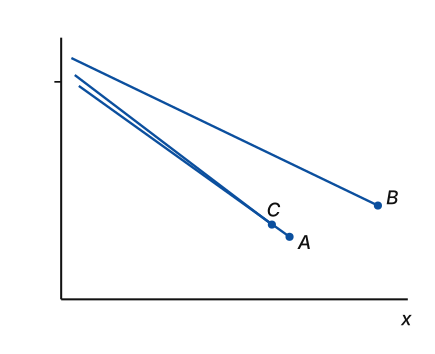
- AP EAPCET 2026Set eng-2026-05-13-AN1 markMCQQ.The molar conductivity of three electrolytes, NaCl, KCl and CsCl, was plotted against c (c = concentration) and the obtained figure is shown below. The λ0 of Na+,K+ and Cs+ is 50, 73 and 77 S cm2mol−1 respectively. Identify the electrolytes y-axis = Λm (in S2cm2mol−1); x-axis = c [FIGURE] (A) A = KCl ; B = CsCl ; C = NaCl (B) A = KCl ; B = NaCl ; C = CsCl (C) A = CsCl ; B = NaCl ; C = KCl (D) A = NaCl ; B = KCl ; C = CsCl
›Reveal solutionSolution
KCl and CsCl are the two close top curves (A and C), NaCl is the lower separate curve (B): option (B).
Concept and Intuition
For a strong electrolyte, Λm=Λm0−bc, so the intercept at c→0 is the limiting molar conductivity Λm0=λ+0+λ−0. Because Cl− is shared, the curves are ordered purely by cation conductivity.
Step-by-Step Solution
- Take λ0(Cl−)≈76 Scm2mol−1.
- Λm0(NaCl)=50+76=126; Λm0(KCl)=73+76=149; Λm0(CsCl)=77+76=153.
- KCl (149) and CsCl (153) differ by only ∼4, so their lines nearly coincide — these are the overlapping pair ending at the adjacent points A and C.
- NaCl (126) is far lower/apart from the pair — it is the distinct line ending at B.
- Within the close pair, the slightly higher curve (C, above) is the larger Λm0 = CsCl; the slightly lower (A) = KCl.
Common Mistakes …
- AP EAPCET 2026Set eng-2026-05-15-FN1 markMCQQ.The resistance of a conductivity cell filled with 0.02 M KCl solution is 85 Ω at 25°C. Conductivity of this solution is 0.3 S m−1. Resistance of 0.0025 M K2SO4 solution taken in the same cell is 300 Ω. The molar conductivity of 0.0025 M K2SO4 solution (in S m2 mol−1) is (A) 6.8×10⁻³ (B) 2.4×10⁻² (C) 3.4×10⁻² (D) 3.4×10⁻³
›Reveal solutionSolution
Use the KCl data to find the cell constant, then use that fixed cell constant to get the conductivity — and hence molar conductivity — of the K2SO4 solution. The answer is 3.4×10⁻² S m² mol⁻¹.
Concept and Intuition
A conductivity cell's geometry fixes a constant, the cell constant G∗=κ×R, which is the same for any solution measured in that same cell. Once G∗ is known from one calibrating solution (here KCl), it can be used to convert any other measured resistance directly into that solution's conductivity, from which molar conductivity follows by dividing by molar concentration.
Step-by-Step Solution
- From the KCl data: G∗=κ×R=0.3 S/m×85 Ω=25.5 m−1.
- This same G∗ applies to the K2SO4 measurement in the same cell: κK2SO4=RG∗=30025.5=0.085 S/m.
- Convert concentration to SI (mol/m³): 0.0025 mol/L=2.5 mol/m3. …
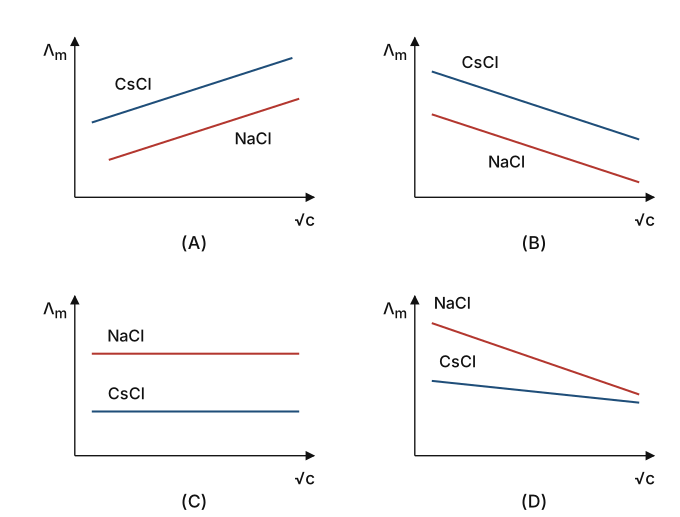
- AP EAPCET 2026Set eng-2026-05-18-FN1 markMCQQ.The Λm (on y-axis) of NaCl and CsCl was plotted against c (c = concentration on x-axis). Identify the correct figure for these electrolytes (λ0 of Na+ and Cs+ is 50 and 77 S cm2 mol−1 respectively) (A) [FIGURE] (two straight lines rising from near the origin toward the upper right; the CsCl line lies above and is offset from the NaCl line, both with positive slope) (B) [FIGURE] (two straight lines falling from upper left to lower right with negative slope; the CsCl line lies above the NaCl line, both roughly parallel) (C) [FIGURE] (two horizontal straight lines, constant with c; the NaCl line lies above the CsCl line) (D) [FIGURE] (two straight lines falling with negative slope, starting close together at the y-axis with NaCl above CsCl, and converging/crossing as c increases)
›Reveal solutionSolution
Strong electrolytes like NaCl and CsCl show Λm falling linearly with c (Kohlrausch's law); since Cs+ has a higher limiting ionic conductivity than Na+, the CsCl line sits above the NaCl line, and the two lines run roughly parallel rather than crossing.
Concept and Intuition
Kohlrausch found that for a strong electrolyte, the molar conductivity varies with concentration as Λm=Λm0−Ac — a straight line with a negative slope when plotted against c, extrapolating to the limiting molar conductivity Λm0 at c→0 (i.e. at c=0). This is very different from weak electrolytes, whose Λm rises steeply (near-vertically) close to c=0 and cannot be extrapolated linearly.
The limiting molar conductivity of an electrolyte is the sum of the limiting ionic conductivities of its ions (Kohlrausch's law of independent migration): Λm0(NaCl)=λ0(Na+)+λ0(Cl−) and Λm0(CsCl)=λ0(Cs+)+λ0(Cl−). Since both share the same Cl− contribution, and λ0(Cs+)=77>λ0(Na+)=50, we must have Λm0(CsCl)>Λm0(NaCl) — the CsCl line intercepts the y-axis higher than the NaCl line.
Step-by-Step Solution
- Both NaCl and CsCl are strong electrolytes → both lines must be straight with negative slope (rules out options with positive slope or horizontal lines).
- Λm0(CsCl)>Λm0(NaCl) since λ0(Cs+)>λ0(Na+) → the CsCl line must lie above the NaCl line, especially at (and near) c=0. …
- AP EAPCET 2025Set eng-2025-05-21-AN1 markMCQQ.The specific conductance of 0.05 M NaOH solution is 0.0115 Scm−1. What is its molar conductance (Λm) in Scm2mol−1? (A) 23 (B) 5.75×10⁻⁷ (C) 2300 (D) 230
›Reveal solutionSolution
Converting specific conductance to molar conductance using Λm=1000κ/C gives 230 S cm² mol⁻¹. Answer: (D).
Concept and Intuition
Specific conductance (κ) is the conductance of a 1 cm cube of solution, while molar conductance (Λm) normalizes this to "per mole of electrolyte," accounting for the fact that the amount of electrolyte (and hence total ions) present per unit volume depends on the molar concentration. The conversion factor of 1000 arises because κ is defined per cm³ but concentration is given per litre (1000 cm³).
Step-by-Step Solution
- Formula: Λm=Cκ×1000, where κ is in S cm⁻¹ and C is molar concentration in mol L⁻¹.
- Given κ=0.0115 S cm⁻¹ and C=0.05 mol L⁻¹.
- Λm=0.050.0115×1000=0.0511.5. …
- AP EAPCET 2025Set eng-2025-05-22-AN1 markMCQQ.The resistance of a conductivity cell filled with 0.1 M KCl solution is 100Ω. If the resistance of the same cell when filled with 0.2 M KCl solution is 520Ω, the molar conductivity of 0.02 M solution (in S cm2mol−1) is (Given : conductivity of 0.1 M KCl solution = 1.29 Sm−1) (A) 124 (B) 186 (C) 248 (D) 104
›Reveal solutionSolution
First get the (fixed) cell constant from the 0.1 M KCl calibration measurement, then use it with the second solution's resistance to get its conductivity, then convert to molar conductivity. The answer is (A) 124 S cm² mol⁻¹.
Concept and Intuition
A conductivity cell has a fixed geometric cell constant G∗=ℓ/A (length between electrodes / cross-sectional area), which relates measured resistance to the solution's conductivity: κ=G∗/R, i.e. G∗=κR. Since G∗ is a property of the cell, not the solution, once we calibrate it with one known solution (0.1 M KCl of known conductivity), we can use the same G∗ for any other solution measured in that same cell — here, the 0.02 M KCl solution. Molar conductivity then normalises conductivity by concentration: Λm=Cκ×1000 (with κ in S/cm and C in mol/L, giving Λm in S cm² mol⁻¹).
Step-by-Step Solution
- Calibrate the cell constant using the 0.1 M KCl data: κ1=1.29 Sm−1, R1=100 Ω.
G∗=κ1R1=1.29×100=129 m−1
- Use the same cell (same G∗) with the second solution: R2=520 Ω. κ2=R2G∗=520129=0.2481 Sm−1 …
- AP EAPCET 2025Set eng-2025-05-26-AN1 markMCQQ.Match the following. List-I (symbol of electrical property): A) Λm B) G C) κ D) G∗. List-II (units): I) Scm−1 II) m−1 III) Scm2mol−1 IV) S. The correct answer is (A) A-IV, B-III, C-I, D-II (B) A-III, B-IV, C-I, D-II (C) A-III, B-IV, C-II, D-I (D) A-II, B-I, C-IV, D-III
›Reveal solutionSolution
Matching electrical/conductance quantities to their SI/CGS units: Λm→Scm2mol−1, G→S, κ→Scm−1, G∗→m−1 — option (B).
Concept and Intuition
Electrolytic conductance quantities form a small family that is easy to confuse: conductance G is simply the reciprocal of resistance and carries the base unit siemens; specific conductance (conductivity) κ is conductance normalised per unit cell geometry, giving Scm−1; molar conductivity Λm further normalises by concentration, giving Scm2mol−1; and the cell constant G∗=l/A is a pure geometric factor with units of reciprocal length.
Step-by-Step Solution
- Λm (molar conductivity) =Cκ×1000, units work out to Scm2mol−1 → matches III.
- G (conductance) =1/R, base SI unit siemens (S) → matches IV.
- κ (specific conductance/conductivity) has units Scm−1 → matches I. …
- AP EAPCET 2024Set ap-2024-05-16-AN1 markMCQQ.A conductivity cell is filled with solution of KCl of concentration 0.2 mol dm−3 and its conductivity is 0.28 Sm−1. The resistance of this solution is 82.2 Ω. The same cell filled with solution of 0.0025 mol dm−3 K2SO4 showed a resistance of 325 Ω. The molar conductivity of K2SO4 solution (in Sm2mol−1) is (A) 1.4×10⁻² (B) 2.8×10⁻² (C) 4.2×10⁻³ (D) 5.6×10⁻⁴
›Reveal solutionSolution
Tests the cell-constant method for molar conductivity: use the KCl calibration run to find the
cell constant, then apply it to the K2SO4 run. Answer: 2.8×10⁻² Sm2mol−1.
Concept and Intuition
A conductivity cell has a fixed geometric cell constant G∗=l/A (in m−1),
which relates the measured resistance to the solution's conductivity via
κ=G∗/R (equivalently G∗=κR). Once G∗ is found from a solution of known
conductivity (here, KCl), the same cell constant applies to any other solution placed in that
cell, letting us find the unknown solution's conductivity, and from that its molar conductivity
Λm=κ/c (with c expressed in molm−3 to get SI units of Λm).
Step-by-Step Solution
- Find the cell constant from the KCl calibration: G∗=κKCl×RKCl=0.28×82.2=23.016 m−1.
- Use G∗ to find κ of the K2SO4 solution: κK2SO4=G∗/RK2SO4=23.016/325=0.0708 Sm−1.
- Convert concentration to SI (mol per m3): 0.0025 moldm−3×1000=2.5 molm−3. …
- AP EAPCET 2023Set eng-2023-05-15-FN1 markMCQQ.The conductivity of a solution containing 2.08 g of anhydrous barium chloride in 200 mL solution is 6×10⁻³ ohm−1cm−1. The molar conductivity of the solution (in ohm−1cm2mol−1) is x×102. The value of x is (Atomic mass of Ba = 137, Cl = 35.5) (A) 1.2 (B) 2.4 (C) 3.6 (D) 3.0
›Reveal solutionSolution
Compute molarity of the BaCl2 solution, then use Λm=1000κ/M to find molar conductivity. Answer: x=1.2.
Concept and Intuition
Molar conductivity Λm relates a solution's specific conductivity (κ) to its molar concentration: Λm=Mκ×1000 (with κ in ohm−1cm−1, M in mol/L, giving Λm in ohm−1cm2mol−1). We first need the molarity from the given mass and volume.
Step-by-Step Solution
- Molar mass of BaCl2=137+2(35.5)=208 g/mol.
- Moles =2082.08=0.01 mol.
- Volume =200 mL=0.2 L, so Molarity =0.20.01=0.05 mol/L. …
- AP EAPCET 2023Set eng-2023-05-16-FN1 markMCQQ.Molar conductivities at infinite dilution Λm∘ for Ba(OH)2, BaCl2 and NH4Cl are 457.0, 240.6 and 2130 Scm2mol−1 respectively. The Λm∘ for ammonium hydroxide (in Scm2mol−1) is (A) 1683.2 (B) 1080.2 (C) 2130.0 (D) 2238.2
›Reveal solutionSolution
Combine the three given limiting molar conductivities via Kohlrausch's law so that the Ba2+ and Cl− contributions cancel, leaving Λm∘(NH4OH).
Concept and Intuition
Kohlrausch's law states each ion contributes independently to the limiting molar conductivity, so ionic contributions can be added/subtracted across compounds that share ions. Here we want λ∘(NH4+)+λ∘(OH−); we can build it from NH4Cl (gives NH4++Cl−) plus half of Ba(OH)2 (gives 21Ba2++OH−) minus half of BaCl2 (gives 21Ba2++Cl−), which cancels the Ba2+ and Cl− contributions, leaving exactly NH4++OH−.
Step-by-Step Solution
- Write ionic contributions: Λ∘(Ba(OH)2)=λ(Ba2+)+2λ(OH−)=457.0; Λ∘(BaCl2)=λ(Ba2+)+2λ(Cl−)=240.6; Λ∘(NH4Cl)=λ(NH4+)+λ(Cl−)=2130.
- Subtract the first two and halve: λ(OH−)−λ(Cl−)=2457.0−240.6=108.2. …
- AP EAPCET 2023Set eng-2023-05-17-FN1 markMCQQ.The molar conductivity of 0.027 M methanoic acid is 40.42 Scm2mol−1. The value of dissociation constant of this acid is (Given λH+∘=349.6 Scm2mol−1 and λHCOO−∘=54.6 Scm2mol−1) (A) 1.5×10⁻⁵ (B) 6.0×10⁻⁵ (C) 4.5×10⁻⁴ (D) 3.0×10⁻⁴
›Reveal solutionSolution
Using α=Λm/Λm∘ and Ostwald's dilution law Ka=1−αcα2 gives Ka=3.0×10⁻⁴ for this weak acid.
Concept and Intuition
For a weak electrolyte, the fraction of molar conductivity actually achieved at a finite concentration compared to its limiting (infinite-dilution) value directly gives the degree of dissociation α (this is Arrhenius's conductance-based definition of α). Once α is known, Ostwald's dilution law connects it to the acid's dissociation constant.
Step-by-Step Solution
- Limiting molar conductivity: Λm∘=λH+∘+λHCOO−∘=349.6+54.6=404.2S cm2mol−1.
- Degree of dissociation: α=Λm∘Λm=404.240.42=0.1.
- Ostwald's dilution law: Ka=1−αcα2.
- Substitute c=0.027M, α=0.1: Ka=1−0.10.027×(0.1)2=0.90.027×0.01=0.92.7×10−4=3.0×10⁻⁴.
Common Mistakes …
- AP EAPCET 2022Set eng-2022-07-06-FN1 markMCQQ.What is the molar conductivity of CH3CO2H at infinite dilution? Given that, Λmo((CH3CO2)2Ba)=x1 S cm2 mol−1 Λmo(BaCl2)=x2 S cm2 mol−1 Λmo(HCl)=x3 S cm2 mol−1 (A) 2x1−x2+x3 (B) 2x1−x3+x2 (C) 2x2−x3+x1 (D) x1+x3−x2
›Reveal solutionSolution
Combining the given limiting molar conductivities of (CH3COO)2Ba, BaCl2, and HCl via Kohlrausch's law of independent ion migration reconstructs Λm0(CH3COOH) as (x1−x2)/2+x3.
Concept and Intuition
Kohlrausch's law says the limiting molar conductivity of any electrolyte is the sum of the limiting ionic conductivities of its constituent ions, each independent of the other ion present. This lets us build the conductivity of a weak electrolyte (like acetic acid) from strong electrolytes sharing common ions.
Step-by-Step Solution
- Write each given compound in terms of ionic conductivities: x1=Λm0((CH3COO)2Ba)=λ0(Ba2+)+2λ0(CH3COO−) x2=Λm0(BaCl2)=λ0(Ba2+)+2λ0(Cl−) x3=Λm0(HCl)=λ0(H+)+λ0(Cl−)
- Subtract: x1−x2=2λ0(CH3COO−)−2λ0(Cl−), so 2x1−x2=λ0(CH3COO−)−λ0(Cl−). …
🎓Unlock everything free for 14 days
- ✓Full step-by-step solutions
- ✓Concept-first explanations
- ✓Methods, shortcuts & mistakes
- ✓PYQ mapping + timed mock tests
Full access for 14 days. No credit card required.