Q.Assertion: When methyl alcohol is added to water, boiling point of water increases. Reason: When a volatile solute is added to a volatile solvent elevation in boiling point is observed. Choose the correct option:
🔒You're viewing a preview — the full solution, concept, methods & PYQ mapping are locked.
🔒 Start your 14-day free trial to unlock the full solution →Concept understanding — Boiling Point Elevation
Boiling Point Elevation — From Intuition to Precision
Imagine you're cooking pasta. You add salt to the water, and the water takes longer to boil. That's not your imagination — it's a real physical effect. The salt has raised the boiling point of the water. Pure water boils at 100°C at sea level, but salt water needs a slightly higher temperature to boil. That's boiling point elevation in action.
Why does this happen?
To understand why, you need to think about what boiling actually is. Boiling occurs when the vapour pressure of the liquid equals the surrounding atmospheric pressure. Vapour pressure is the pressure exerted by molecules escaping from the liquid surface into the gas phase.
When you dissolve a non-volatile solute (like salt, which doesn't evaporate) in a solvent (like water), something interesting happens at the surface. Some of the surface molecules are now solute particles — they don't escape into the vapour. This means fewer solvent molecules can leave the liquid per second. The result? The vapour pressure of the solution is lower than that of the pure solvent at the same temperature.
Now, to make this reduced vapour pressure equal to the atmospheric pressure (so the liquid can boil), you need to raise the temperature. That extra heat gives the remaining solvent molecules enough energy to overcome the solute's interference and produce the required vapour pressure.
The solute itself doesn't boil away — it stays behind. That's why we call it a non-volatile solute. If the solute were volatile (like alcohol), the story changes.
The precise statement
Boiling point elevation is the increase in the boiling point of a solvent when a non-volatile solute is dissolved in it. The boiling point of the solution is always higher than that of the pure solvent.
The elevation ΔTb is given by:
ΔTb=Tb(solution)−Tb(pure solvent)
And it depends only on the number of solute particles, not on their chemical identity (for dilute solutions). This is a colligative property — a property that depends on the concentration of particles, not their nature.
ΔTb=Kb⋅m
Where:
- ΔTb = boiling point elevation (in °C or K)
- Kb = ebullioscopic constant of the solvent (a fixed value for each solvent)
- m = molality of the solution (moles of solute per kg of solvent)
What is Kb?
The ebullioscopic constant Kb is a property of the pure solvent. It tells you how much the boiling point rises per unit molal concentration. For water, Kb=0.512°C kg mol−1. So a 1 molal aqueous solution (1 mole of solute per kg of water) boils at 100.512°C.
For quick calculations: ΔTb∝m. Double the molality, double the elevation. But this works only for dilute solutions — at high concentrations, interactions between solute particles break the linearity.
What about electrolytes?
If the solute dissociates into ions (like NaCl → Na⁺ + Cl⁻), the number of particles increases. One mole of NaCl gives two moles of particles in solution. So the effective concentration is higher. We account for this using the van't Hoff factor i:
ΔTb=i⋅Kb⋅m
For NaCl, i≈2 (in dilute solutions). For sugar (which doesn't dissociate), i=1. …
Why this formula?
Boiling Point Elevation: Why the Formula Holds
Let's build this from first principles — understanding the why before the what.
What Happens at the Boiling Point?
At the boiling point, a liquid's vapor pressure equals the external atmospheric pressure. For a pure solvent, this happens at a fixed temperature (e.g., 100°C for water at 1 atm).
When you add a non-volatile solute (like salt or sugar), the solute particles occupy space at the liquid surface, reducing the number of solvent molecules that can escape into vapor. This lowers the vapor pressure of the solution compared to the pure solvent.
The Key Consequence
Since vapor pressure is now lower, the solution must be heated to a higher temperature to make its vapor pressure reach atmospheric pressure again. That's the boiling point elevation.
The Formula and Its Derivation
The boiling point elevation ΔTb is given by:
ΔTb=Kb⋅m
where:
- ΔTb=Tb(solution)−Tb(pure solvent)
- Kb = ebullioscopic constant (depends only on the solvent)
- m = molality of the solution (moles of solute per kg of solvent)
Why Molality and Not Molarity?
Molality is temperature-independent — it doesn't change when the solution is heated. Molarity (moles per liter) changes because volume expands with temperature. Since we're measuring a temperature change, we need a concentration unit that stays fixed.
The Reasoning Behind Kb
The constant Kb comes from thermodynamics. For a dilute solution, the vapor pressure lowering follows Raoult's Law:
Psolution=xsolvent⋅Psolvent0
where xsolvent is the mole fraction of solvent and Psolvent0 is the pure solvent's vapor pressure.
Using the Clausius-Clapeyron equation (which relates vapor pressure to temperature) and Raoult's Law, one can derive:
Kb=1000⋅ΔHvapRTb2
where:
- R = gas constant (8.314 J/mol·K)
- Tb = boiling point of pure solvent (in Kelvin)
- ΔHvap = molar enthalpy of vaporization (J/mol)
- The factor 1000 converts grams to kg (since molality uses kg of solvent)
What This Tells Us
- Kb is a property of the solvent alone — it doesn't depend on the solute.
- Solvents with higher boiling points or lower heats of vaporization have larger Kb values (greater elevation per molal concentration).
--- …
The key idea is that adding a volatile solute (methyl alcohol) to a volatile solvent (water) does not always raise the boiling point — it depends on the relative volatilities. Henry’s Law governs the partial pressures of both components in the vapour phase.
Reasoning:
- Methyl alcohol (methanol) is more volatile than water (lower boiling point, higher vapour pressure at a given temperature).
- When added to water, the vapour pressure of the solution is not simply lowered — it becomes a mixture of both vapours. The total vapour pressure may actually be higher than that of pure water at the same temperature. …
The assertion is wrong (adding methyl alcohol to water lowers the boiling point), and the reason is also wrong (a volatile solute in a volatile solvent does not show the usual boiling point elevation). So both statements are incorrect.
The core idea: Henry’s Law and vapour pressure
Boiling happens when the vapour pressure of the liquid equals the external (atmospheric) pressure.
Adding a non-volatile solute (like salt or sugar) to a solvent lowers the solvent’s vapour pressure — so you need a higher temperature to reach atmospheric pressure. That’s the familiar elevation in boiling point.
But here, methyl alcohol (methanol) is volatile — it has its own significant vapour pressure. When you add a volatile solute to a volatile solvent, the total vapour pressure above the mixture is the sum of the partial pressures of both components (Raoult’s law for ideal mixtures). That sum can be higher than the vapour pressure of pure water, not lower.
For an ideal binary mixture of volatile liquids A and B:
Ptotal=PA∘xA+PB∘xB
where P∘ is the vapour pressure of the pure component and x is its mole fraction.
Step-by-step reasoning
-
What happens to the boiling point when you add methanol to water?
Methanol has a much higher vapour pressure than water at any given temperature (it boils at 65∘C, water at 100∘C). Adding methanol to water increases the total vapour pressure of the mixture above that of pure water.
Since the mixture now reaches atmospheric pressure at a lower temperature, the boiling point decreases.
So the assertion — “boiling point of water increases” — is false.
-
Is the reason statement correct?
The reason says: “When a volatile solute is added to a volatile solvent, elevation in boiling point is observed.” …
Concept: Colligative Properties & Volatile Solutes
The relevant concept is Raoult’s Law for volatile solutes and how it affects boiling point. A colligative property depends only on the number of solute particles, not their identity — but this holds strictly for non-volatile solutes. When the solute is volatile, both solute and solvent contribute to the vapour pressure, changing the boiling point behaviour.
Method: Conceptual Analysis of Boiling Point Elevation with Volatile Solute
Step 1: Understand the Assertion
“When methyl alcohol is added to water, boiling point of water increases.”
- Methyl alcohol (methanol, CHX3OH) is volatile (it boils at 64.7∘C).
- Water boils at 100∘C.
- When methanol is added, the vapour pressure of the solution is the sum of partial pressures of both components (Raoult’s law for ideal solutions).
- Methanol has a higher vapour pressure than water at a given temperature.
- So, the solution’s total vapour pressure is higher than pure water’s.
- A higher vapour pressure means the solution boils at a lower temperature, not higher.
Conclusion: Assertion is incorrect.
Step 2: Understand the Reason
“When a volatile solute is added to a volatile solvent, elevation in boiling point is observed.”
- For a non-volatile solute, boiling point elevation occurs (vapour pressure decreases).
- For a volatile solute, the vapour pressure of the solution may increase or decrease depending on the relative volatilities.
- In general, adding a volatile solute does not guarantee boiling point elevation — it can cause depression of boiling point. …
Here’s a breakdown of the common mistakes students make with this question, and how to avoid each.
The Core Concept: Colligative Properties & Volatile Solutes
This question tests your understanding of colligative properties — properties that depend on the number of solute particles, not their identity. The key twist here is that both the solute and solvent are volatile.
- Normal boiling point elevation: Adding a non-volatile solute (like salt) to a volatile solvent (like water) raises the boiling point. The solute particles block solvent molecules from escaping, so you need a higher temperature to boil.
- Volatile solute + volatile solvent: If the solute is also volatile (like methyl alcohol), it lowers the partial pressure of the solvent, but it adds its own vapor pressure. The net effect on the boiling point depends on the relative volatilities. In the case of methyl alcohol (more volatile than water) added to water, the boiling point of the solution decreases (or remains nearly the same, but definitely does not increase).
Common Mistake #1: Assuming all solutes raise the boiling point
The Mistake: Students blindly apply the rule “adding a solute raises the boiling point” without checking if the solute is volatile. They assume the Assertion is correct.
Why it happens: The standard textbook example is salt in water. Students memorize the result without understanding the mechanism (vapor pressure lowering).
How to Avoid:
- Always ask: “Is the solute volatile?” If yes, the colligative property rule for boiling point elevation does not apply in the same way.
- Remember the mechanism: Boiling point elevation happens because the solute reduces the vapor pressure of the solvent. A volatile solute adds its own vapor pressure, which can increase the total vapor pressure, thus lowering the boiling point.
- Key fact: Methyl alcohol (methanol) is more volatile than water. Adding it to water makes the solution easier to boil (lower boiling point).
Correct understanding: The Assertion is wrong. The boiling point of water decreases when methyl alcohol is added.
Common Mistake #2: Confusing “volatile” with “non-volatile” in the Reason
The Mistake: Students think the Reason is correct because it sounds like a standard textbook statement. They don’t notice the critical word “volatile” in the Reason.
Why it happens: The Reason says: “When a volatile solute is added to a volatile solvent elevation in boiling point is observed.” This is a false statement. Students often read it quickly and mentally replace “volatile” with “non-volatile.”
How to Avoid:
- Read every word carefully. The Reason explicitly says “volatile solute” and “volatile solvent.” That combination does not give boiling point elevation.
- Create a mental checklist:
- Non-volatile solute + volatile solvent → Elevation in boiling point.
- Volatile solute + volatile solvent → Depression or no change in boiling point (depends on relative volatilities).
- Practice with examples: Sugar (non-volatile) in water → elevation. Alcohol (volatile) in water → depression.
Correct understanding: The Reason is wrong because it states the opposite of the correct behavior.
--- …
Showing the 12 most recent of 21 on this concept.
- AP EAPCET 2026Set eng-2026-05-12-AN1 markMCQQ.The value of Kf (in Kkgmol−1) of a solvent (X) is four times the value of its Kb. 2g of a non-volatile, non-electrolytic solute A is dissolved in 200 g of solvent X. The ΔTb of resultant solution is YK. 4g of A is dissolved in 200 g of X and the ΔTf of resultant solution is ZK. What is the ratio of Y and Z? (Molar mass of A = 100 gmol−1) (A) 1 : 2 (B) 1 : 4 (C) 1 : 8 (D) 1 : 16
›Reveal solutionSolution
Using ΔT=K× molality for both cases and Kf=4Kb, the ratio Y:Z works out to 1:8.
Concept and Intuition
Both elevation of boiling point and depression of freezing point are colligative properties proportional to molality: ΔTb=Kbm and ΔTf=Kfm. Since the same solute A (molar mass 100) is used in the same mass of the same solvent X in both cases, only the mass of solute taken and the relevant constant (Kb vs Kf) differ between the two scenarios.
Step-by-Step Solution
- Case 1 (ΔTb=Y): moles of A =1002=0.02 mol; mass of solvent =0.2 kg. Molality m1=0.20.02=0.1 mol/kg.
Y=Kb×0.1
- Case 2 (ΔTf=Z): moles of A =1004=0.04 mol; mass of solvent =0.2 kg. Molality m2=0.20.04=0.2 mol/kg. Z=Kf×0.2 …
- AP EAPCET 2026Set eng-2026-05-13-FN1 markMCQQ.An aqueous solution of a non-volatile and non-electrolytic solute boils at 100.5°C. What will be the freezing point of the same solution? (Given Kb=0.512 K kg mol−1 and Kf=1.86 K kg mol−1) (A) −2.816 °C (B) −1.816 °C (C) −0.908 °C (D) −3.632 °C
›Reveal solutionSolution
This tests linking boiling-point elevation to freezing-point depression via a common molality; the freezing point works out to −1.816°C.
Concept and Intuition
For a dilute solution of a non-volatile, non-electrolyte solute, both the elevation in boiling point and the depression in freezing point are colligative properties proportional to the same molality of the solute: ΔTb=Kbm and ΔTf=Kfm. Given one property, we can back out the molality and then predict the other.
Step-by-Step Solution
- Elevation in boiling point: ΔTb=100.5°C−100°C=0.5 K.
- Find molality from ΔTb=Kbm: m=KbΔTb=0.5120.5≈0.9766 molkg−1.
- Find depression in freezing point: ΔTf=Kfm=1.86×0.9766≈1.8164 K. …
- AP EAPCET 2026Set eng-2026-05-15-AN1 markMCQQ.The boiling point of 1M aqueous solution of KCl (85% dissociation) having density 1.04 gmL−1 is (Given: Kb(H2O)=0.52 Kkgmol−1, molar mass of KCl=74.5 gmol−1) (A) 100.096°C (B) 100.996°C (C) 100.896°C (D) 100.796°C
›Reveal solutionSolution
This tests boiling-point elevation with a dissociating electrolyte, requiring first converting molarity to molality via the given density. The boiling point comes out to 100.996 °C.
Concept and Intuition
Boiling point elevation depends on molality (not molarity), and for an electrolyte that partially dissociates, the van't Hoff factor i accounts for the actual number of particles in solution.
Step-by-Step Solution
- Take 1 litre (1000 mL) of the 1M KCl solution as the basis. Moles of KCl =1 mol.
- Mass of the whole solution =density×volume=1.04 g/mL×1000 mL=1040 g.
- Mass of solute (KCl) =1 mol×74.5 g/mol=74.5 g.
- Mass of solvent (water) =1040−74.5=965.5 g=0.9655 kg.
- Molality m=kg solventmoles solute=0.96551≈1.0357 molkg−1.
- KCl dissociates as KCl→K++Cl−, so n=2 ions per formula unit. With degree of dissociation α=0.85: van't Hoff factor i=1+α(n−1)=1+0.85(2−1)=1.85. …
- AP EAPCET 2026Set eng-2026-05-18-FN1 markMCQQ.At 300 K, x moles of CaCl2 (i=2.5 ; molar mass =111 g mol−1) is dissolved in 2.5 L of water. The osmotic pressure of resultant solution is 0.75 atm. What is ΔTb of solution? (density of water =1 g mL−1 ; Kb=0.52 K kg mol−1 ; R=0.08 L atm mol−1K−1) (A) 0.016 K (B) 0.032 K (C) 0.048 K (D) 0.064 K
›Reveal solutionSolution
Using the osmotic-pressure data to find the molar concentration, then the molality, and finally applying ΔTb=iKbm gives ΔTb≈0.016 K.
Concept and Intuition
Both osmotic pressure and boiling-point elevation are colligative properties that depend on the effective number of particles in solution (captured by the van't Hoff factor i). We first use the osmotic pressure relation π=iCRT to back out the molar concentration C of CaCl2, convert that to molality using the mass of water given, and then apply the boiling-point elevation formula.
Step-by-Step Solution
- From π=iCRT: C=iRTπ=2.5×0.08×3000.75=600.75=0.0125 mol L−1.
- Moles of CaCl2, x=C×V=0.0125×2.5 L=0.03125 mol.
- Mass of water (solvent) =2.5 L×1000 g/L (density=1 g/mL)=2500 g=2.5 kg.
- Molality, m=kg of solventx=2.50.03125=0.0125 mol kg−1. …
- AP EAPCET 2025Set eng-2025-05-23-FN1 markMCQQ.A solution of urea in water has a boiling point of 100.18 °C. What is the freezing point of the same solution, if Kf and Kb of water are 1.86 and 0.52 K kg mol−1, respectively ? (Boiling point of water = 100 °C) (A) −0.34 ∘C (B) −0.22 ∘C (C) −0.64 ∘C (D) −0.32 ∘C
›Reveal solutionSolution
This links two colligative properties (boiling point elevation and freezing point depression) through the common molality of the solution.
Concept and Intuition
Both boiling-point elevation and freezing-point depression are colligative properties proportional to the same molality of solute particles: ΔTb=Kbm and ΔTf=Kfm. Given one, we can find the molality and then use it to get the other.
Step-by-Step Solution
- Boiling point elevation: ΔTb=100.18−100=0.18∘C.
- Molality from ΔTb=Kbm: m=KbΔTb=0.520.18=0.3462 mol/kg.
- Freezing point depression: ΔTf=Kfm=1.86×0.3462=0.6439∘C≈0.64∘C. …
- AP EAPCET 2024Set ap-2024-05-16-FN1 markMCQQ.The molal depression constant of water (Kf) is 1.86 Kkgmol−1. What is the approximate ΔfusH (in kJmol−1) of water if it freezes at 273 K? (A) 3 (B) 6 (C) 9 (D) 12
›Reveal solutionSolution
The cryoscopic-constant formula relates Kf to the solvent's molar mass, freezing point, and molar enthalpy of fusion; solving gives ΔfusH≈6 kJ/mol for water.
Concept and Intuition
The molal depression constant Kf of a solvent is fundamentally derived from its freezing point and its enthalpy of fusion (the energy needed to melt the solid), via the thermodynamic relation:
Kf=1000ΔfusHRTf2M
where M is the solvent's molar mass (g/mol), Tf its freezing point (K), and ΔfusH its molar enthalpy of fusion (J/mol).
Step-by-Step Solution
- Rearranging for ΔfusH: ΔfusH=1000KfRTf2M.
- Substitute R=8.314 Jmol−1K−1, Tf=273 K, M=18 g/mol, Kf=1.86 Kkgmol−1.
- Tf2=74529. …
- AP EAPCET 2024Set eng-2024-05-20-AN1 markMCQQ.A non-volatile solute is dissolved in water. The ΔTb of resultant solution is 0.052 K. What is the freezing point of the solution (in K)? (Kb of water = 0.52 K kg mol−1; Kf of water = 1.86 K kg mol−1; Freezing point of water = 273 K) (A) 272.628 (B) 273.186 (C) 273.000 (D) 272.814
›Reveal solutionSolution
From the boiling-point elevation, the molality is found (0.1 mol/kg), and then the SAME molality is used with Kf to get the freezing-point depression, giving a freezing point of 272.814 K.
Concept and Intuition
Both boiling-point elevation and freezing-point depression are colligative properties governed by the same solution molality — ΔTb = Kb·m and ΔTf = Kf·m. Since molality doesn't change, we can find it from one property and use it to compute the other.
Step-by-Step Solution
- ΔTb = Kb·m → m = ΔTb/Kb = 0.052 / 0.52 = 0.1 mol/kg.
- ΔTf = Kf·m = 1.86 × 0.1 = 0.186 K.
- Freezing point of solution = freezing point of pure water − ΔTf = 273 − 0.186 = 272.814 K. …
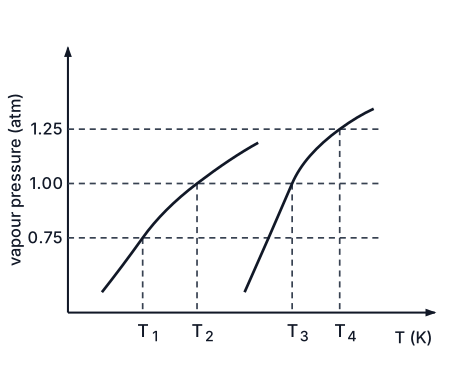
- AP EAPCET 2024Set eng-2024-05-21-AN1 markMCQQ.The following graph is obtained for vapour pressure (in atm) (on y-axis) and T (in K) (on x-axis) for aqueous urea solution and water. What is the boiling point (in K) of urea solution? (Atmospheric pressure = 1 atm) [FIGURE] (two vapour-pressure-vs-temperature curves rising left to right; three horizontal dashed lines at y = 0.75, 1.00 and 1.25 atm intersect the two curves; the resulting four intersection points are projected onto the x-axis at four temperatures labeled, in increasing order, T1,T2,T3,T4) (A) T1 (B) T2 (C) T3 (D) T4
›Reveal solutionSolution
The solution's boiling point is where its vapour-pressure curve meets P=1 atm, which is T3 on the graph (higher than pure water's T2, consistent with boiling point elevation).
Concept and Intuition
A liquid boils at the temperature where its vapour pressure equals the surrounding atmospheric pressure. Dissolving a non-volatile solute (urea) lowers the solution's vapour pressure at any given temperature (Raoult's law), which means the solution's vapour-pressure curve sits to the right of pure water's curve — it needs a HIGHER temperature to reach the same vapour pressure. This is exactly boiling point elevation, ΔTb>0.
Step-by-Step Solution
- Atmospheric pressure is given as 1 atm, so the boiling point of any liquid on this graph is where its curve crosses the horizontal y=1.00 line.
- The problem states the left curve (pure water, lower vapour pressure needed at lower temperature) crosses y=1.00 at T2.
- The right curve (urea solution, shifted to higher temperature for the same vapour pressure due to boiling point elevation) crosses y=1.00 at T3. …
- AP EAPCET 2023Set eng-2023-05-16-FN1 markMCQQ.The elevation in the boiling point of aqueous urea solution is 0.104 K. What is its ΔTf (in K) value? (for Water Kb=0.52 K kg mol−1, Kf=1.86 K kg mol−1) (A) 0.0186 (B) 0.186 (C) 0.372 (D) 0.0372
›Reveal solutionSolution
The same molality drives both boiling-point elevation and freezing-point depression; find m from ΔTb, then use it with Kf to get ΔTf.
Concept and Intuition
Both colligative properties depend on the same solution molality m: ΔTb=Kbm and ΔTf=Kfm. Since urea is a non-electrolyte (no dissociation), the molality computed from one property applies directly to the other.
Step-by-Step Solution
- m=KbΔTb=0.520.104=0.2 mol/kg. …
- AP EAPCET 2023Set eng-2023-05-18-FN1 markMCQQ.What is the boiling point of solution of 0.1m KCl? Kb of water is 0.52 K kg mol−1. (α=100%) (water boil at 373 K) (A) 100.104 K (B) 373.104 K (C) 273.104 K (D) 373.052 K
›Reveal solutionSolution
Since KCl fully dissociates into 2 ions per formula unit (van't Hoff factor i=2), the boiling point elevation is ΔTb=iKbm=0.104 K, giving a boiling point of 373.104 K.
Concept and Intuition
Boiling point elevation is a colligative property that depends on the total number of solute particles in solution, not just the number of formula units dissolved. For an electrolyte like KCl that dissociates completely into K+ and Cl− (α=100%), each mole of KCl produces 2 moles of particles, so the van't Hoff factor i=2 must be included in the elevation formula.
Step-by-Step Solution
- Formula: ΔTb=iKbm.
- Since KCl dissociates completely (α=100%) into 2 ions (K+ + Cl−), i=1+α(n−1)=1+1×(2−1)=2.
- Substitute: ΔTb=2×0.52×0.1=0.104 K. …
- AP EAPCET 2023Set eng-2023-05-19-FN1 markMCQQ.What is the depression of freezing point, when mole fraction of non-electrolyte solute in aqueous solution is 0.01? (Kf of H2O=1.86 K kg mol−1) (A) 1.246 K (B) 1.380 K (C) 1.528 K (D) 1.043 K
›Reveal solutionSolution
Converting the given mole fraction of solute to molality and applying ΔTf=Kfm gives a freezing-point depression of about 1.043 K.
Concept and Intuition
Freezing point depression depends on molality, not mole fraction directly, so we must first convert. For a solution with total 1 mole (basis), if x2=0.01 is the solute's mole fraction, then n2=0.01 and n1=0.99 (moles of water). Molality is moles of solute per kg of solvent.
Step-by-Step Solution
- Take a basis of 1 total mole: n2=0.01 mol solute, n1=0.99 mol water.
- Mass of water (solvent): 0.99 mol×18 g/mol=17.82 g =0.01782 kg.
- Molality m=mass of solvent in kgn2=0.017820.01≈0.5612 mol/kg. …
- AP EAPCET 2022Set eng-2022-07-04-FN1 markMCQQ.At T (K) x g of a non-volatile solid (molar mass 78 g mol−1) when added to 0.5 kg water, lowered its freezing point by 1.0∘C. What is x (in g)? (Kf of water at T(K) = 1.86 K Kg mol−1) (A) 10.48 (B) 20.96 (C) 41.92 (D) 5.24
›Reveal solutionSolution
Freezing-point depression gives the molality directly; converting molality to mass via the given molar mass gives x≈20.96g.
Concept and Intuition
Freezing-point depression is a colligative property: ΔTf=Kf×m, where m is the molality of the solute (moles of solute per kg of solvent) and Kf is the cryoscopic constant of the solvent. Since the solute is non-volatile and (implicitly) a non-electrolyte (no van't Hoff factor mentioned), we use this formula directly.
Step-by-Step Solution
- Given: ΔTf=1.0∘C, Kf=1.86 Kkgmol−1, mass of water =0.5 kg, molar mass of solute M=78 gmol−1.
- Find molality: m=KfΔTf=1.861.0=0.5376 molkg−1.
- Molality is moles of solute per kg solvent, so moles of solute n=m×(mass of water in kg)=0.5376×0.5=0.2688 mol. …
🎓Unlock everything free for 14 days
- ✓Full step-by-step solutions
- ✓Concept-first explanations
- ✓Methods, shortcuts & mistakes
- ✓PYQ mapping + timed mock tests
Full access for 14 days. No credit card required.