Q.Using Raoult's law explain how the total vapour pressure over the solution is related to mole fraction of components in the following solutions.
🔒You're viewing a preview — the full solution, concept, methods & PYQ mapping are locked.
🔒 Start your 14-day free trial to unlock the full solution →Concept understanding — Raoult's Law
Raoult's Law: From Intuition to Precision
Imagine you have a beaker of pure water at room temperature. Some water molecules at the surface have enough energy to escape into the air above — that's vapour pressure. Now dissolve some sugar in that water. The sugar molecules take up space at the surface, blocking some water molecules from escaping. Fewer water molecules can leave the liquid per second, so the vapour pressure drops.
That's the core intuition: a non-volatile solute lowers the solvent's vapour pressure simply by getting in the way.
But what if both components can evaporate — say, a mixture of benzene and toluene? Then both kinds of molecules crowd the surface, and both contribute to the total vapour pressure. The question becomes: how much does each contribute?
The Precise Statement
For a solution of volatile liquids, Raoult's Law says:
pi=xipi∗
where:
- pi = partial vapour pressure of component i above the solution
- xi = mole fraction of component i in the liquid solution
- pi∗ = vapour pressure of pure component i at the same temperature
The law applies to each volatile component separately. The total vapour pressure above the solution is simply the sum:
Ptotal=p1+p2=x1p1∗+x2p2∗
What This Means Physically
The mole fraction xi tells you the fraction of molecules at the surface that are of type i. If half the molecules in the liquid are benzene (xbenzene=0.5), then roughly half the surface sites are occupied by benzene molecules. So the rate at which benzene escapes should be about half the rate from pure benzene — hence pbenzene=0.5×pbenzene∗.
This is a linear relationship: plot pi against xi, and you get a straight line from the origin (when xi=0, pi=0) up to pi∗ (when xi=1, pure component).
Raoult's Law is an idealisation. It works best when the two liquids are chemically similar — same type of intermolecular forces (e.g., both non-polar, or both with similar hydrogen bonding). Benzene–toluene is a classic example. When the molecules interact very differently (like ethanol and water), the law fails — that's when you get deviations from Raoult's Law.
A Concrete Example
Suppose you mix 2 moles of benzene (p∗=100 mm Hg) with 3 moles of toluene (p∗=40 mm Hg) at 25°C.
Mole fractions:
- xbenzene=2+32=0.4
- xtoluene=53=0.6
Partial pressures:
- pbenzene=0.4×100=40 mm Hg
- ptoluene=0.6×40=24 mm Hg
Total vapour pressure: 40+24=64 mm Hg
Notice: the total pressure is not a simple average of the pure pressures. It's a weighted average, with mole fractions as weights.
Why This Matters …
Concept: Raoult’s law — for a solution of volatile liquids, the partial vapour pressure of each component is proportional to its mole fraction in the liquid phase: pi=xipi0.
(i) CHCl3 and CH2Cl2 — both are volatile liquids.
Using Raoult’s law:
pCHCl3=xCHCl3pCHCl30,
pCH2Cl2=xCH2Cl2pCH2Cl20.
Total vapour pressure:
P=pCHCl3+pCH2Cl2=xCHCl3pCHCl30+(1−xCHCl3)pCH2Cl20.
This is a linear function of xCHCl3, so P varies linearly between the pure vapour pressures.
(ii) NaCl(s) and H2O(l) — NaCl is a non-volatile solute.
Raoult’s law applies only to the solvent (water):
pH2O=xH2OpH2O0, where xH2O<1 due to dissolved ions. …
Raoult’s law relates the partial vapour pressure of each component to its mole fraction in the liquid phase. For ideal solutions (like chloroform–dichloromethane), total pressure varies linearly with composition; for non‑volatile solutes (like NaCl in water), the total pressure is simply the vapour pressure of the solvent, lowered by the solute.
The core idea
Raoult’s law says: At a given temperature, the partial vapour pressure of a component in a liquid solution is equal to the vapour pressure of the pure component multiplied by its mole fraction in the liquid mixture.
pi=xipi∘
where pi is the partial pressure of component i above the solution, xi is its mole fraction in the liquid, and pi∘ is the vapour pressure of pure i at that temperature.
The total vapour pressure above the solution is the sum of all partial pressures:
Ptotal=∑ipi=∑ixipi∘
How this total pressure changes with composition depends entirely on whether both components are volatile and whether the solution is ideal or not.
(i) CHCl3(l) and CH2Cl2(l) — two volatile liquids, nearly ideal
Chloroform (CHCl3) and dichloromethane (CH2Cl2) are both volatile organic liquids. Their molecular structures are similar, and they mix without strong interactions — so the solution behaves very close to an ideal solution.
- Both components contribute to vapour pressure. Let A=CHCl3 and B=CH2Cl2.
pA=xApA∘andpB=xBpB∘
- Total pressure is a linear function of mole fraction. Since xB=1−xA, we have:
Ptotal=xApA∘+(1−xA)pB∘=pB∘+xA(pA∘−pB∘)
This is a straight line when plotted against xA (or xB).
At xA=0, Ptotal=pB∘; at xA=1, Ptotal=pA∘.
- The vapour composition is different from the liquid composition (that’s the basis of fractional distillation), but the total pressure follows Raoult’s law exactly.
For an ideal binary solution of two volatile liquids, the total vapour pressure always lies between the two pure vapour pressures. If pA∘>pB∘, then Ptotal increases linearly as xA increases.
(ii) NaCl(s) and H2O(l) — a non‑volatile solute in a volatile solvent
Here, NaCl is a solid salt that dissolves in water. The key difference: NaCl has essentially zero vapour pressure — it does not evaporate. Only water contributes to the vapour above the solution.
- Only the solvent is volatile. Let A=H2O (solvent) and B=NaCl (solute).
pNaCl≈0⇒Ptotal=pwater
- Raoult’s law applies to the solvent. For the solvent:
pwater=xwaterpwater∘
Since xwater<1 (because NaCl is present), the vapour pressure of water above the solution is lower than that of pure water. …
Method: Raoult's Law for Vapour Pressure of Solutions
Raoult's Law states that for a solution of volatile liquids, the partial vapour pressure of each component is directly proportional to its mole fraction in the solution:
pi=pi0⋅xi
Where:
- pi = partial vapour pressure of component i above the solution
- pi0 = vapour pressure of pure component i at the same temperature
- xi = mole fraction of component i in the liquid solution
Total vapour pressure above the solution is the sum of partial pressures:
Ptotal=p1+p2=p10x1+p20x2
(i) CHCl3(l) and CH2Cl2(l) — Ideal Solution
Step 1: Identify the nature of the solution
Both are volatile liquids with similar molecular structures (chlorinated hydrocarbons). They mix without significant interaction changes → ideal solution.
Step 2: Apply Raoult's law for both components
Let A=CHCl3 and B=CH2Cl2
pA=pA0xAandpB=pB0xB
Step 3: Write total vapour pressure
Since xB=1−xA:
Ptotal=pA0xA+pB0(1−xA)
Step 4: Interpret the relationship
- Ptotal varies linearly with mole fraction xA
- The graph of Ptotal vs xA is a straight line between pB0 (at xA=0) and pA0 (at xA=1)
Key result: For ideal solutions, total vapour pressure is a linear function of mole fraction.
(ii) NaCl(s) and H2O(l) — Non-volatile Solute in Volatile Solvent
Step 1: Identify the nature
- NaCl is a non-volatile solid (its vapour pressure ≈ 0)
- H2O is the volatile solvent
Step 2: Apply Raoult's law only to the volatile component
Let solvent = H2O (component 1), solute = NaCl (component 2, p20≈0)
psolvent=psolvent0⋅xsolvent
Step 3: Express mole fraction of solvent
If n1 = moles of water and n2 = moles of NaCl:
xsolvent=n1+n2n1
Step 4: Write total vapour pressure …
Common Mistakes with Henry’s Law & Raoult’s Law (and How to Avoid Them)
Mistake 1: Confusing Henry’s Law with Raoult’s Law
The error: Students often apply Henry’s Law (p=KHx) to all solutions, even when the solute and solvent are chemically similar (like CHCl3 and CH2Cl2). They forget that Raoult’s Law applies only when intermolecular forces between components are nearly identical.
How to avoid:
- Raoult’s Law → pi=xipi0 (for ideal solutions or solvent in dilute solutions)
- Henry’s Law → pi=KHxi (for solute in very dilute solutions, where solute–solvent forces differ)
- Key test: If the two liquids are structurally similar (both chlorinated hydrocarbons), expect Raoult’s Law behaviour. If one is a gas or a solid dissolving in a liquid, use Henry’s Law for the solute.
Mistake 2: Applying Raoult’s Law to a Non-Volatile Solute (like NaCl)
The error: Students write pNaCl=xNaClpNaCl0 for the solid solute. But NaCl has zero vapour pressure at room temperature — it is non-volatile.
How to avoid:
- For a non-volatile solute, the vapour pressure of the solute is zero.
- Only the solvent contributes to total vapour pressure.
- Total vapour pressure:
Ptotal=xsolventPsolvent0
- For NaCl in water:
Ptotal=xH2OPH2O0
Mistake 3: Forgetting that NaCl Dissociates in Water
The error: Students use the formula mass of NaCl to calculate mole fraction, ignoring that NaCl splits into Na⁺ and Cl⁻ ions. This gives an incorrect xH2O and hence wrong vapour pressure.
How to avoid:
- For ionic solutes, use the van’t Hoff factor i:
- NaCl → i=2 (Na⁺ + Cl⁻)
- Effective moles of particles = i× moles of NaCl
- Then calculate mole fraction of water using total particles (ions + water molecules).
Mistake 4: Assuming Both Components in a Mixture Follow Raoult’s Law When They Don’t
The error: For CHCl3 and CH2Cl2, students sometimes assume ideal behaviour without checking. While these two are nearly ideal, many mixtures show positive or negative deviations.
How to avoid:
- Ideal solution → ΔHmix=0, ΔVmix=0 …
- AP EAPCET 2025Set eng-2025-05-21-AN1 markMCQQ.At 300 K vapour pressure of a pure liquid, 'A' is 70 mm Hg. It forms an ideal solution with another liquid 'B'. The mole fraction of B in the solution is 0.2 and total vapour pressure of solution is 84 mm Hg at same temperature. What is the vapour pressure (in mm) of pure liquid B at 300 K? (A) 140 (B) 70 (C) 280 (D) 560
›Reveal solutionSolution
Applying Raoult's law for an ideal solution and solving for the unknown pure-liquid vapour pressure gives 140 mm Hg. Answer: (A).
Concept and Intuition
For an ideal solution of two volatile liquids A and B, Raoult's law states that the total vapour pressure is the mole-fraction-weighted sum of each component's pure vapour pressure: ptotal=xApA∘+xBpB∘. Given the total pressure, one component's pure vapour pressure, and the composition, we can solve directly for the other component's pure vapour pressure.
Step-by-Step Solution
- Given: pA∘=70 mm Hg, xB=0.2⇒xA=1−0.2=0.8, and ptotal=84 mm Hg.
- Raoult's law: ptotal=xApA∘+xBpB∘.
- Substitute known values: 84=(0.8)(70)+(0.2)pB∘.
- Compute (0.8)(70)=56. …
- AP EAPCET 2025Set eng-2025-05-22-AN1 markMCQQ.At 298 K, 0.714 moles of liquid A is dissolved in 5.555 moles of liquid B. The vapour pressure of the resultant solution is 475 torr. The vapour pressure of pure liquid A at the same temperature is 280.7 torr. What is the vapour pressure of pure liquid B in torr? (A) 486 (B) 550 (C) 514 (D) 500
›Reveal solutionSolution
Apply Raoult's law for the total vapour pressure of an ideal two-component solution and solve for the unknown pure-component pressure. The answer is (D) 500 torr.
Concept and Intuition
For an ideal liquid–liquid solution, each component contributes to the total vapour pressure in proportion to its mole fraction in the liquid and its own pure vapour pressure (Raoult's law):
Ptotal=xAPA∘+xBPB∘
Given the total pressure of the mixture, the mole fractions, and one pure vapour pressure, the other pure vapour pressure can be found algebraically.
Step-by-Step Solution
- Total moles =nA+nB=0.714+5.555=6.269 mol.
- Mole fraction of A: xA=6.2690.714=0.1139.
- Mole fraction of B: xB=1−xA=0.8861.
- Raoult's law: P=xAPA∘+xBPB∘ 475=(0.1139)(280.7)+(0.8861)PB∘ …
- AP EAPCET 2025Set eng-2025-05-23-FN1 markMCQQ.At T(K), the vapour pressure of pure benzene and toluene are 75 and 22 mm Hg respectively. 23.4 g of benzene and 64.4 g of toluene are mixed to form an ideal solution. If the vapours are in equilibrium with the liquid mixture, the mole fraction of toluene in vapour phase is (At.wt of C = 12; H = 1) (A) 0.406 (B) 0.594 (C) 0.539 (D) 0.461
›Reveal solutionSolution
This applies Raoult's law to an ideal benzene-toluene solution, then converts liquid-phase composition to vapour-phase composition via partial pressures.
Concept and Intuition
For an ideal solution, each component's partial vapour pressure is proportional to its mole fraction in the liquid: Pi=Pi∘xi. But the composition of the vapour above the liquid is different — it's richer in the more volatile component — and is found from the ratio of partial pressures to total pressure, i.e. Dalton's law applied to the vapour phase.
Step-by-Step Solution
- Moles of benzene (M=78): nbenzene=7823.4=0.3 mol.
- Moles of toluene (M=92): ntoluene=9264.4=0.7 mol.
- Total moles =1.0, so liquid-phase mole fractions: xbenzene=0.3, xtoluene=0.7.
- Partial pressures by Raoult's law: Pbenzene=75×0.3=22.5 mmHg; Ptoluene=22×0.7=15.4 mmHg. …
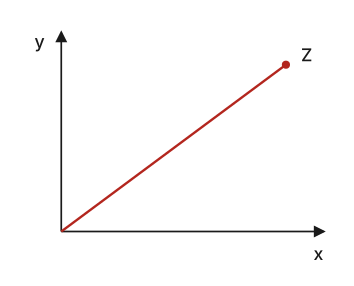
- AP EAPCET 2025Set ap-2025-05-20-AN1 markMCQQ.At 298 K, liquid A (solute) forms an ideal solution with liquid B (solvent). The following graph is obtained for this solution. [FIGURE] (a straight line graph starting at the origin and rising diagonally to a labelled point Z at the top right; x-axis labelled x, y-axis labelled y; y = vapour pressure) Identify the correct statements about this graph (only = only) I) x-axis represents the mole fraction of A II) Point Z represents the vapour pressure of pure solvent III) x-axis represents the mole fraction of B. (A) I, II only (B) I, III only (C) II, III only (D) I, II, III
›Reveal solutionSolution
A vapour-pressure-vs-mole-fraction line through the origin is Raoult's law plotted for the solvent against its own mole fraction, so the axis is xB and the endpoint Z is the pure solvent's vapour pressure.
Concept and Intuition
For an ideal solution, Raoult's law gives each component's partial vapour pressure as directly proportional to its own mole fraction:
pi=xipi∘
Plotted against xi, this is a straight line through the origin (when xi=0, pi=0) rising to pi∘ when xi=1 (i.e. the pure liquid). A single such line, ending at a labelled point Z, must therefore represent one specific component's own partial pressure against its own mole fraction — and whichever component reaches x=1 at Z is the one whose pure vapour pressure Z equals.
Step-by-Step Solution
- Statements I and III are mutually exclusive: the x-axis cannot simultaneously be the mole fraction of A and of B. So any option combining both (as True) is internally inconsistent — this rules out picking "I, III" or "I, II, III" together.
- If the x-axis were xA (statement I), the line would represent pA vs xA, and Z (at xA=1) would be the vapour pressure of pure A (the solute) — not the solvent, so statement II would be false. That combination (I true, II false) isn't offered as an answer. …
- AP EAPCET 2025Set ap-2025-05-20-FN1 markMCQQ.At T(K) vapour pressure of pure benzene and toluene are 500 and 200 mm Hg respectively. If they form an ideal solution, what is the mole fraction of toluene in a mixture boiling at T(K) at a total pressure of 380 mm Hg? (A) 0.20 (B) 0.60 (C) 0.40 (D) 0.80
›Reveal solutionSolution
Using Raoult's law for an ideal benzene-toluene solution, the liquid-phase mole fraction of toluene that gives a total vapour pressure of 380 mmHg is 0.40.
Concept and Intuition
For an ideal solution, Raoult's law gives the total vapour pressure as a weighted average of the pure-component vapour pressures, weighted by liquid mole fractions: Ptotal=PA∘xA+PB∘xB. "Boiling at T(K)" simply tells us the pure-component vapour pressure values quoted are valid at that temperature; the liquid composition is found by solving this linear equation for the unknown mole fraction.
Step-by-Step Solution
- Let x = mole fraction of toluene in the liquid; then (1−x) = mole fraction of benzene.
- Ptotal=Pbenzene∘(1−x)+Ptoluene∘(x)=500(1−x)+200x. …
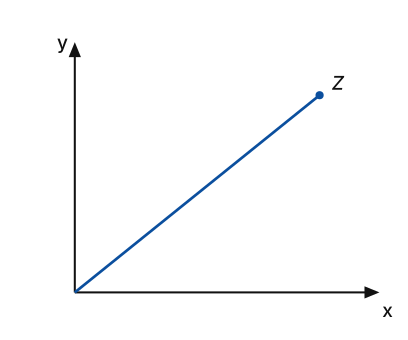
- AP EAPCET 2025Set eng-2025-05-27-FN1 markMCQQ.The following graph is obtained for an ideal solution containing a non-volatile solute. x- and y-axis represent, respectively [FIGURE] (a graph with axes labelled y (vertical) and x (horizontal); a straight line starting from the origin and rising to a point labelled Z) (A) mole fraction of solute, vapour pressure of solute. (B) mole fraction of solvent, vapour pressure of solution. (C) mole fraction of solute, vapour pressure of solution. (D) concentration of solution, vapour pressure of solution
›Reveal solutionSolution
The straight line through the origin rising to Z is Raoult's law plotted as vapour pressure of solution vs mole fraction of the solvent.
Concept and Intuition
For an ideal solution of a non-volatile solute in a volatile solvent, Raoult's law states the solution's vapour pressure depends only on the solvent's mole fraction:
psolution=psolvent∘xsolvent
This is linear in xsolvent and passes through the origin: when xsolvent=0 (pure solute, no solvent), the vapour pressure is 0; when xsolvent=1 (pure solvent), psolution=psolvent∘, the maximum, which the graph shows as point Z.
Step-by-Step Solution
- The line starts at the origin — this rules out any option where the y-intercept would be nonzero.
- It rises linearly to a maximum at Z — consistent with p=p∘xsolvent maxing out at xsolvent=1.
- Vapour pressure of the solute (non-volatile) would be essentially zero throughout, not a rising line to a high value Z — rules out options mentioning solute vapour pressure. …
- AP EAPCET 2024Set eng-2024-05-22-FN1 markMCQQ.At T(K) two liquids A and B form an ideal solution. The vapour pressures of pure liquids A and B at that temperature are 400 and 600 mm Hg respectively. If the mole fraction of liquid B is 0.3 in the mixture, the mole fractions of A and B in vapour phase respectively are (A) 0.391, 0.609 (B) 0.509, 0.491 (C) 0.609, 0.391 (D) 0.491, 0.509
›Reveal solutionSolution
Raoult's law gives partial pressures from liquid composition; dividing each by the total pressure gives the vapour-phase mole fractions, yA≈0.609 and yB≈0.391.
Concept and Intuition
For an ideal solution, each component's partial vapour pressure is proportional to its mole fraction in the LIQUID (Raoult's law): pi=xiPi∘. But the composition of the VAPOUR above the solution is generally different — it is enriched in the more volatile component. The vapour mole fraction of each component is its partial pressure divided by the total vapour pressure (Dalton's law): yi=pi/Ptotal.
Step-by-Step Solution
- Given xB=0.3⇒xA=1−0.3=0.7.
- Partial pressure of A: pA=xAPA∘=0.7×400=280 mm Hg.
- Partial pressure of B: pB=xBPB∘=0.3×600=180 mm Hg.
- Total vapour pressure: P=pA+pB=280+180=460 mm Hg.
- Vapour mole fraction of A: yA=PpA=460280≈0.609.
- Vapour mole fraction of B: yB=PpB=460180≈0.391. …
- AP EAPCET 2024Set eng-2024-05-23-FN1 markMCQQ.At 300 K, the vapour pressures of A and B liquids are 500 and 400 mm Hg respectively. Equal moles of A and B are mixed to form an ideal solution. The mole fraction of A and B in vapor state is respectively (A) 0.5, 0.5 (B) 0.666, 0.333 (C) 0.444, 0.555 (D) 0.555, 0.444
›Reveal solutionSolution
Using Raoult's law for an ideal solution of equal moles of A and B, the vapor mole fractions come out to yA=0.555 and yB=0.444.
Concept and Intuition
For an ideal solution, each component's partial vapor pressure follows Raoult's law: pi=xiPi∘, where xi is its mole fraction in the LIQUID. The mole fraction of each component in the VAPOR phase is then obtained by dividing its partial pressure by the total vapor pressure — because the more volatile component (higher P∘) always gets enriched in the vapor relative to the liquid.
Step-by-Step Solution
- Equal moles of A and B mixed ⇒ liquid mole fractions xA=xB=0.5.
- Partial pressure of A: pA=xAPA∘=0.5×500=250 mmHg.
- Partial pressure of B: pB=xBPB∘=0.5×400=200 mmHg.
- Total pressure: Ptotal=pA+pB=250+200=450 mmHg.
- Vapor mole fraction of A: yA=PtotalpA=450250=0.555. …
- AP EAPCET 2023Set ap-2023-05-23-AN1 markMCQQ.At T (K), 1 mol of benzene is mixed with 1 mol of toluene. The mole fraction of benzene and toluene in its vapour state is respectively (PBenzene0=160 torr, Ptoluene0=60 torr) (A) 0.5 & 0.5 (B) 0.4 & 0.6 (C) 0.62 & 0.38 (D) 0.73 & 0.27
›Reveal solutionSolution
Raoult's law gives the liquid-phase partial pressures; Dalton's law then converts those into vapour-phase mole fractions, giving benzene ≈0.73 and toluene ≈0.27 in the vapour.
Concept and Intuition
For an ideal liquid mixture, each component's partial vapour pressure is proportional to its mole fraction in the LIQUID (Raoult's law), but the vapour phase is enriched in the more volatile component — because the vapour's mole fraction is the ratio of that partial pressure to the TOTAL pressure, and the more volatile component contributes disproportionately more to the total pressure.
Step-by-Step Solution
- Liquid-phase mole fractions with 1 mol benzene + 1 mol toluene: xbenzene=xtoluene=0.5.
- Raoult's law: pbenzene=xbenzenePbenzene0=0.5×160=80 torr; ptoluene=xtoluenePtoluene0=0.5×60=30 torr.
- Total vapour pressure: Ptotal=pbenzene+ptoluene=80+30=110 torr.
- Vapour mole fraction of benzene: ybenzene=pbenzene/Ptotal=80/110=0.727≈0.73. …
- AP EAPCET 2023Set eng-2023-05-17-AN1 markMCQQ.A solution is formed by the combination of two liquids such as dichloromethane and chloroform. The partial pressures of dichloromethane and chloroform in solution are 285.5 and 62.4 mm Hg respectively. What is the total pressure of the solution? (A) 223.1 mm Hg (B) 347.9 mm Hg (C) 357.9 mm Hg (D) 337.9 mm Hg
›Reveal solutionSolution
This tests Dalton's law of partial pressures for a two-component liquid solution's vapour. Answer: 347.9 mm Hg.
Concept and Intuition
For a solution of two volatile liquids, the total vapour pressure above the solution equals the sum of the partial vapour pressures of each component (Dalton's law), each of which follows Raoult's law individually.
Step-by-Step Solution
- Given partial pressure of dichloromethane p1=285.5 mm Hg.
- Given partial pressure of chloroform p2=62.4 mm Hg. …
- AP EAPCET 2022Set ap-2022-07-12-FN1 markMCQQ.At T (K) vapour pressures of H2O and CH3OH are 36 and 120 torr respectively. 72 g of H2O and 'x' g of CH3OH when mixed, the resulting solution has a total vapour pressure of 64 torr. The amount x (in g) is (A) 32 (B) 56 (C) 64 (D) 72
›Reveal solutionSolution
Applying Raoult's law to the two-component ideal mixture and solving for moles of methanol gives x = 64 g.
Concept and Intuition
For an ideal solution of two volatile liquids, the total vapour pressure is the mole-fraction-weighted sum of the pure-component vapour pressures (Raoult's Law): Ptotal=PA0XA+PB0XB. Knowing the masses (hence moles) of one component and the total pressure lets us solve for the unknown moles of the other component.
Step-by-Step Solution
- Moles of water: nH2O=1872=4 mol.
- Let moles of methanol =m. Mole fractions: XH2O=4+m4, XCH3OH=4+mm.
- Raoult's law: Ptotal=36⋅4+m4+120⋅4+mm=64. …
🎓Unlock everything free for 14 days
- ✓Full step-by-step solutions
- ✓Concept-first explanations
- ✓Methods, shortcuts & mistakes
- ✓PYQ mapping + timed mock tests
Full access for 14 days. No credit card required.