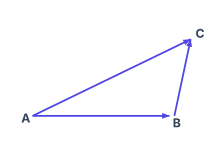
Q.In triangle ABC (Fig 10.18), which of the following is not true: (A) AB+BC+CA=0 (B) AB+BC−AC=0 (C) AB+BC−CA=0 (D) AB−CB+CA=0
🔒You're viewing a preview — the full solution, concept, methods & PYQ mapping are locked.
🔒 Start your 14-day free trial to unlock the full solution →Concept understanding — Vector Addition Triangle Law
Triangle Law of Vector Addition
How do you combine two vectors into a single one? If you make two journeys one after the other, the net journey is a single vector from where you started to where you finished. That is exactly the triangle law.
The law
If two vectors are represented, in magnitude and direction, by two sides of a triangle taken in order (the tip of the first joined to the tail of the second), then their sum is represented by the third side taken in the reverse order — from the tail of the first to the tip of the second.
Place a, then start b where a ends. The arrow that closes the triangle, drawn from the start of a to the end of b, is the resultant a+b.
AB+BC=AC
Why it works
Read the vectors as directed displacements: going from A to B and then B to C lands you at C, and the single displacement that achieves the same is A to C. The intermediate point B cancels — only the overall start and finish survive.
Consequences
- Commutative: a+b=b+a. Completing the triangle the other way gives the same closing side — which is why the parallelogram law agrees with the triangle law.
- Closed triangle = zero: if three vectors form a triangle taken in order, AB+BC+CA=0, since you return to the start.
- To subtract, add the negative: a−b=a+(−b), reversing b before joining it. …
Concept: Vector Addition Triangle Law — in a closed triangle, the head-to-tail sum of the directed sides taken in order is zero.
Reasoning:
- For triangle ABC, the natural cycle AB+BC+CA returns to the starting point, so the sum is 0. Hence (A) is true.
- Since CA=−AC, statement (B) becomes AB+BC+CA=0, which is the same as (A). So (B) is true. …
Using the triangle law of vector addition, the head-to-tail sum of vectors around a closed triangle is zero. Option (C) is the only one that does not simplify to 0, so it is the false statement.
The core idea here is the Triangle Law of Vector Addition: if you place vectors head to tail, the resultant vector goes from the first tail to the last head. When you go completely around a closed polygon (like a triangle) and return to the starting point, the net displacement is zero. That is, for any triangle ABC,
AB+BC+CA=0.
This is the fundamental relation. Every option is just a rearrangement of these three vectors. Our job is to check which one does not reduce to 0.
Let’s go through each option one by one.
-
Option (A): AB+BC+CA=0
This is exactly the closed-triangle condition. It is true by definition.
-
Option (B): AB+BC−AC=0
Notice that −AC=CA (reversing a vector flips its direction). So the expression becomes AB+BC+CA, which is exactly option (A). Hence it is true.
-
Option (C): AB+BC−CA=0
Here −CA=AC. So the expression is AB+BC+AC.
But AB+BC=AC (by the triangle law, going from A to B to C gives the same as going directly from A to C). So this sum becomes AC+AC=2AC, which is not zero unless the triangle is degenerate. Therefore this statement is false. …
Method: Deciding Which Triangle-Law Identity is False
This is a reasoning task on the triangle law of vector addition. The technique is to reduce every option to the closed-loop form and see which one fails to become 0.
Steps
Step 1: State the anchor identity.
Going around a closed triangle returns you to the start:
AB+BC+CA=0.
Step 2: Rewrite every reversed vector using −PQ=QP.
Whenever you see a minus sign in front of a directed vector, flip its letters: −AC=CA, −CB=BC, and so on. This exposes hidden closed loops.
Step 3: Compare each option to the anchor. …
Common Mistakes
Mistake 1: Treating −CA as CA.
Why it's wrong: reversing a vector flips its letters, so −CA=AC. Forgetting this turns the false option (C) into the true identity by accident. Correct approach: apply −PQ=QP before simplifying.
Mistake 2: Assuming AB+BC=0. …
Showing the 12 most recent of 17 on this concept.
- AP EAPCET 2021Set eng-2021-08-25-FN1 markMCQQ.If 'C' is the midpoint of line segment AB and 'P' is any point not on the line AB, then (A) PA+PB+PC=0 (B) PA+PB+2PC=0 (C) PA−PC=PC−PB (D) PA+PB−PC=0
›Reveal solutionSolution
The midpoint formula in vector form, PA+PB=2PC, rearranges exactly to option (C).
Concept and Intuition
For any point P (on or off the line AB) and C the midpoint of AB, the position vector of C relative to P is the average of the position vectors of A and B relative to P — this is the vector form of the midpoint formula, and it holds regardless of where P is.
Step-by-Step Solution
- Since C is the midpoint of segment AB, PC=PA+AC=PA+21AB.
- Also AB=PB−PA, so PC=PA+21(PB−PA)=21(PA+PB).
- So 2PC=PA+PB, i.e. PA+PB−2PC=0. …
- AP EAPCET 2022Set eng-2022-07-07-FN1 markMCQQ.If C is the midpoint of the line segment AB and P is any point outside the line AB, then (A) PA+PB+2PC=0ˉ (B) PA+PB+PC=0ˉ (C) PA+PB=2PC (D) PA+PB=PC
›Reveal solutionSolution
This tests the midpoint vector identity: for C the midpoint of AB and any external point P,
PA+PB=2PC.
Concept and Intuition
The position vector of the midpoint of a segment is the average of the endpoints' position
vectors. Writing every vector PX as X−P (position vector of X minus that of P,
taking any convenient origin) turns this geometric fact into simple algebra.
Step-by-Step Solution
- C is the midpoint of AB, so (taking any origin) C=2A+B, i.e. A+B=2C.
- PA=A−P and PB=B−P.
- Adding: PA+PB=(A+B)−2P=2C−2P=2(C−P).
- Since PC=C−P, this is exactly PA+PB=2PC. …
- AP EAPCET 2021Set eng-2021-08-23-FN1 markMCQQ.In △OAC, if B is the midpoint of side AC and OA=a,OB=b then OC= (A) 2b−a (B) b−2a (C) a−2b (D) a−b
›Reveal solutionSolution
The midpoint formula for position vectors directly gives OC=2b−a.
Concept and Intuition
If B is the midpoint of segment AC, then the position vector of B (from any common origin O) is the average of the position vectors of A and C: OB=2OA+OC. This is just the vector form of "midpoint = average of endpoints".
Step-by-Step Solution
- Given OA=a, OB=b, and B the midpoint of AC.
- Midpoint formula: b=2a+OC.
- Multiply both sides by 2: 2b=a+OC. …
- AP EAPCET 2021Set eng-2021-08-24-AN1 markMCQQ.If ABCDEF is a regular hexagon with AB=a and BC=b then CE equals (A) b−a (B) −b (C) b−2a (D) a−2b
›Reveal solutionSolution
Expressing all hexagon vertices via coordinates and solving for CE in terms of a=AB and b=BC gives b−2a.
Concept and Intuition
Once two consecutive side vectors of a regular hexagon are known, every other side or diagonal can be written as an integer combination of them, because the hexagon's vertices are all fixed linear combinations of the first two edges.
Step-by-Step Solution
- Place A=(1,0), B=(21,23), C=(−21,23), E=(−21,−23).
- Then a=AB=(−21,23) and b=BC=(−1,0).
- CE=E−C=(0,−3).
- Write CE=pa+qb: matching the y-component, 23p=−3⇒p=−2. …
- AP EAPCET 2021Set eng-2021-08-24-AN1 markMCQQ.ABCDEF is a regular hexagon. The sum of the vectors BE,BC,EF,BA,CF,AF (A) BF (B) 2BF (C) FB (D) 3BF
›Reveal solutionSolution
Direct vector addition using hexagon coordinates shows the sum of the six vectors is exactly 3BF.
Concept and Intuition
For a regular hexagon, placing coordinates at the vertices (center at origin, circumradius 1) turns any vector-sum identity into simple coordinate arithmetic, avoiding error-prone geometric reasoning.
Step-by-Step Solution
- Place A=(1,0), B=(21,23), C=(−21,23), D=(−1,0), E=(−21,−23), F=(21,−23).
- Compute each vector: BE=(−1,−3), BC=(−1,0), EF=(1,0), BA=(21,−23), CF=(1,−3), AF=(−21,−23).
- Sum the x-components: −1−1+1+21+1−21=0. …
- AP EAPCET 2021Set eng-2021-08-23-FN1 markMCQQ.Let ABCDEF be a regular hexagon with the vertices A,B,C,D,E,F counterclockwise. Then the vector AB+BC is equal/parallel to (A) BC+CD (B) CD+DE (C) AF+FE (D) FE+ED
›Reveal solutionSolution
AB+BC=AC, a fixed vector. Checking all four options against a coordinate model of the hexagon shows only FE+ED=FD equals AC exactly.
Concept and Intuition
In any polygon, consecutive edge vectors telescope: PQ+QR=PR. So each option is really just a "skip one vertex" displacement vector between two hexagon vertices two apart. The question becomes: which of these skip-vectors equals AC?
Step-by-Step Solution
- Place the regular hexagon (counterclockwise) on a unit circle centered at O: A=(1,0), B=(0.5,0.866), C=(−0.5,0.866), D=(−1,0), E=(−0.5,−0.866), F=(0.5,−0.866).
- AB+BC=AC=C−A=(−1.5, 0.866).
- Option (A): BC+CD=BD=D−B=(−1.5,−0.866) — not equal (mirrored in y).
- Option (B): CD+DE=CE=E−C=(0,−1.732) — not equal.
- Option (C): AF+FE=AE=E−A=(−1.5,−0.866) — not equal. …
- AP EAPCET 2024Set eng-2024-05-18-FN1 markMCQQ.In a regular hexagon ABCDEF, AB=aˉ and BC=bˉ, then FA= (A) aˉ−bˉ (B) aˉ+bˉ (C) bˉ−aˉ (D) 2bˉ−aˉ
›Reveal solutionSolution
In a regular hexagon ABCDEF with AB=aˉ, BC=bˉ, the closing side FA=aˉ−bˉ.
Concept and Intuition
In a regular hexagon, opposite sides are parallel and equal in magnitude but point in opposite directions, and consecutive side-vectors are related by a fixed 60∘ rotation. Rather than track this abstractly, placing coordinates on a unit circle makes the vector relations immediate and safe from sign errors.
Step-by-Step Solution
- Place the regular hexagon's vertices on a unit circle at angles 0∘,60∘,120∘,180∘,240∘,300∘: A=(1,0), B=(0.5,0.866), C=(−0.5,0.866), D=(−1,0), E=(−0.5,−0.866), F=(0.5,−0.866).
- Compute aˉ=AB=B−A=(−0.5,0.866) and bˉ=BC=C−B=(−1,0).
- Compute FA=A−F=(1−0.5,0−(−0.866))=(0.5,0.866). …
- AP EAPCET 2022Set eng-2022-07-06-AN1 markMCQQ.In a △ABC, ∣CB∣=aˉ, ∣CA∣=bˉ, ∣AB∣=cˉ and CD is the median through the vertex C. Then CA.CD= (A) 41(3a2+b2−c2) (B) 41(a2+3b2−c2) (C) 41(a2+b2−3c2) (D) 41(−3a2−b2+c2)
›Reveal solutionSolution
Writing the median vector as the average of the two side-vectors and using the law-of-cosines relation for a⋅b gives CA⋅CD=41(a2+3b2−c2).
Concept and Intuition
Vector dot products of triangle sides connect directly to the law of cosines: expanding ∣AB∣2=∣a−b∣2 produces the dot product a⋅b in terms of the side lengths a,b,c. The median to a side is naturally the average of the two vectors from the opposite vertex, since the midpoint's position vector is the average of the endpoints.
Step-by-Step Solution
- Take C as the origin. Then CA=b (magnitude b) and CB=a (magnitude a).
- D, the midpoint of AB, has position vector CD=2a+b (average of A and B's position vectors from C).
- CA⋅CD=b⋅2a+b=2a⋅b+2b2. …
- AP EAPCET 2021Set eng-2021-08-19-FN1 markMCQQ.If D,E and F are respectively mid points of AB,AC and BC in △ABC, then BE+AF is equal to (A) DC (B) 23BF (C) 21BF (D) 21DC
›Reveal solutionSolution
Expressing every midpoint in terms of the triangle's position vectors and adding shows BE+AF=DC.
Concept and Intuition
Midpoint vector problems become simple bookkeeping once every named point is written as a position vector combination of the triangle's vertices. Vector addition of two such combinations is just adding coefficients.
Step-by-Step Solution
- Let A,B,C denote the position vectors of the vertices.
- D = midpoint of AB: D=2A+B. E = midpoint of AC: E=2A+C. F = midpoint of BC: F=2B+C.
- BE=E−B=2A+C−B=2A+C−2B.
- AF=F−A=2B+C−A=2B+C−2A.
- Sum: BE+AF=2(A+C−2B)+(B+C−2A)=22C−A−B. …
- AP EAPCET 2024Set eng-2024-05-19-AN1 markMCQQ.If L, M, N are the mid points of the sides PQ, QR and RP of △PQR respectively, then QM+LN+ML+RN−MN−QL= (A) PQ+QR+LM+MN (B) LP+PM+MQ (C) PQ+QR−PR (D) LM+MN+NR
›Reveal solutionSolution
The six-term vector sum on the left simplifies exactly to the zero vector; among the choices only PQ+QR−PR is identically zero, so that is the match.
Concept and Intuition
Midpoints of a triangle's sides are just averages of the vertex position vectors. Any vector joining two of the six points P,Q,R,L,M,N can be written as a combination of P,Q,R, so a sum of several such vectors can always be reduced to a single combination of P,Q,R and simplified.
Step-by-Step Solution
- Let P,Q,R be the position vectors of the vertices. Then L=2P+Q,M=2Q+R,N=2R+P.
- Compute each vector needed: QM=M−Q=2R−Q, LN=N−L=2R−Q, ML=L−M=2P−R, RN=N−R=2P−R, MN=N−M=2P−Q, QL=L−Q=2P−Q.
- Add them with the signs given: QM+LN+ML+RN−MN−QL=(R−Q)+(P−R)−(P−Q)=0. …
- AP EAPCET 2022Set eng-2022-07-08-AN1 markMCQQ.OABCD is a pentagon in which the sides OA and CB are parallel and the sides OD and AB are parallel. Also, it is given that CBOA=2,ABOD=31. If OA=aˉ,OD=dˉ, then AD+OC+DC= (A) dˉ−aˉ (B) 21aˉ+3dˉ (C) 21aˉ+2dˉ (D) 6dˉ
›Reveal solutionSolution
Express every vertex of the pentagon in terms of aˉ=OA and dˉ=OD using the two given parallel/ratio conditions, then add the three requested vectors.
Concept and Intuition
A pentagon with two pairs of parallel sides can be fully built from two independent vectors (aˉ and dˉ) plus the given ratios — exactly like building a trapezoid from its two parallel sides. Once every vertex's position vector (relative to O) is known, any requested vector sum is pure algebra.
Step-by-Step Solution
- Take O as the origin. A=aˉ, D=dˉ.
- OD/AB=1/3 with OD∥AB (same sense, as in a trapezoid's parallel sides) gives AB=3dˉ, so B=A+AB=aˉ+3dˉ.
- OA/CB=2 with OA∥CB gives CB=aˉ/2, i.e. BC=−aˉ/2, so C=B+BC=aˉ+3dˉ−aˉ/2=aˉ/2+3dˉ. …
- AP EAPCET 2026Set eng-2026-05-15-FN1 markMCQQ.OABCD is a pentagon in which the sides OA and CB are parallel and the sides OD and AB are parallel. If OA=aˉ,OD=dˉ,CBOA=2 and ABOD=31, then AD+OC+DC= (A) dˉ+aˉ (B) 5aˉ+3dˉ (C) 6dˉ (D) 7aˉ
›Reveal solutionSolution
Using O as the origin and the given parallel-side ratios to pin down B and C in terms of aˉ,dˉ, the required sum of vectors telescopes to 6dˉ (the aˉ terms cancel).
Concept and Intuition
In a pentagon built from two pairs of parallel sides with known ratios, every vertex's position vector can be written in terms of the two "free" vectors aˉ=OA and dˉ=OD. Once all vertices are pinned down, any combination of side vectors reduces to simple algebra.
Step-by-Step Solution
- Let O be the origin, so A=aˉ, D=dˉ.
- OD∥AB with ABOD=31 means AB=3OD=3dˉ (same sense), so B=A+3dˉ=aˉ+3dˉ.
- OA∥CB with CBOA=2 means CB=21OA=21aˉ, i.e. B−C=21aˉ⇒C=B−21aˉ=(aˉ+3dˉ)−21aˉ=21aˉ+3dˉ.
- Now compute each required vector:
- AD=D−A=dˉ−aˉ.
- OC=C=21aˉ+3dˉ.
- DC=C−D=(21aˉ+3dˉ)−dˉ=21aˉ+2dˉ. …
🎓Unlock everything free for 14 days
- ✓Full step-by-step solutions
- ✓Concept-first explanations
- ✓Methods, shortcuts & mistakes
- ✓PYQ mapping + timed mock tests
Full access for 14 days. No credit card required.