Q.Two fixed, identical conducting plates α and β, each of surface area S, are held parallel to each other. Plate α (on the left) carries charge −Q and plate β (in the middle) carries charge q, with Q>q>0. A third identical plate γ, free to move, is placed parallel to them on the far side of β (to the right), at a distance d from β; initially γ is uncharged. The plate γ is released and slides toward β, striking it. The collision is elastic, and the contact time is long enough for charge to redistribute between β and γ while they touch.
🔒You're viewing a preview — the full solution, concept, methods & PYQ mapping are locked.
🔒 Start your 14-day free trial to unlock the full solution →Concept understanding — Gauss Law
Gauss's Law is a shortcut. Instead of adding up the Coulomb contribution of every charge — a nightmare of vectors and integrals — it lets you read the field straight off the symmetry of a problem. The whole idea rests on one quantity: electric flux.
Flux — field-lines counted through a surface. For a uniform field E crossing a flat area A, the flux is Φ = E·A = EA cosθ, where θ is the angle between the field and the normal to the surface. Picture the field as a bundle of lines; flux is how many pierce the surface. When E is edge-on (θ = 90°) nothing passes through and Φ = 0; when E is ⊥ to the surface (θ = 0) the count is maximal. For a closed surface, Φ is the net number of lines leaving it — lines that enter and exit cancel.
The law itself. Gauss's law states that the net flux out of any closed surface depends only on the charge trapped inside:
Φ = q_enclosed / ε₀.
Two consequences do most of the work. First, only enclosed charge counts — a charge outside sends as many lines in as out, so its net contribution is exactly zero. Second, the surface's shape is irrelevant; move the charge around inside or deform the surface, and Φ never changes.
Why symmetry makes it powerful. By itself Φ = q/ε₀ has E buried in an integral. It becomes a tool only when you pick a Gaussian surface matched to the symmetry — one where E is constant and everywhere either ⊥ to the surface (so Φ = EA) or ∥ to it (contributing nothing). Then E slides out and you solve in one line. This works for exactly three geometries:
1 — Infinite line charge (linear density λ). Use a coaxial cylinder: E = λ / 2πε₀r, falling off as ∝ 1/r.
2 — Infinite sheet (surface density σ). Use a pillbox pierced through the sheet: E = σ / 2ε₀ — uniform and completely independent of distance. The field near a large charged plane simply doesn't weaken as you step back. …
Why this formula?
Gauss's Law: Why It Holds
Gauss's Law is one of the four Maxwell's equations and a cornerstone of electromagnetism. Let's build the understanding from the ground up — not just the formula, but the why.
1. The Core Idea: Flux as "Flow" of Field
Imagine an electric field E passing through a small patch of area dA. The electric flux through that patch is:
dΦE=E⋅dA=EdAcosθ
where θ is the angle between E and the outward normal to the surface.
Why this definition?
- If E is perpendicular to the surface (θ=0), maximum field "flows through".
- If E is parallel (θ=90∘), no flux — the field just slides along the surface.
Total flux through a closed surface S is:
ΦE=∮SE⋅dA
2. The Key Insight: Flux Depends Only on Enclosed Charge
Consider a single point charge +q at the centre of a spherical surface of radius r.
- By Coulomb's law, at every point on the sphere: E=4πε01r2q, radially outward.
- The area vector dA is also radially outward.
- So E⋅dA=EdA everywhere.
The total flux:
ΦE=∮EdA=E∮dA=(4πε01r2q)(4πr2)=ε0q
Notice: The r2 cancels! The flux is independent of the radius.
3. Why Shape Doesn't Matter
Now, what if the surface is not spherical but any closed shape enclosing the charge?
- Draw a small cone from the charge to the surface.
- The flux through a patch dA at distance r is dΦ=4πε01r2qcosθdA.
- But r2cosθdA is exactly the solid angle dΩ subtended by dA at the charge.
So dΦ=4πε0qdΩ.
Integrating over the entire closed surface: ∮dΩ=4π (total solid angle around a point).
Hence:
ΦE=4πε0q⋅4π=ε0q
Result: For any closed surface enclosing q, the flux is ε0q.
4. Multiple Charges: Superposition
If there are many charges q1,q2,…,qn inside the surface, the total electric field is the vector sum of individual fields:
E=E1+E2+⋯+En
Flux is linear: …
Treat each plate as a sheet giving field 2ε0Scharge on each side. Before collision the field on γ is 2ε0SQ−q (toward the plates). After contact the plates share charge as β=2Q+q, γ=2q−Q. The net constant force then does work over d, giving v=(Q−q)4mε0Sd.
- E=2ε0SQ−q.
- qβ=2Q+q, qγ=2q−Q. …
Each charged plate of charge σS produces a uniform field 2ε0Scharge on each side. Superposing the fields of α and β gives the field on γ before impact. During contact β and γ merge into one conductor, so the charge redistributes onto the outer faces, giving qβ=2Q+q and qγ=2q−Q. After the collision the (uniform, hence constant) net force on γ does work Fd, which equals its kinetic energy, fixing the speed.
Model
A large plate carrying charge ±(magnitude) over area S acts like a charged sheet producing a uniform field of magnitude 2ε0S∣charge∣ on each side, directed away from the plate if positive, toward it if negative. Take +x to the right (from α toward γ).
(a) Field on γ before collision (γ uncharged)
At γ's location (to the right of both α and β):
- Due to α(−Q): magnitude 2ε0SQ, pointing toward α (left).
- Due to β(+q): magnitude 2ε0Sq, pointing away from β (right).
Net (taking left as the resultant direction since Q>q):
Eγ=2ε0SQ−2ε0Sq=2ε0SQ−qdirected toward the plates (left).
(b) Charges after the collision
While β and γ touch they form a single conductor of total charge q+0=q, sitting next to plate α (charge −Q). For two separated conductors, the two outer faces carry equal charge 2(total of both)=2−Q+q, and the facing surfaces carry ±2Q+q. Since the merged β–γ conductor has no charge on its internal contact interface:
- β (inner plate, facing α) carries the facing-surface charge: qβ=2Q+q.
- γ (outer plate) carries the outer-surface charge: qγ=2q−Q(<0).
Check: qβ+qγ=2Q+q+2q−Q=q. ✓
(c) Speed of γ after travelling d
After the collision γ carries qγ=2q−Q. The field on γ from the other two plates:
- Due to α(−Q): 2ε0SQ toward α (left).
- Due to β(2Q+q): 4ε0SQ+q away from β (right). …
Method: Charged Conducting Plates — Sheet-Field Superposition + Conductor Contact
This technique applies to any problem with several large parallel charged conducting plates, where you must find the field at some point, the charge redistribution after two plates touch, or the resulting motion of a free plate.
Steps
Step 1: Model each plate as a charged sheet, not a point charge
A large conducting plate of charge Q spread over area S produces a uniform field on each side, independent of distance from the plate — this is what makes the problem tractable without doing an integral each time.
E=2ε0S∣Q∣
directed away from the plate if Q>0, toward the plate if Q<0.
Step 2: Superpose the sheet fields at the point of interest
Pick a consistent axis. At any point, add up (with sign, since each field is one-dimensional along that axis) the contribution from every plate, using each plate's own sign convention from Step 1. A charge-free plate contributes nothing until it acquires charge.
Step 3: When two plates come into contact, treat them as one conductor
Two touching plates merge into a single conductor: total charge is conserved, and it redistributes so that no field exists inside the merged conductor. In a stack of parallel plates, this means the charge splits between the merged conductor's two exposed faces so as to balance whatever external field the other (untouched) plates produce — the outer face and the face adjacent to a neighbouring charged plate generally end up with different amounts, found by requiring internal consistency (zero net field inside the conductor) together with total-charge conservation. Once the two split apart again, each plate keeps the charge that was sitting on the face it retains. …
Showing the 12 most recent of 33 on this concept.
- AP EAPCET 2026Set eng-2026-05-12-FN1 markMCQQ.A spherical rubber balloon has the electric charges uniformly distributed over its surface. If the balloon is inflated further, the electric intensity E on the surface (A) increases (B) decreases (C) remains same (D) is zero
›Reveal solutionSolution
This tests how surface field strength changes for a charged sphere whose radius grows while total charge stays constant; the field decreases.
Concept and Intuition
Inflating the balloon spreads the same total charge Q over a larger surface area, so the surface charge density σ=Q/4πR2 drops. The electric field just outside a uniformly charged sphere depends only on Q and R (by Gauss's law, exactly as if all charge were concentrated at the centre), so as R grows for fixed Q, the field at the surface must weaken.
Step-by-Step Solution
- By Gauss's law, the field at the surface of a uniformly charged sphere of radius R carrying charge Q is E=4πε01R2Q.
- Inflating the balloon increases R but does not add or remove any charge, so Q stays constant. …
- AP EAPCET 2026Set eng-2026-05-15-AN1 markMCQQ.A cylinder of radius 50 cm and length 2m is placed along x-axis as shown in the figure. If electric field is 70i^ along its axis, the electric flux through the left face of the cylinder is (A) 50 (B) 52 (C) 55 (D) 58
›Reveal solutionSolution
A straightforward flux calculation: since the uniform field is parallel to the cylinder's axis, the flux through each flat end face equals E times the face's circular area, giving a magnitude of about 55 (SI units).
Concept and Intuition
Electric flux through a flat surface in a uniform field is Φ=E⋅A=EAcosθ, where θ is the angle between the field and the surface's (outward) normal. For a cylinder with its axis along x and a uniform field E=70i^ also along x, the two flat circular end faces have their normals exactly along (or exactly against) the field direction — so cosθ=±1 for these faces, and the flux magnitude reduces to simply E times the face area. (The curved lateral surface, by contrast, has its normal everywhere perpendicular to the axis, so it carries zero flux — consistent with the field lines simply passing straight through the cylinder without net flux crossing the sides.)
Step-by-Step Solution
- The left face is a circular disk of radius r=0.5 m, with area A=πr2.
- Compute the area: A=π×(0.5)2=π×0.25≈722×0.25=0.7857 m2. …
- AP EAPCET 2026Set eng-2026-05-18-FN1 markMCQQ.Two large circular metal plates each of radius 50 cm carrying equal and unlike charges are parallel to each other. If the electric field between the plates is 720 NC−1, then the magnitude of charge on any one plate is (A) 7.5 nC (B) 10 nC (C) 2.5 nC (D) 5 nC
›Reveal solutionSolution
This tests the field between oppositely-charged parallel plates, E=σ/ε0, to find the charge on each plate. Answer: 5 nC.
Concept and Intuition
For a single charged plate (infinite sheet), the field on each side is σ/2ε0. But for two large plates with equal and opposite charges facing each other (a parallel-plate-capacitor-like arrangement), the fields from both plates point in the same direction in the region between them, so they add: Ebetween=2ε0σ+2ε0σ=ε0σ.
Step-by-Step Solution
- Field between two oppositely charged plates: E=ε0σ.
- Solve for surface charge density: σ=Eε0=720×8.854×10−12=6.3749×10⁻⁹ C/m2.
- Area of each circular plate: A=πr2=π(0.5)2=π(0.25)≈0.7854 m2. …
- AP EAPCET 2026Set ap-2026-05-19-FN1 markMCQQ.Electric flux through cube of side 'a' enclosing charge 'q' is (A) q/a2 (B) q/ϵ0 (C) Zero (D) aϵ02q
›Reveal solutionSolution
Tests the core statement of Gauss's law: flux through a closed surface depends only on enclosed charge, not on the surface's shape, size, or the charge's exact position inside.
Concept and Intuition
Gauss's law is a global statement — it doesn't care whether the enclosing surface is a sphere, a cube, or any irregular shape, and it doesn't care exactly where inside the charge sits. All that matters is how much charge is inside. This is precisely why Gauss's law is so powerful for symmetric charge distributions: you're free to choose whatever surface makes the calculation easiest.
Step-by-Step Solution
- Gauss's law states ∮E⋅dA=ϵ0qenc for any closed surface.
- Here the closed surface is a cube of side a that encloses a charge q.
- Regardless of the cube's side length a or the position of q inside it, the total flux is simply Φ=ϵ0q. …
- AP EAPCET 2026Set eng-2026-05-18-AN1 markMCQQ.The net outward flux through surface of a box is 8.0×10³ Nm2C−1. The net charge inside the box is (approximately) (A) 70 nC (B) 42 nC (C) 21 nC (D) 60 nC
›Reveal solutionSolution
Gauss's law directly relates the flux through a closed surface to the enclosed charge: q=ε0Φ≈70nC.
Concept and Intuition
Gauss's law states that the net electric flux through any closed surface depends only on the charge enclosed, regardless of the shape of the surface or the position of the charge inside it: Φ=ε0qenc.
Step-by-Step Solution
- Given Φ=8.0×10³Nm2C−1.
- Rearranging Gauss's law: qenc=ε0Φ.
- Substitute ε0=8.85×10⁻¹²C2N−1m−2: qenc=8.85×10−12×8.0×103=7.08×10⁻⁸C.
- Convert: 7.08×10⁻⁸C=70.8nC≈70nC. …
- AP EAPCET 2026Set ap-2026-05-20-FN1 markMCQQ.The electric field intensity on the surface of a charged sphere of radius R and volume charge density ρ is (A) R23ϵ0 (B) 4πϵ01ρR2 (C) 3ϵ0R2 (D) 3ϵ0ρR
›Reveal solutionSolution
This tests Gauss's law applied to a uniformly charged solid sphere — the field just outside the surface behaves as if all charge were concentrated at the centre.
Concept and Intuition
For any spherically symmetric charge distribution, Gauss's law lets us treat the enclosed charge as if it were a point charge at the centre when evaluating the field outside (or at) the surface. So we first find the total charge in terms of the given volume charge density, then apply the point-charge field formula at r=R.
Step-by-Step Solution
- Total charge enclosed by the sphere: Q=ρ×Volume=ρ⋅34πR3.
- By Gauss's law, the field at the surface (r=R) is E=4πϵ01R2Q. …
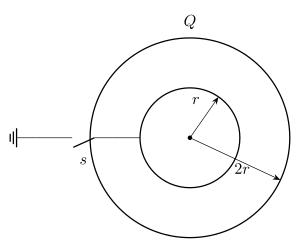
- AP EAPCET 2026Set ap-2026-05-20-FN1 markMCQQ.Two conducting thin concentric shells of radii r and 2r are shown in figure. Outer shell carries a charge Q. Inner shell is neutral. The charge that will flow from inner shell to earth after closing the switch s is [FIGURE] (two concentric conducting spherical shells, inner of radius r and outer of radius 2r; the outer shell carries charge Q; the inner shell is connected through a switch s to earth/ground) (A) Q (B) 3Q (C) 2Q (D) 4Q
›Reveal solutionSolution
Grounding the inner shell of a concentric-shell system forces its potential to zero; solving for the resulting charge shows exactly Q/2 flows to earth.
Concept and Intuition
When a conductor is grounded, its potential is fixed at zero (earth's potential), and charge flows onto or off it until that condition is met. For concentric shells, we use the fact that inside a uniformly charged shell the potential is constant and equals kqshell/Rshell, and we superpose contributions from every shell of charge present.
Step-by-Step Solution
- Let the final charge on the inner shell (radius r) be q. The outer shell (radius 2r) has total charge Q; by electrostatic induction its inner surface carries −q and its outer surface carries Q+q.
- Potential of the inner shell = (its own contribution) + (contribution of outer shell's charges, since inner shell is inside the outer shell):
V=rkq+2rk(−q)+2rk(Q+q)=rkq+2rkQ
- Setting V=0 (grounded): rq=−2rQ⇒q=−2Q. …
- AP EAPCET 2025Set eng-2025-05-22-AN1 markMCQQ.Two charged conducting spheres of radii 5 cm and 10 cm have equal surface charge densities. If the electric field on the surface of the smaller sphere is E, then the electric field on the surface of the larger sphere is (A) 2E (B) 4E (C) 0.5E (D) E
›Reveal solutionSolution
This tests a subtlety of conductors: the field just outside a charged conducting surface depends only on the local surface charge density, not on the sphere's radius. Equal σ means equal E, regardless of size — the answer is E (unchanged).
Concept and Intuition
It's tempting to reach for E=kQ/r2 and think a bigger sphere (different Q, different r) must have a different field. But the correct starting point for a conductor's surface is Gauss's law applied to a small pillbox straddling the surface, which gives the general boundary condition E=σ/ε0 for ANY conductor surface — this holds locally, independent of the conductor's overall size or shape. Since surface charge density is defined as σ=Q/A=Q/(4πr2), a sphere's total charge Q does scale with r2 for a given σ, but the field expressed in terms of σ directly doesn't care about r at all.
Step-by-Step Solution
- Field just outside any conductor's surface: E=ε0σ (a standard result from Gauss's law at a conducting boundary).
- This expression contains no explicit dependence on the sphere's radius.
- Both spheres (radii 5 cm and 10 cm) are given to have the SAME surface charge density σ. …
- AP EAPCET 2025Set eng-2025-05-22-FN1 markMCQQ.In a region, the electric field is given by Eˉ=(3i^+5j^+7k^) NC−1. The electric flux through a surface of area 3 m2 in yz plane is (in SI units) (A) 21 (B) 15 (C) 12 (D) 9
›Reveal solutionSolution
Electric flux through a surface only depends on the field component perpendicular to it; for the yz-plane that's Ex, giving Φ=9 (SI units).
Concept and Intuition
Electric flux is the dot product Φ=E⋅A, where A points along the surface's normal. A surface lying in the yz-plane has its normal along the x-axis, so components of E along j^ and k^ lie within the plane and contribute nothing to flux through it — only the i^ component matters.
Step-by-Step Solution
- Surface lies in the yz-plane ⇒ its area vector is A=3i^ m2 (magnitude 3, along x).
- Given E=(3i^+5j^+7k^) N/C. …
- AP EAPCET 2025Set ap-2025-05-19-AN1 markMCQQ.The electric flux through the surface of a thin spherical shell of radius 6 cm, having a point charge 2 μC at its center is (A) 36π×105 N m2 C−1 (B) 72π×105 N m2 C−1 (C) 36π×108 N m2 C−1 (D) 72π×103 N m2 C−1
›Reveal solutionSolution
Gauss's law says the flux through a closed surface depends only on the enclosed charge, never on the surface's size or shape — giving 72π×103 N m2C−1 regardless of the 6 cm radius given.
Concept and Intuition
Gauss's law states ∮E⋅dA=ε0qenc. This is a purely topological statement — as long as the same charge is enclosed, the total flux out of any closed surface around it (sphere, cube, irregular blob) is identical. The radius of the shell given here is a distractor; it doesn't enter the flux calculation at all.
Step-by-Step Solution
- Enclosed charge: q=2 μC=2×10⁻⁶ C.
- Φ=ε0q. Using 4πε01=k=9×10⁹, we get ε01=4πk. …
- AP EAPCET 2025Set ap-2025-05-20-FN1 markMCQQ.A sphere of radius R and charge 'Q' is placed inside an imaginary sphere of radius 2R such that the centres of two spheres coincide. The electric flux linked with the imaginary sphere is (A) ε04Q (B) ε02Q (C) ε0Q (D) 2ε0Q
›Reveal solutionSolution
Gauss's law says the flux through a closed surface depends only on the enclosed charge, not on the surface's size or shape; since the imaginary sphere of radius 2R encloses the same charge Q as the inner sphere, the flux is simply Q/ε0.
Concept and Intuition
Gauss's law, ∮E⋅dA=ε0Qenc, is a statement about total enclosed charge, completely independent of the geometry of the enclosing (Gaussian) surface or the exact charge distribution inside it. Doubling or tripling the radius of the imaginary sphere changes nothing about the flux, as long as no additional charge is included or excluded.
Step-by-Step Solution
- The imaginary sphere of radius 2R is concentric with, and completely encloses, the charged sphere of radius R and charge Q.
- Total charge enclosed by the imaginary sphere: Qenc=Q (no additional charge outside the inner sphere but inside the imaginary sphere). …
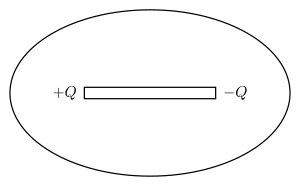
- AP EAPCET 2024Set ap-2024-05-17-AN1 markMCQQ.As shown in the figure, a surface encloses an electric dipole with charge ±6×10⁻⁶ C. The total electric flux through the closed surface is [FIGURE] (an oval closed surface enclosing an electric dipole shown as a rod with +Q labelled at its left end and −Q labelled at its right end) (A) +12×10−6 Nm2C−1 (B) −12×10−6 Nm2C−1 (C) Zero (D) +6×10⁻⁶ Nm2C−1
›Reveal solutionSolution
Gauss’s law says the net electric flux through a closed surface equals the net charge enclosed divided by ε₀. Since a dipole has equal and opposite charges, the net enclosed charge is zero, so the total flux is zero.
The key insight is that Gauss’s law relates the total electric flux through a closed surface to the net charge inside that surface — not to the arrangement or separation of the charges. A dipole consists of two equal-magnitude, opposite-sign charges. When both are fully inside the closed surface, their contributions to the net enclosed charge cancel exactly.
- State Gauss’s law For any closed surface, the total electric flux Φₑ is given by
Φe=ε0Qenc
where Qenc is the algebraic sum of all charges inside the surface.
- Identify the enclosed charges The dipole has +Q=+6×10⁻⁶ C at one end and −Q=−6×10⁻⁶ C at the other. Both charges lie completely inside the oval surface.
Qenc=(+6×10⁻⁶)+(−6×10⁻⁶)=0
- Apply Gauss’s law With Qenc=0,
Φe=ε00=0
The flux is zero regardless of the shape of the surface or the positions of the charges inside, as long as both are enclosed. …
🎓Unlock everything free for 14 days
- ✓Full step-by-step solutions
- ✓Concept-first explanations
- ✓Methods, shortcuts & mistakes
- ✓PYQ mapping + timed mock tests
Full access for 14 days. No credit card required.