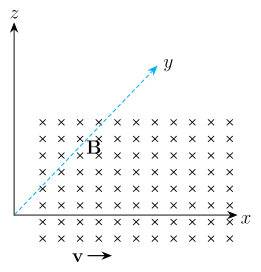
Q.If the magnetic field is parallel to the positive y-axis and the charged particle is moving along the positive x-axis (Fig. 4.4), which way would the Lorentz force be for
🔒You're viewing a preview — the full solution, concept, methods & PYQ mapping are locked.
🔒 Start your 14-day free trial to unlock the full solution →Concept understanding — Charged Particle in Magnetic Field
Charged Particle in a Magnetic Field
When a charged particle moves through a magnetic field, the field grabs it sideways. Unlike an electric field, which can speed a charge up or slow it down, a magnetic field only bends the path — it never changes the particle's speed. Understanding why leads directly to circular and helical motion, the basis of cyclotrons, mass spectrometers and the aurora.
The force: always sideways
A particle of charge q moving with velocity v in a magnetic field B feels the magnetic (Lorentz) force:
F=q(v×B)
Because of the cross product, F is perpendicular to both v and B. Its magnitude is
F=∣q∣vBsinθ
where θ is the angle between v and B.
Since F⊥v, the force does no work: F⋅v=0. Therefore the kinetic energy and the speed stay constant — the field only changes the direction of motion, never the magnitude.
Case 1: velocity perpendicular to the field → a circle
If v⊥B (θ=90∘), the force F=qvB stays constant in size and always points toward one central point. That is exactly the condition for uniform circular motion, with the magnetic force acting as the centripetal force:
qvB=rmv2
Solving for the radius:
r=qBmv
The time period of one revolution is
T=v2πr=qB2πm
The period T (and the frequency f=qB/2πm, the cyclotron frequency) does not depend on the speed or the radius. A faster particle traces a bigger circle but takes exactly the same time per loop. This speed-independence is what makes the cyclotron work.
Case 2: velocity at an angle → a helix
If v makes an angle θ with B, split it into two parts:
- Perpendicular component v⊥=vsinθ — feels the magnetic force and drives circular motion of radius r=qBmv⊥.
- Parallel component v∥=vcosθ — feels no force (since v∥×B=0) and carries the particle steadily along the field line.
Combining a circle with a steady drift gives a helix. The distance advanced along the field in one full turn is the pitch:
p=v∥T=vcosθ⋅qB2πm
A quick example
An electron (m=9.1×10⁻³¹ kg, q=1.6×10⁻¹⁹ C) enters a 0.02 T field at 106 m/s, perpendicular to B:
r=qBmv=(1.6×10⁻¹⁹)(0.02)(9.1×10⁻³¹)(106)≈2.8×10⁻⁴ m …
Why this formula?
Charged Particle in a Magnetic Field — Why the Key Formulas Hold
Let's build this from first principles. The core idea is that a magnetic field exerts a force only on a moving charge, and that force is always perpendicular to both the velocity and the field.
1. The Fundamental Force Law: Lorentz Force
The starting point is the Lorentz force for a charge q moving with velocity v in a magnetic field B:
Fm=q(v×B)
Why this form?
- Cross product v×B means the force is perpendicular to both v and B.
- Magnitude: Fm=∣q∣vBsinθ, where θ is the angle between v and B.
- Direction: given by the right-hand rule (for positive q).
Key insight: Because Fm⊥v, the magnetic force does no work — it changes only the direction of velocity, not its speed.
2. Circular Motion in a Uniform Magnetic Field
Consider a charge q moving with speed v perpendicular to a uniform B (so θ=90∘, sinθ=1).
Step 1: Force provides centripetal acceleration
The magnetic force is the only radial force:
Fm=qvB
This must equal the centripetal force required for circular motion:
Fc=rmv2
Step 2: Equate and solve for r
qvB=rmv2
Cancel one v (assuming v=0):
qB=rmv
Thus:
r=qBmv
This is the radius of the circular path (cyclotron radius).
Why this makes sense:
- Larger mass m → harder to turn → larger r
- Larger charge q or stronger B → stronger force → tighter turn → smaller r
- Faster speed v → more momentum → larger r
3. Angular Frequency (Cyclotron Frequency)
From the circular motion relation:
ω=rv
Substitute r=qBmv:
ω=qBmvv=mqB
Thus:
ωc=mqB
Why this is remarkable:
- ωc is independent of speed v — all particles with same q/m have the same angular frequency, regardless of how fast they move.
- This is the principle behind cyclotrons (particle accelerators).
4. General Motion: Helical Path …
The key idea is the Lorentz force F=q(v×B). The direction of the force depends on the sign of the charge q.
Step 1: The magnetic field B is along +y, and the velocity v is along +x. Using the right-hand rule for v×B: point fingers along +x, curl them toward +y. The thumb points along +z (upward). This is the direction of the force for a positive charge.
Step 2: For a proton (q>0), the force is directly along +z (upward). …
The Lorentz force direction is given by F=q(v×B). For a proton (positive q), the force is along +z; for an electron (negative q), the force is along −z.
The core idea here is the direction of the Lorentz force, set by the cross product v×B together with the sign of the charge. The Lorentz force law tells us that a charged particle moving in a magnetic field experiences a force perpendicular to both its velocity and the field. This perpendicular nature is what makes magnetic forces so elegant (and tricky): they never speed up or slow down a particle, only bend its path.
For this problem, we have:
- B along +y (positive y-axis)
- v along +x (positive x-axis)
- Two cases: q=+e (proton) and q=−e (electron)
The right-hand rule (or the cross product) gives the direction of v×B, and then the sign of q decides whether the force is along that direction or opposite to it.
-
Find the direction of v×B
Using the right-hand rule: point fingers along v (positive x), curl them toward B (positive y). Your thumb points along +z (upward).
Mathematically: x^×y^=z^, so v×B points along +z.
-
Apply the Lorentz force law
The force is F=q(v×B).
- For a proton (q=+e): F=+e(along +z), so the force is along +z.
- For an electron (q=−e): F=−e(along +z), so the force is along −z. …
Method: Right-Hand Rule (for Lorentz Force)
This is a vector cross-product problem:
F=q(v×B)
Steps
-
Identify the directions
- B is along +y
- v is along +x
- For a positive charge, use the right hand directly
- For a negative charge, reverse the direction
-
Apply the right-hand rule for positive charge
- Point fingers of right hand along v (+x)
- Curl fingers toward B (+y)
- Thumb points along v×B → +z direction (out of page)
-
Adjust for sign of charge
- Proton (q>0): force is along +z (out of page)
- Electron (q<0): force is opposite → −z (into page)
Final Answer
| Particle | Charge | Force direction | …
Here are the common mistakes students make when solving this Magnetic Force Balance problem, along with how to avoid each.
Mistake 1: Using the wrong hand rule for the charge sign
The error:
Students often use the right-hand rule for both positive and negative charges without flipping the direction for negative charges.
How to avoid:
- For a positive charge (proton): Use the right-hand rule. Point fingers along velocity (+x), curl them toward magnetic field (+y), thumb gives force direction (+z).
- For a negative charge (electron): Use the right-hand rule to find the direction for a positive charge, then reverse it.
- Alternatively, use the left-hand rule directly for negative charges.
Key result:
- Proton: force along +z (out of page).
- Electron: force along −z (into page).
Mistake 2: Forgetting the cross product order
The error:
Writing F=q(B×v) instead of the correct F=q(v×B).
How to avoid:
- Memorise: Lorentz force is F=q(v×B).
- The cross product v×B is not the same as B×v — they give opposite directions.
- Use the right-hand rule with velocity first, then magnetic field.
Mistake 3: Misidentifying the coordinate axes
The error:
Confusing which axis is x, y, or z, especially in 3D diagrams.
How to avoid:
- Draw a clear 3D coordinate system before starting.
- Standard convention:
- +x: right
- +y: up
- +z: out of the page (toward you)
- In this problem:
- Velocity: +x (right)
- Magnetic field: +y (up)
- Force: +z (out of page) for positive charge.
Mistake 4: Ignoring the charge sign when applying the right-hand rule
The error:
Applying the right-hand rule and forgetting to reverse the thumb direction for a negative charge.
How to avoid:
- Always first find the force direction for a positive charge using the right-hand rule.
- Then, if the charge is negative, simply reverse that direction.
- This two-step method prevents sign errors.
--- …
Showing the 12 most recent of 25 on this concept.
- AP EAPCET 2026Set eng-2026-05-12-FN1 markMCQQ.A proton with energy 2 MeV is moving perpendicular to a uniform magnetic field of 2.5 tesla. The force on the proton is (mass of proton is 1.66×10⁻²⁷ kg) (A) 2.5×10⁻¹⁰ N (B) 7.8×10⁻¹¹ N (C) 2.5×10⁻¹¹ N (D) 7.8×10⁻¹² N
›Reveal solutionSolution
This tests the magnetic Lorentz force on a moving charge, after first extracting speed from kinetic energy; the force is ≈7.8×10⁻¹² N.
Concept and Intuition
The magnetic force on a charge moving perpendicular to a field is F=qvB (maximum, since sin90∘=1). The only extra step here is that the speed isn't given directly — it must be extracted from the kinetic energy using KE=21mv2, converting MeV to joules first.
Step-by-Step Solution
- Convert energy: KE=2 MeV=2×1.6×10−13 J=3.2×10⁻¹³ J.
- Solve for speed: v=m2KE=1.66×10−272×3.2×10−13=3.855×10¹⁴≈1.9635×10⁷ m/s.
- Since the proton moves perpendicular to B, the force is maximum: F=qvB. …
- AP EAPCET 2026Set eng-2026-05-14-AN1 markMCQQ.A charged particle moves in a region where there is a uniform electric field E=2×10³i^ NC−1 and a uniform magnetic field B=5×10⁻²j^ T. The velocity of the particle (in ms−1), if the particle moves without any acceleration. (A) 5×10⁴k^ (B) 2×10³k^ (C) 4×10⁴k^ (D) 4×10⁴(−k^)
›Reveal solutionSolution
This is the classic velocity-selector condition — zero net force means the electric and magnetic forces exactly cancel, fixing both the speed (v=E/B) and the direction of v.
Concept and Intuition
A charged particle experiences zero acceleration only when the total force is zero. Here the forces are electric (qE) and magnetic (qv×B). For these to cancel exactly (for any nonzero charge), their magnitudes must match and their directions must be opposite. This is exactly the working principle of a velocity selector — only particles with a specific speed v=E/B pass through undeflected, regardless of charge magnitude.
Step-by-Step Solution
- Balance condition: qE+q(v×B)=0⇒v×B=−E.
- Magnitude: vB=E⇒v=BE=5×10−22×103=4×10⁴m/s. …
- AP EAPCET 2026Set eng-2026-05-18-FN1 markMCQQ.A charged particle is moving parallel to a uniform magnetic field. Then the force on the charged particle (A) qvB (B) qvB (C) qv2B (D) zero
›Reveal solutionSolution
The magnetic force on a moving charge is F=qvBsinθ; when velocity is parallel to B, the angle between them is zero, so the force vanishes. Answer: zero.
Concept and Intuition
The magnetic Lorentz force is F=qv×B, whose magnitude is qvBsinθ, where θ is the angle between velocity and field. This is a cross product, and cross products of parallel (or anti-parallel) vectors are always zero — there is no component of velocity perpendicular to B to generate a deflecting force.
Step-by-Step Solution
- Force law: F=qvBsinθ.
- "Moving parallel to the field" means the angle between v and B is θ=0∘. …
- AP EAPCET 2025Set eng-2025-05-21-FN1 markMCQQ.A velocity selector is to be constructed to select ions with a velocity of 6 kms−1. If the electric field used is 400 Vm−1, then the magnetic field to be used is (A) 2011 T (B) 32 T (C) 151 T (D) 152 T
›Reveal solutionSolution
This tests the velocity selector principle: crossed electric and magnetic fields let through only one speed. Answer: B=151 T.
Concept and Intuition
In a velocity selector, an electric field and a magnetic field are arranged perpendicular to each other and to the ion's velocity, so the electric force qE and magnetic force qvB act in opposite directions. Only ions moving at the exact speed where these forces balance pass through undeflected: qE=qvB⇒v=BE.
Step-by-Step Solution
- Balance condition: v=BE⇒B=vE.
- Convert velocity: v=6 km/s=6000 m/s. …
- AP EAPCET 2025Set ap-2025-05-20-FN1 markMCQQ.When an electron accelerated from rest through a potential difference V1 enters a uniform magnetic field, the maximum force on it is F. If the potential difference is changed to V2, then the maximum force on the electron in the same magnetic field is 4F, then V2V1= (A) 1 : 4 (B) 4 : 1 (C) 2 : 1 (D) 1 : 16
›Reveal solutionSolution
The maximum magnetic force on a charge scales with its speed, and speed scales with the square root of the accelerating voltage; a 4-fold force increase means a 16-fold voltage increase, so V1:V2=1:16.
Concept and Intuition
When a charge is accelerated from rest through a potential difference V, all the electrical work goes into kinetic energy: qV=21mv2, so v=2qV/m — speed grows only as the square root of the voltage. Once in a uniform magnetic field, the maximum magnetic force (when velocity is perpendicular to B) is Fmax=qvB, which is directly proportional to v, and hence to V.
Step-by-Step Solution
- Speed after acceleration through V1: v1=2qV1/m, giving force F=qv1B.
- Speed after acceleration through V2: v2=2qV2/m, giving force 4F=qv2B. …
- AP EAPCET 2025Set eng-2025-05-26-AN1 markMCQQ.If a proton of kinetic energy 8.35 MeV enters a uniform magnetic field of 10 T at right angles to the direction of the field, then the force acting on the proton is (Mass of proton =1.67×10⁻²⁷ kg and charge of proton =1.6×10⁻¹⁹ C) (A) 48×10−12 N (B) 16×10−12 N (C) 64×10−12 N (D) 32×10−12 N
›Reveal solutionSolution
This tests converting kinetic energy to speed and then applying the magnetic Lorentz force F=qvB for a charge moving perpendicular to B; the answer is 64×10−12 N.
Concept and Intuition
A charged particle moving at right angles to a uniform magnetic field feels a force F=qvBsinθ=qvB (since θ=90∘). To use this we first need the proton's speed, which we get from its kinetic energy.
Step-by-Step Solution
- Convert kinetic energy to joules using the proton charge as the eV-to-J factor: KE=8.35×1.6×10−13J=1.336×10⁻¹² J.
- From KE=21mv2: v=m2KE=1.67×10−272×1.336×10−12=1.60×10¹⁵≈4.0×10⁷ m/s. …
- AP EAPCET 2024Set eng-2024-05-18-FN1 markMCQQ.An electron is moving with a velocity (2iˉ+3jˉ) ms−1 in an electric field (3iˉ+6jˉ+2kˉ) Vs−1 and a magnetic field of (2jˉ+3kˉ) T. Then the magnitude and direction (with x-axis) of the Lorentz force acting on the electron is (A) 9.6×10⁻¹⁹ N, θ=cos−1(52) (B) 9.6×10⁻¹⁹ N, θ=cos−1(25) (C) 2.15×10⁻¹⁸ N, θ=cos−1(52) (D) 2.15×10⁻¹⁸ N, θ=cos−1(25)
›Reveal solutionSolution
Computing v×B and adding E gives the net field vector (12,0,6) V/m; its magnitude times e gives 2.15×10⁻¹⁸ N at cos−1(2/5) from the x-axis.
Concept and Intuition
The Lorentz force is F=q(E+v×B). We compute the cross product component-wise, add the electric field, then find magnitude and direction of the resultant.
Step-by-Step Solution
- v×B with v=(2,3,0), B=(0,2,3):
v×B=(3⋅3−0⋅2, 0⋅0−2⋅3, 2⋅2−3⋅0)=(9,−6,4)
- Add E=(3,6,2): E+v×B=(12,0,6).
- Magnitude: ∣F-field∣=122+02+62=180=65.
- Force: F=e×65=1.6×10−19×13.42≈2.15×10⁻¹⁸ N. …
- AP EAPCET 2024Set eng-2024-05-21-AN1 markMCQQ.A proton and an alpha particle moving with energies in the ratio 1:4 enter a uniform magnetic field of 3T at right angles to the direction of magnetic field. The ratio of the magnetic forces acting on the proton and the alpha particle is (A) 1:2 (B) 1:4 (C) 2:3 (D) 1:3
›Reveal solutionSolution
Express the magnetic force in terms of kinetic energy (not just charge and mass separately), then substitute the known charge/mass/energy ratios for proton and alpha. Answer: 1:2.
Concept and Intuition
The magnetic force on a charged particle moving perpendicular to a field is F=qvB. Since we're given kinetic energies rather than speeds, it helps to write v=2KE/m and substitute, so that F=qB2KE/m.
Step-by-Step Solution
- Proton: charge qp=e, mass mp, kinetic energy K.
- Alpha particle: charge qα=2e, mass 4mp, kinetic energy 4K (given ratio 1:4).
- Fp=eBmp2K.
- Fα=2eB4mp2(4K)=2eBmp2K. …
- AP EAPCET 2024Set eng-2024-05-21-AN1 markMCQQ.A charged particle moving along a straight line path enters a uniform magnetic field of 4 mT at right angles to the direction of the magnetic field. If the specific charge of the charged particle is 8×10⁷ Ckg−1, the angular velocity of the particle in the magnetic field is (A) 64×104 rads−1 (B) 32×104 rads−1 (C) 16×104 rads−1 (D) 48×104 rads−1
›Reveal solutionSolution
Cyclotron angular frequency depends only on the specific charge (charge-to-mass ratio) and the field strength. Answer: 32×104 rad/s.
Concept and Intuition
When a charged particle moves perpendicular to a uniform magnetic field, it moves in a circle with angular velocity ω=mqB. This is independent of the particle's speed or the radius of its path — it depends only on the specific charge q/m and the field B.
Step-by-Step Solution
- Specific charge: q/m=8×107 Ckg−1.
- Field: B=4 mT=4×10⁻³ T. …
- AP EAPCET 2024Set eng-2024-05-21-FN1 markMCQQ.When an electron placed in a uniform magnetic field is accelerated from rest through a potential difference V1, it experiences a force F. If the potential difference is changed to V2, the force experienced by the electron in same magnetic field is 2F, then the ratio of potential differences V2/V1 is (A) 2:1 (B) 1:4 (C) 4:1 (D) 1:2
›Reveal solutionSolution
Speed after acceleration scales as V, and magnetic force scales linearly with speed, so force scales as V; doubling the force means quadrupling the potential difference.
Concept and Intuition
Accelerating the electron through a potential difference converts electrical PE into KE: qV=21mv2, so v=2qV/m — speed grows only as the square root of the accelerating voltage. Once moving in the magnetic field, the magnetic (Lorentz) force is F=qvB, which is directly proportional to speed v (with q, B fixed). Chaining these two proportionalities, F∝V.
Step-by-Step Solution
- From energy: v=m2qV⇒v∝V.
- Magnetic force: F=qvB∝v∝V.
- Given F2=2F1: F1F2=V1V2=2. …
- AP EAPCET 2023Set ap-2023-05-22-AN1 markMCQQ.An electron moving along positive x-direction with velocity 2×10⁵ ms−1, enters a magnetic field of B=(i^+4j^+3k^) T. The magnitude of the force acting on the electron is (A) 1.6×10¹³ N (B) 1.6×10⁻¹³ N (C) 1.6×10⁻¹⁴ N (D) 1.6×10⁻³ N
›Reveal solutionSolution
Computing v×B for the given vectors gives a magnitude of 5v; multiplying by the electron charge yields a magnetic force of 1.6×10⁻¹³ N.
Concept and Intuition
A charged particle moving through a magnetic field experiences the Lorentz magnetic force F=qv×B, whose magnitude depends only on the component of velocity perpendicular to B. Direct vector cross-product computation is the cleanest way to handle a B with multiple non-zero components.
Step-by-Step Solution
- Write v=2×10⁵i^ m/s (only x-component) and B=i^+4j^+3k^ T.
- Compute v×B=i^v1j^04k^03=i^(0⋅3−0⋅4)−j^(v⋅3−0⋅1)+k^(v⋅4−0⋅1)=(0,−3v,4v).
- Magnitude: ∣v×B∣=v32+42=v×5=2×105×5=1×10⁶ (in SI units, this is m/s⋅T).
- Force magnitude: F=∣q∣∣v×B∣=1.6×10−19×106=1.6×10⁻¹³ N.
- This matches option (B).
Common Mistakes …
- AP EAPCET 2023Set ap-2023-05-23-AN1 markMCQQ.If the magnetic field is along the positive y-axis and the electron is moving along the positive x-axis, the direction of force on the electron is (A) along -y axis (B) along +y axis (C) along +z axis (D) along -z axis
›Reveal solutionSolution
Using F=qv×B with v along +x, B along +y, and the electron's negative charge, the force points along −z.
Concept and Intuition
The magnetic (Lorentz) force on a moving charge is F=qv×B. The cross product direction is found from the right-hand rule, and then the sign of the charge flips the direction if the charge is negative (as for an electron).
Step-by-Step Solution
- v=vx^, B=By^.
- v×B=vB(x^×y^)=vBz^. …
🎓Unlock everything free for 14 days
- ✓Full step-by-step solutions
- ✓Concept-first explanations
- ✓Methods, shortcuts & mistakes
- ✓PYQ mapping + timed mock tests
Full access for 14 days. No credit card required.