Q.Two charged particles traverse identical helical paths in a completely opposite sense in a uniform magnetic field B=B0k^.
Concept understanding — Cyclotron Motion Radius
Cyclotron Motion Radius – From Intuition to Formula
Imagine you're pushing a charged ball on a frictionless table, and there's a giant magnet underneath. The moment that ball starts moving, the magnet doesn't pull it or push it forward — it turns it. The force from the magnet always acts sideways, perpendicular to the ball's velocity. So the ball never speeds up or slows down; it just keeps changing direction. If the magnetic field is uniform and the ball keeps moving, it will trace out a perfect circle.
That circle is called cyclotron motion, and the radius of that circle is what we're after.
Why does it curve at all?
The magnetic force on a moving charge is given by:
F=q(v×B)
The cross product means the force is always perpendicular to both the velocity v and the magnetic field B. For a charge moving perpendicular to a uniform field, this force acts as a centripetal force — it constantly pulls the charge toward the centre of a circle, without doing any work (since force is perpendicular to displacement).
So the charge moves in uniform circular motion. The magnetic force provides the necessary centripetal acceleration.
Deriving the radius
For circular motion, the centripetal force required is:
Fcentripetal=rmv2
where m is the mass of the particle, v is its speed, and r is the radius of the circle.
The magnetic force (for v⊥B) has magnitude:
FB=∣q∣vB
Set them equal:
∣q∣vB=rmv2
Cancel one factor of v (assuming v=0):
∣q∣B=rmv
Solve for r:
r=∣q∣Bmv
That's the cyclotron motion radius (also called the Larmor radius or gyroradius).
What the formula tells you
- Faster particle → larger radius (it's harder to turn something moving fast).
- Heavier particle → larger radius (more inertia resists the turn).
- Stronger magnetic field → smaller radius (the turning force is stronger).
- Larger charge → smaller radius (more force for the same field).
If the particle's velocity has a component parallel to B, it doesn't feel any magnetic force in that direction. So the particle moves in a helix — circular motion in the plane perpendicular to B, plus constant speed along B. The radius formula above still applies using only the perpendicular component of velocity, v⊥.
A quick example
A proton (m=1.67×10⁻²⁷ kg, q=1.6×10⁻¹⁹ C) moves at 2.0×10⁶ m/s perpendicular to a 0.50 T magnetic field.
r=(1.6×10⁻¹⁹)(0.50)(1.67×10⁻²⁷)(2.0×10⁶)=8.0×10−203.34×10−21=0.042 m
So the proton circles with a radius of about 4.2 cm.
Common mistake to avoid
The formula r=∣q∣Bmv uses the speed v, not velocity. And it assumes the velocity is perpendicular to B. If there's a parallel component, use only v⊥ in the numerator. The parallel component doesn't affect the radius — it just carries the particle along the field line.
Why "cyclotron"?
The name comes from the cyclotron, a particle accelerator that uses this exact principle. Particles spiral outward in a magnetic field, gaining energy from an alternating electric field each half-turn. The radius increases as the particle speeds up — exactly what the formula predicts.
Queries like "cyclotron radius formula derivation" and "moving charges and magnetism class 12 physics" are common, since this result comes straight from the Moving Charges and Magnetism chapter of the NCERT/CBSE Class 12 Physics curriculum. It's also a standard numerical-question type in JEE Main and NEET on charged-particle motion in magnetic fields.
The two particles trace identical helices (same radius r=mv⊥/∣q∣B0 and same pitch p=v∥T, with T=2πm/∣q∣B0) but in completely opposite sense.
- The sense of gyration is fixed only by the sign of the charge, so opposite sense means the two charges are opposite in sign.
- Both r and T depend on m,q only through ∣q∣/m (the cyclotron frequency ω=∣q∣B0/m), so identical path shape requires ∣q1∣/m1=∣q2∣/m2.
- Combining opposite sign with equal magnitude: (me)1=−(me)2.
Equal z-momenta (a), equal charges (b), and a forced particle-antiparticle pair (c) are not implied by this - only the reciprocal charge-to-mass relation is.
Only option (d) is necessarily true: (me)1+(me)2=0.
Matching helical paths in opposite sense forces the two particles' charge-to-mass ratios to be equal in magnitude but opposite in sign - this is exactly option (d): (e/m)1+(e/m)2=0.
Setting up the helix
For a charged particle of mass m, charge q, moving in B=B0k^, split the velocity into v⊥ (perpendicular to B) and v∥ (along B). The perpendicular part gives circular motion:
r=∣q∣B0mv⊥,T=∣q∣B02πm
and the parallel part carries the particle steadily along the field, giving a helix of pitch
p=v∥T=∣q∣B02πmv∥.
Same shape, opposite sense
"Identical helical paths" means the two particles trace the same radius r and the same pitch p. The sense of rotation (clockwise or anticlockwise, viewed along B) is fixed entirely by the sign of the charge - a positive charge circulates one way, a negative charge the other way, for the same B. "Completely opposite sense" therefore means the two charges have opposite sign.
Both r and T (and hence p) are governed by the single combination ∣q∣/m, through the cyclotron angular frequency ω=∣q∣B0/m. For the two particles to trace geometrically identical helices in this same field, this angular frequency must be the same for both:
m1∣q1∣=m2∣q2∣.
Combine this with the opposite sign of the charges: writing e/m for the signed charge-to-mass ratio of each particle,
m1q1=−m2q2⟹(me)1+(me)2=0.
This is exactly stem option (d).
Why the other options are not forced
- (a) equal z-components of momenta: the pitch condition fixes v∥ to be the same for both particles once ∣q∣/m is matched, but the mass m need not be the same - so pz=mv∥ need not be equal.
- (b) equal charges: the charges must be opposite in sign, so, other than the trivial case q=0, they cannot be equal.
- (c) a particle-antiparticle pair: this would additionally require the two masses to be exactly equal, which is not implied - any two species with the same ∣q∣/m magnitude and opposite charge sign satisfy the condition, not only a particle and its antiparticle.
Only option (d) is necessarily true: (me)1+(me)2=0 - the charge-to-mass ratios are equal in magnitude and opposite in sign.
Method: Comparing Two Charged Particles' Helical Paths in a Uniform Field
Whenever a problem describes two (or more) charged particles tracing helices in the same field and asks what must be true of their charges/masses, the technique is to write each particle's path parameters symbolically and match them term by term.
Steps
Step 1: Write the three helix parameters for a general particle
For a particle of mass m, charge magnitude ∣q∣, in field B=B0k^, split velocity into v⊥ and v∥:
r=∣q∣B0mv⊥,T=∣q∣B02πm,p=v∥T
Notice r and T (and therefore p) depend on the particle's charge and mass only through the single combination ∣q∣/m (equivalently, the cyclotron frequency ω=∣q∣B0/m).
Step 2: Translate "identical path shape" into an equation
"Identical helices" means both particles have the same r, T, and p in the same B. Since these depend only on ∣q∣/m (and on v⊥,v∥, which the problem may or may not force equal), matching path shape between particle 1 and particle 2 gives:
m1∣q1∣=m2∣q2∣
Step 3: Translate "opposite sense" into a sign condition
The rotational sense (clockwise vs anticlockwise, viewed along B) is fixed purely by the sign of the charge -- it does not depend on mass, speed, or radius. "Completely opposite sense" therefore forces the two charges to have opposite sign.
Applying to this problem: combine the magnitude condition from Step 2 with the opposite-sign condition from Step 3 -- a same-magnitude, opposite-sign charge-to-mass ratio is exactly (e/m)1+(e/m)2=0. Check each remaining option (equal momenta, equal charges, particle-antiparticle pair) against only what Steps 2-3 actually proved, not against extra assumptions the problem never stated.
Showing the 12 most recent of 15 on this concept.
- AP EAPCET 2026Set eng-2026-05-13-FN1 markMCQQ.A proton and a deuteron, both having the same kinetic energy, enter perpendicularly into a uniform magnetic field B. For motion of proton and deuteron on circular path of radius Rp and Rd respectively, the correct statement is (A) Rd=2Rp (B) Rd=2Rp (C) Rd=Rp (D) Rd=2Rp
›Reveal solutionSolution
Same kinetic energy, same charge, different mass: the circular-motion radius scales as m, so the deuteron's radius is 2 times the proton's.
Concept and Intuition
A charged particle moving perpendicular to a magnetic field B travels in a circle of radius R=qBmv, from balancing the magnetic force against the centripetal requirement (qvB=mv2/R). When particles share the same kinetic energy K=21mv2 rather than the same speed, it's more useful to write momentum as p=mv=2mK, giving
R=qB2mK.
So for fixed K and B, R∝m/q. The deuteron (one proton + one neutron) has essentially twice the proton's mass but the same charge magnitude +e, so its radius scales up by 2 relative to the proton's.
Step-by-Step Solution
- Rp=eB2mpK, Rd=eB2mdK (same K, same B, same charge magnitude e for both).
- Ratio: RpRd=mpmd.
- md≈2mp, so RpRd=2.
- Rd=2Rp.
Common Mistakes
- Using R=mv/(qB) directly with "same v" instead of "same K" — the problem states equal kinetic energy, not equal speed, which changes the mass-dependence from linear to a square-root.
- Forgetting the deuteron's charge is the same as the proton's (not doubled) even though its mass is doubled.
✓Final answerThe correct option is (A) — Rd=2Rp.
ANSWER: A
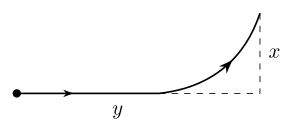
- AP EAPCET 2026Set eng-2026-05-15-FN1 markMCQQ.A particle having charge 'q' enters a uniform transverse magnetic field B. It is deflected through a distance 'x' while travelling a distance 'y' as shown in figure. The magnitude of the momentum of the particle is [FIGURE: a particle enters horizontally from the left travelling distance y, then curves upward on a parabolic-like path, being deflected a vertical distance x] (A) 2qB[y2+x2] (B) xqBy2 (C) 2qB[xy2+x] (D) 2xqBy2
›Reveal solutionSolution
A charged particle deflects along a circular arc in a transverse field; eliminating the turn-angle between the deflection x and the along-path distance y gives the orbit radius, hence the momentum. Answer: (C).
Concept and Intuition
A charged particle moving perpendicular to a uniform B travels on a circular arc of radius R=qBmv=qBp. The two measured quantities x (deflection) and y (distance travelled before that deflection) are just the sagitta and chord-projection of this same circle, so geometry alone fixes R in terms of x and y — no need to assume x≪y.
Step-by-Step Solution
- Put the entry point at the origin with the initial velocity along the +y′ (horizontal) direction. The particle's path is a circular arc of radius R.
- After the velocity vector has turned through angle θ, the coordinates on the circle are y=Rsinθ (distance travelled along the original direction) and x=R(1−cosθ) (perpendicular deflection).
- From these: Rcosθ=R−x and Rsinθ=y. Squaring and adding: y2+(R−x)2=R2.
- Expand: y2+R2−2Rx+x2=R2⇒y2+x2=2Rx⇒R=2xx2+y2.
- Momentum: p=qBR=2qB(x+xy2)=2qB[xy2+x].
Common Mistakes
- Assuming the small-deflection approximation x≈2Ry2 and dropping the x term entirely — that only works when x≪y; the exact geometric relation keeps both terms.
- Confusing which of x,y is the chord-direction distance and which is the deflection.
✓Final answerThe correct option is (C) — 2qB[xy2+x].
ANSWER: C
- AP EAPCET 2025Set eng-2025-05-23-FN1 markMCQQ.If a charged particle enters a uniform magnetic field normally with certain velocity, then the time period of revolution of the particle (A) decreases with increase of velocity of the particle (B) increases with increase of radius of the orbit (C) increases with increase of magnetic field (D) decreases with increase of specific charge of the particle
›Reveal solutionSolution
The cyclotron period T=2πm/(qB) depends only on the specific charge q/m and the field B — never on the particle's speed or the orbit radius.
Concept and Intuition
When a charged particle enters a magnetic field perpendicular to its velocity, the magnetic force provides centripetal force: qvB=rmv2, giving r=qBmv. The period is T=v2πr=qB2πm. Notice v cancels out completely — a faster particle moves in a larger circle, and the two effects exactly compensate so that the time to complete one revolution stays the same. This is the basis of the cyclotron's fixed-frequency operation.
Step-by-Step Solution
- Write T=qB2πm=(q/m)B2π.
- Velocity dependence: T has no v in it at all, so option (A) — "decreases with increase of velocity" — is false; T is unchanged.
- Radius dependence: since r=mv/(qB), a larger radius (at fixed B, q/m) simply means a proportionally larger v; T still stays constant. Option (B) is false.
- Magnetic field dependence: T∝1/B, so T decreases, not increases, as B increases. Option (C) is false.
- Specific charge dependence: T∝1/(q/m). As the specific charge q/m increases, T decreases. This matches option (D).
Common Mistakes
- Assuming a larger radius must mean a longer period, forgetting that radius and speed increase together and cancel in T.
- Sign-flipping the field dependence (thinking T increases with B instead of decreasing).
✓Final answerThe correct option is (D) — decreases with increase of specific charge of the particle.
ANSWER: D
- AP EAPCET 2025Set ap-2025-05-19-AN1 markMCQQ.If the operating magnetic field in a cyclotron for accelerating protons is 668 mT, then the angular frequency of the oscillator of the cyclotron is (Charge of proton =1.6×10⁻¹⁹ C and mass of proton =1.67×10⁻²⁷ kg) (A) 9.6×10⁷ rad s−1 (B) 3.2×10⁷ rad s−1 (C) 12.8×10⁷ rad s−1 (D) 6.4×10⁷ rad s−1
›Reveal solutionSolution
The cyclotron's operating angular frequency is simply the charged particle's cyclotron frequency ω=qB/m, which comes out to 6.4×10⁷ rad/s for a proton in a 668 mT field.
Concept and Intuition
Inside a cyclotron, a charged particle moving in a magnetic field experiences the magnetic force as the centripetal force for circular motion: qvB=rmv2, which rearranges to v/r=ω=qB/m. Remarkably, this angular frequency (the "cyclotron frequency") doesn't depend on the particle's speed or the radius of its path — that's exactly what makes the cyclotron work, since the oscillator driving the accelerating voltage can run at a single fixed frequency throughout the whole spiral.
Step-by-Step Solution
- ω=mqB, with q=1.6×10⁻¹⁹ C, B=668 mT=0.668 T, m=1.67×10⁻²⁷ kg.
- Numerator: qB=1.6×10−19×0.668=1.0688×10⁻¹⁹.
- ω=1.67×10−271.0688×10⁻¹⁹≈6.4×10⁷ rad/s.
Common Mistakes
- Confusing angular frequency ω (rad/s) with cyclic frequency f (Hz), which would require an extra 2π factor.
- Forgetting to convert the field from millitesla to tesla before substituting.
✓Final answerThe correct option is (D) — 6.4×10⁷ rad s−1.
ANSWER: D
- AP EAPCET 2025Set ap-2025-05-20-AN1 markMCQQ.If an electron and a proton enter normally into a uniform magnetic field with equal kinetic energies, then (A) the electron travels in circular path of less radius. (B) the proton travels in circular path of less radius. (C) both electron and proton travel in circular paths of same radius. (D) both electron and proton travel in straight line path.
›Reveal solutionSolution
With equal kinetic energy, the lighter particle (electron) has a smaller circular radius in a magnetic field because radius scales with m.
Concept and Intuition
The magnetic force provides centripetal force: qvB=rmv2⇒r=qBmv=qBp. Expressing momentum in terms of kinetic energy, p=2mKE, so r=qB2mKE. For the same KE and charge magnitude, r∝m.
Step-by-Step Solution
- r=qB2mKE.
- For equal KE and equal ∣q∣ (electron and proton have the same charge magnitude) and the same B: r∝m.
- melectron≪mproton, so relectron≪rproton.
- Hence the electron travels in a circle of smaller radius.
Common Mistakes
- Assuming equal momentum (not equal KE) is given, which would instead make the radii equal.
- Forgetting both particles do curve (not travel straight), since they enter "normally" (perpendicular) to B.
✓Final answerThe correct option is (A) — the electron travels in circular path of less radius.
ANSWER: A
- AP EAPCET 2025Set eng-2025-05-24-FN1 markMCQQ.Two charged particles of specific charges in the ratio 2:1 and masses in the ratio 1:4 moving with same kinetic energy enter a uniform magnetic field at right angles to the direction of the field. The ratio of the radii of the circular paths in which the particles move under the influence of the magnetic field is (A) 2:1 (B) 1:1 (C) 4:1 (D) 8:1
›Reveal solutionSolution
Expressing the cyclotron radius in terms of specific charge and mass for equal kinetic energies shows the two particles trace circles of exactly equal radius, i.e. ratio 1:1.
Concept and Intuition
For a charged particle moving in a uniform magnetic field, the radius of its circular path is r=qBmv. Since kinetic energy (not speed) is given as equal here, it's cleanest to eliminate v using KE=21mv2⇒v=2KE/m, so r ends up depending on mass and specific charge q/m in a particular combined way — not simply on mass or charge alone.
Step-by-Step Solution
- Write r=qBmv and substitute v=m2KE: r=qBmm2KE=qB2KEm.
- Since KE and B are the same for both particles, r∝qm.
- Rewrite using specific charge s=q/m: q=sm, so r∝smm=sm1.
- r2r1=1/(s2m2)1/(s1m1)=s1m1s2m2.
- With s1:s2=2:1 (so s1=2, s2=1) and m1:m2=1:4 (so m1=1, m2=4): r2r1=2×11×4=2×11×2=1.
Common Mistakes
- Using r∝m/q (valid for equal speed, not equal kinetic energy) — this is the classic trap in this exact question style.
- Forgetting to take the square root of the mass ratio when converting KE to speed.
✓Final answerThe correct option is (B) — 1:1.
ANSWER: B
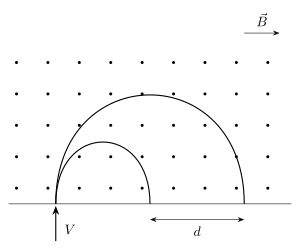
- AP EAPCET 2024Set ap-2024-05-17-FN1 markMCQQ.Two charged particles of same charge but different masses m1 and m2 are projected with the same velocity V normally into the uniform magnetic field B as shown in figure. The maximum separation of the particles is [FIGURE] (a region of uniform magnetic field shown as dots coming out of the page (field B); two charged particles enter from the bottom with velocity V directed upward and follow two different semicircular/parabolic paths of different radii inside the field, emerging at the top separated by a horizontal distance d) (A) ∣qB∣∣(m2−m1)V∣ (B) ∣2qB∣∣(m2−m1)V∣ (C) ∣qB∣∣2(m2−m1)V∣ (D) ∣4qB∣∣(m2−m1)V∣
›Reveal solutionSolution
The maximum separation between the two particles is twice the difference in their cyclotron radii, because each follows a semicircular path in the magnetic field. The correct expression is ∣qB∣2∣(m2−m1)V∣, which corresponds to option (C).
Concept and Intuition
When a charged particle moves perpendicular to a uniform magnetic field, it experiences a magnetic force that is always perpendicular to its velocity. This force provides the centripetal force for circular motion. The radius of that circle — the cyclotron radius — is given by:
r=∣q∣Bmv
Here, both particles have the same charge q and the same initial speed V, but different masses m1 and m2. So they will follow circular paths of different radii inside the field. Since they enter the field moving straight upward (velocity perpendicular to B), each will trace out exactly a semicircle before exiting the field region. The maximum separation between them occurs at the moment they are farthest apart — which is when they are on opposite sides of their circular paths, i.e., when one is at the far left of its semicircle and the other at the far right. But here, because both start from the same point and curve in the same direction (both bend to the right, as shown in the figure), the maximum separation is simply the difference in the diameters of their semicircular paths.
Step-by-Step Solution
- Determine the radius of each particle's path For a particle of mass m and charge q moving with speed V perpendicular to a uniform magnetic field B, the magnetic force provides the centripetal force:
qVB=rmV2⇒r=qBmV
(We take absolute values; the sign of q determines direction of bending, but both particles have the same sign, so they bend the same way.)
Thus:
r1=∣q∣Bm1V,r2=∣q∣Bm2V
-
Path inside the field is a semicircle
The particles enter from the bottom, moving upward. The magnetic force is always perpendicular to velocity, so they will follow a circular arc. Since they enter at the bottom of the field region and exit at the top, and the field is uniform, each completes exactly half a circle (a semicircle) before leaving. The horizontal displacement from entry point to exit point is equal to the diameter of that circle: 2r.
-
Find the horizontal positions of the exit points
Both start at the same point at the bottom. The lighter particle (smaller mass) has a smaller radius, so it bends more sharply and exits closer to the entry point. The heavier particle has a larger radius, so it sweeps out a wider semicircle and exits farther to the right.
Let the entry point be at x=0. Then:
- Particle 1 exits at x1=2r1
- Particle 2 exits at x2=2r2
-
Maximum separation
The maximum separation between the two particles occurs when they are farthest apart horizontally. Since both follow semicircles that open in the same direction, the farthest horizontal distance between them is simply the difference in their exit positions:
d=∣x2−x1∣=∣2r2−2r1∣=2∣r2−r1∣
- Substitute the radii
d=2∣q∣Bm2V−∣q∣Bm1V=∣q∣B2∣m2−m1∣V
This matches option (C).
Watch outA common mistake is to use the radius difference instead of the diameter difference. The separation is the distance between the two exit points, each of which is a full diameter from the start. So the factor of 2 is essential.
TipIf the particles bent in opposite directions (opposite charges), the maximum separation would be the sum of the diameters. But here both have the same charge, so they bend the same way — hence the difference.
✓Final answerThe correct option is (C).
ANSWER: C
- AP EAPCET 2023Set ap-2023-05-22-AN1 markMCQQ.The radius of the path of a charged particle of mass 'm' and charge 'q' moving with a speed v in a magnetic field B is given by (A) qBmv2 (B) qBmv (C) qB2mπv (D) qB2mv
›Reveal solutionSolution
Equating the magnetic (Lorentz) force to the required centripetal force directly gives the standard cyclotron-radius formula.
Concept and Intuition
A charged particle moving perpendicular to a uniform magnetic field experiences a force qvB that is always perpendicular to its velocity — this makes it move in a circle, with the magnetic force itself supplying the centripetal force needed for that circular path.
Step-by-Step Solution
- Magnetic force: F=qvB.
- Centripetal force required: F=rmv2.
- Equate: qvB=rmv2⇒r=qBmv.
Common Mistakes
- Misremembering the formula with an extra power of v or B (e.g. mv2/qB), which doesn't dimensionally reduce to a radius correctly here.
✓Final answerThe correct option is (B) — qBmv.
ANSWER: B
- AP EAPCET 2023Set ap-2023-05-23-AN1 markMCQQ.To generate the high magnetic fields, the synchrotron uses (A) solenoid only (B) toroid only (C) combination of solenoid and toroid (D) metal dee
›Reveal solutionSolution
A synchrotron needs very high magnetic fields to bend energetic particles around its ring; this is achieved using a combination of solenoid and toroid winding configurations, not either alone.
Concept and Intuition
A solenoid produces a strong, nearly uniform field along its axis but the field outside is weak; a toroid confines the field entirely within its doughnut-shaped core, giving a strong field along a closed loop path. Large accelerators like synchrotrons need very high, well-confined fields over an extended, closed path to bend and focus particle beams — a purpose best served by combining aspects of both configurations rather than using either winding type in isolation.
Step-by-Step Solution
- Solenoid alone: strong field but only along its own axis, does not confine a field around a full ring by itself.
- Toroid alone: confines the field around a closed loop, but a single toroidal geometry doesn't reach the field strengths needed at accelerator scale.
- For a synchrotron's requirements (very high, closed-path magnetic field), a combination of both configurations is used.
Common Mistakes
- Confusing "metal dee" (used in a cyclotron for accelerating electrodes) with the magnetic field configuration of a synchrotron.
✓Final answerThe correct option is (C) — combination of solenoid and toroid.
ANSWER: C
- AP EAPCET 2023Set eng-2023-05-15-AN1 markMCQQ.The magnetic force q [v x B] is (A) parallel to both v and B (B) perpendicular to v (C) perpendicular to both v and B (D) parallel to B
›Reveal solutionSolution
This tests the direction of the magnetic (Lorentz) force; being a cross product, it is perpendicular to both the velocity and the field.
Concept and Intuition
The magnetic force on a charge is defined through the vector (cross) product F=q(v×B). By the very definition of a cross product A×B, the resulting vector is always perpendicular to the plane containing A and B — never parallel to either one (unless the force is zero). Physically this is why a magnetic field can change a charge's direction of motion but never do work on it: the force is always sideways to the velocity.
Step-by-Step Solution
- Write the force law: F=q(v×B).
- By the geometric definition of a cross product, v×B is a vector perpendicular to the plane formed by v and B.
- Hence F is perpendicular to both v and B simultaneously (its direction is found by the right-hand rule, but its perpendicularity to both is guaranteed regardless of their relative angle, as long as v×B=0).
Common Mistakes
- Thinking the force is only perpendicular to v (true but incomplete) or only to B (true but incomplete) — it is perpendicular to both simultaneously, which is the strongest and most complete correct statement among the options.
- Confusing this with the electric force, which is parallel/antiparallel to the field.
✓Final answerThe correct option is (C) — perpendicular to both v and B.
ANSWER: C
- AP EAPCET 2023Set eng-2023-05-17-FN1 markMCQQ.If 'q' is electric charge, B is magnetic field, 'R' is the dee radius and 'm' is the mass of ions, the kinetic energy of the ions in cyclotron is given by (A) 2mqBR (B) mqBR (C) 4πmq2B2R2 (D) 2mq2B2R2
›Reveal solutionSolution
Balancing magnetic force with centripetal force gives the ion's speed at the dee radius; squaring and substituting into KE=21mv2 gives 2mq2B2R2.
Concept and Intuition
In a cyclotron, charged ions move in circular arcs inside the dees under a uniform magnetic field B perpendicular to their motion. The magnetic (Lorentz) force supplies the centripetal force needed for circular motion. As the ions gain energy from the accelerating electric field between dees, their radius of curvature grows, reaching maximum radius R (the dee radius) just before ejection — that determines their maximum kinetic energy.
Step-by-Step Solution
- Centripetal force condition: qvB=Rmv2.
- Solve for speed: v=mqBR.
- Kinetic energy: KE=21mv2.
- Substitute: KE=21m(mqBR)2=21⋅mq2B2R2=2mq2B2R2.
Common Mistakes
- Forgetting to square v when substituting into the kinetic energy formula, leading to the wrong power of R or B.
- Confusing this formula with the cyclotron frequency formula f=qB/(2πm), which is independent of R and v — a completely different quantity.
✓Final answerThe correct option is (D) — 2mq2B2R2.
ANSWER: D
- AP EAPCET 2023Set eng-2023-05-18-AN1 markMCQQ.A cyclotron's oscillator frequency is 20 MHz. The operating magnetic field for accelerating protons is (charge of proton = 1.6×10⁻¹⁹ C, mass of proton = 1.67×10⁻²⁷ kg) (A) 0.66 T (B) 1.1 T (C) 0.33 T (D) 1.31 T
›Reveal solutionSolution
This tests the cyclotron resonance formula relating oscillator frequency, magnetic field, and the accelerated particle's charge-to-mass ratio. The required field is 1.31 T.
Concept and Intuition
In a cyclotron, a charged particle moves in a circular path under a magnetic field, and it must cross the gap between the dees exactly in phase with the oscillating electric field. This requires the particle's own cyclotron (revolution) frequency to match the oscillator's frequency: f=2πmqB. Rearranging gives the magnetic field needed for a given oscillator frequency and particle type.
Step-by-Step Solution
- Cyclotron frequency condition: f=2πmqB⇒B=q2πfm.
- Substitute values: f=20×106 Hz, m=1.67×10⁻²⁷ kg, q=1.6×10⁻¹⁹ C.
- Numerator: 2π×20×106×1.67×10−27=6.2832×20×106×1.67×10−27.
- 6.2832×20×106=1.2566×10⁸; then ×1.67×10−27=2.0986×10⁻¹⁹.
- Divide by q: B=1.6×10−192.0986×10⁻¹⁹≈1.31 T.
Common Mistakes
- Forgetting the factor of 2π (confusing angular frequency with ordinary frequency).
- Using the electron's mass instead of the proton's mass, which would give a wildly different (much smaller) field.
✓Final answerThe correct option is (D) — 1.31 T.
ANSWER: D
🎓Unlock everything free for 14 days
- ✓Full step-by-step solutions
- ✓Concept-first explanations
- ✓Methods, shortcuts & mistakes
- ✓PYQ mapping + timed mock tests
Full access for 14 days. No credit card required.