Q.Biot-Savart law indicates that the moving electrons (velocity v) produce a magnetic field B such that
Concept understanding — Magnetic Force on Current
Magnetic Force on Current
Imagine a garden hose spraying pure water — bring a magnet near the stream and nothing happens, because water is electrically neutral. But if that stream carried electric charge (a current), the magnet would push the whole stream sideways. That is the essence of this concept: a current-carrying wire placed in a magnetic field experiences a sideways force, because every moving charge inside the wire feels the Lorentz force, and since the charges cannot leave the wire, they drag the wire along with them.
From a single charge to a wire
A single charge q moving with velocity v in a field B feels F=q(v×B). A current is just many such charges drifting together, so summing their individual forces over the whole wire gives a net force on it.
The metal lattice itself is neutral and stationary — only the free electrons drift. The magnetic force acts on those drifting electrons, which then collide with the lattice and transfer the push to the entire wire.
The formula
For a straight wire of length L carrying current I in a uniform field B:
F=I(L×B),F=ILBsinθ
where L points along the current and θ is the angle between the wire and B.
The force is zero when the wire runs parallel to the field (θ=0∘ or 180∘) and maximum when perpendicular (θ=90∘) — the magnetic force only responds to the component of current motion that is perpendicular to B.
Direction: the right-hand rule
Point your index finger along the current (L), your middle finger along the field (B); your thumb then gives the force direction — this is just the cross product L×B read off by hand. Because it is a cross product, swapping the two vectors reverses the force.
Worked example
A 0.5 m wire carries 3 A from east to west, in a uniform field of 0.2 T pointing north.
- θ=90∘ (the wire and the field are perpendicular), so F=ILBsinθ=(3)(0.5)(0.2)(1)=0.3 N.
- Direction: index finger west (current), middle finger north (field) — curling from west to north, the right-hand thumb points vertically downward. (Flip it: current flowing east with the same northward field gives a force straight up — reversing the current direction always reverses the force.)
For a wire that is not straight, in a uniform field the force still depends only on the net displacement vector from the start to the end of the wire, not on its actual curved path — a useful shortcut for irregular shapes.
Why it matters
This is the operating principle behind electric motors (opposite sides of a current loop feel opposite forces, producing rotation), galvanometers (a current-carrying coil deflects in a fixed field), and loudspeakers (a current-carrying voice coil is pushed back and forth by a magnet). It is not a new force — it is the same Lorentz force acting on the charges inside the wire, transmitted to the wire as a whole.
Queries like "force on current carrying conductor in magnetic field formula" and "moving charges and magnetism class 12 numericals" point to the Moving Charges and Magnetism chapter of the NCERT/CBSE Class 12 Physics curriculum. This same result underlies electric-motor and galvanometer questions commonly tested in JEE Main and NEET.
This is a Biot-Savart question about the FIELD a moving charge creates, not the force on it.
A charge q moving with velocity v produces, at a point whose position vector from the charge is r (unit vector r^), a magnetic field
B=4πμ0r2q(v×r^).
Because B comes from the cross product v×r^, it is perpendicular to both v and r. In particular B⊥v.
The magnetic field is perpendicular to the velocity, B⊥v (option a). Its magnitude falls off as 1/r2, not as an inverse cube.
The Biot-Savart field of a moving charge is B∝q(v×r^), so B is always perpendicular to the velocity v -- option (a), B⊥v.
What the question asks
It asks about the magnetic field a moving electron creates (the Biot-Savart law), not the force a field exerts on a current.
The Biot-Savart field of a moving charge
For a charge q moving with velocity v, the field at a point with position vector r (unit vector r^) from the charge is
B=4πμ0r2q(v×r^).
1. Direction. A cross product v×r^ is perpendicular to both vectors that build it. Hence B is perpendicular to v and to r. So B⊥v.
2. Magnitude. B=4πμ0r2qvsinθ, where θ is the angle between v and r. This is an inverse-square law in r, not inverse-cube.
3. Rejecting the other choices. B is not parallel to v (a cross product is never parallel to its factors), and it does not lie along the line joining the charge to the point (that line is r^, to which B is also perpendicular).
B⊥v -- the field is perpendicular to the electron's velocity (option a).
Method: Reading Off Field Direction/Magnitude Directly from the Biot-Savart Cross Product
For any "what does the Biot-Savart law say about the field of a moving/current-carrying source" question, the entire answer comes from the geometric properties of a cross product -- you rarely need to compute an actual number.
Steps
Step 1: Write the Biot-Savart field in cross-product form
For a moving point charge q (or a current element Idl), the field at a point displaced by r^ is:
B=4πμ0r2q(v×r^)(or dB=4πμ0r2Idl×r^)
Step 2: Use the cross-product rule to fix the direction
A cross product a×b is always perpendicular to both a and b -- never parallel to either, and never lying along a third, unrelated direction. So here B must be perpendicular to v (the source's velocity/current direction) and perpendicular to r^ (the line to the field point) simultaneously. This single fact eliminates "parallel to v" and "along the line joining source and point" options immediately.
Step 3: Use the 1/r2 prefactor to fix the distance dependence
The explicit r2 in the denominator makes this an inverse-square law, exactly like Coulomb's law for E -- never inverse-cube, inverse-linear, etc. Any option proposing a different power of r can be rejected on sight from the formula's structure.
Applying to this problem: with v as the electron's velocity, B⊥v follows immediately from Step 2 -- no vector algebra with actual numbers is needed to answer a qualitative direction/magnitude-dependence question like this one.
Showing the 12 most recent of 20 on this concept.
- AP EAPCET 2026Set eng-2026-05-14-FN1 markMCQQ.If a current is passing in a spring, it (A) gets compressed (B) gets expanded (C) oscillates (D) remains unchanged
›Reveal solutionSolution
This tests the force between parallel current-carrying conductors, applied to the loops of a helical spring. Answer: it gets compressed.
Concept and Intuition
A spring carrying current is essentially a stack of closely-spaced current loops (like a solenoid). Two parallel wires carrying current in the same direction attract one another (this is the basic result behind the definition of the ampere). Since adjacent turns of the spring carry current flowing the same rotational way, neighbouring turns effectively attract each other, pulling the coils closer together.
Step-by-Step Solution
- Model the spring as a helix of closely-spaced circular current loops — locally, adjacent turns look like short parallel segments carrying current in the same direction.
- The magnetic force between two parallel currents flowing in the same direction is attractive (Ampère's force law).
- This attraction pulls each turn of the spring toward its neighbours.
- The net effect over the whole spring is that its coils are drawn together, i.e. the spring visibly compresses when current flows through it (a well-known lecture demonstration).
Common Mistakes
- Assuming current-carrying wires always repel — the direction of the force depends on whether the currents are parallel (attract) or antiparallel (repel); here they are parallel.
- Confusing this with the unrelated effect of thermal expansion from resistive heating, which is a separate (and here, not the intended) effect.
✓Final answerThe correct option is (A) — gets compressed.
ANSWER: A
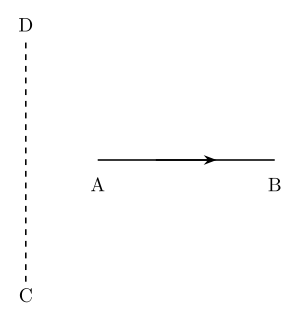
- AP EAPCET 2026Set eng-2026-05-15-AN1 markMCQQ.A current carrying wire AB is placed near an another long, straight current carrying wire CD as shown in figure. If AB is free to move, then AB will have [FIGURE: CD is a long straight vertical wire (dashed, current direction upward) and AB is a horizontal wire (current flowing from A to B, left to right) placed to the right of CD, oriented perpendicular to CD, with its left end A level with the midpoint of CD] (A) Translational motion only (B) Rotational motion only (C) Both translational and rotational motion (D) Neither translational nor rotational motion
›Reveal solutionSolution
The field from CD is non-uniform along AB, so the forces on different parts of AB are unequal in magnitude but parallel in direction — this produces both a net translation and a net torque; the answer is: both.
Concept and Intuition
Treating CD as an infinite straight wire, the magnetic field it produces at any external point in the plane containing the two wires is perpendicular to that plane, with magnitude B=2πrμ0I falling off with distance r from CD. Because AB is laid out along the direction of increasing r (A is closer to CD than B), the field is strongest near A and weakest near B. The force on each element of AB, dF=Idl×B, therefore points the same way everywhere along AB (perpendicular to AB, parallel to CD) — but its magnitude steadily decreases from A to B.
Step-by-Step Solution
- Because the field magnitude is unequal along AB (strong near A, weak near B) but always points the same way, integrating dF along the length of AB gives a non-zero net force — so AB translates.
- Because the larger forces act nearer A and the smaller ones nearer B, the force-weighted "centre of force" is shifted toward A, away from the geometric centre of AB — this asymmetric distribution produces a net torque about AB's centre.
- A net force together with a net torque means AB undergoes both translational and rotational motion simultaneously.
Common Mistakes
- Assuming a straight current-carrying rod near another wire only ever translates.
- Forgetting that a non-uniform force distribution over a rigid body also produces a net torque, even with no explicit external couple mentioned.
✓Final answerThe correct option is (C) — Both translational and rotational motion.
ANSWER: C
- AP EAPCET 2026Set ap-2026-05-20-AN1 markMCQQ.Two long parallel straight conductors separated by 10cm carrying currents 20A, 40A in the same direction. The work required per unit length to move the conductors apart to 30cm is [Take log103=0.4771] (A) 17.6×10⁻⁵ J m−1 (B) 21.2×10⁻⁵ Jm−1 (C) 16.8×10⁻⁵ Jm−1 (D) 14.6×10⁻⁵ Jm−1
›Reveal solutionSolution
The attractive force per unit length between parallel same-direction currents is μ0I1I2/2πd; integrating it from 10 cm to 30 cm gives the work done per unit length, about 17.6×10⁻⁵ J/m.
Concept and Intuition
Currents flowing in the same direction in two parallel wires attract each other. To pull them apart (increase their separation), an external agent must do positive work against this attractive force. Since the force is not constant with separation (f∝1/d), the work must be found by integrating force over distance, not by a simple F×Δd.
Step-by-Step Solution
- Force per unit length at separation d: f(d)=2πdμ0I1I2.
- Work done per unit length moving from d1=0.1 m to d2=0.3 m:
LW=∫0.10.3f(d)dd=2πμ0I1I2ln(d1d2)=2πμ0I1I2ln3
- 2πμ0=2×10⁻⁷; I1I2=20×40=800.
- ln3=2.303log103=2.303×0.4771=1.0989.
- LW=2×10−7×800×1.0989=1.6×10−4×1.0989≈1.758×10−4=17.6×10⁻⁵ J/m.
Common Mistakes
- Treating the force as constant and multiplying by Δd=0.2 m directly — the 1/d dependence requires integration (a logarithm), not a linear multiply.
- Forgetting to convert log10 to ln using the given value.
✓Final answerThe correct option is (A) — 17.6×10⁻⁵ J m−1.
ANSWER: A
- AP EAPCET 2025Set eng-2025-05-22-FN1 markMCQQ.The force per unit length on a straight wire carrying current of 8 A making an angle of 30° with a uniform magnetic field of 0.15 T is (A) 1.2 Nm−1 (B) 1.02 Nm−1 (C) 0.6 Nm−1 (D) 2.4 Nm−1
›Reveal solutionSolution
Force per unit length on a wire in a magnetic field is f=BIsinθ; plugging in the given values gives 0.6 Nm−1.
Concept and Intuition
A straight current-carrying wire of length L placed in a uniform magnetic field B experiences a force F=BILsinθ, where θ is the angle between the current direction and the field. This comes directly from the Lorentz force acting on the moving charge carriers, summed over the wire. Dividing both sides by L gives the force per unit length, f=BIsinθ — a useful quantity because it doesn't depend on how long the wire actually is.
Step-by-Step Solution
- Write the force-per-length formula: f=BIsinθ.
- Substitute B=0.15 T, I=8 A, θ=30°.
- sin30°=0.5.
- f=0.15×8×0.5=1.2×0.5=0.6 Nm−1.
Common Mistakes
- Forgetting the sinθ factor and using f=BI directly (which would give 1.2, matching a distractor option) — the angle between the wire and the field must always be included.
- Using cosθ instead of sinθ — the force depends on the sine of the angle between the current and the field (maximum force when they are perpendicular).
✓Final answerThe correct option is (C) — 0.6 Nm−1.
ANSWER: C
- AP EAPCET 2025Set ap-2025-05-19-FN1 markMCQQ.The magnetic force per unit length acting on a wire carrying a current of 43 A and making an angle of 60∘ with the direction of a uniform magnetic field of 200 mT is (A) 1.8 Nm−1 (B) 2.4 Nm−1 (C) 0.6 Nm−1 (D) 1.2 Nm−1
›Reveal solutionSolution
The force per unit length on a current-carrying wire in a magnetic field is F/L=BIsinθ; plugging in the given values yields 1.2N/m.
Concept and Intuition
A current-carrying conductor in an external magnetic field experiences a force F=IL×B, whose magnitude per unit length is F/L=BIsinθ, where θ is the angle between the current direction and the field.
Step-by-Step Solution
- Given I=43A, B=200mT=0.2T, θ=60∘.
- sin60∘=23.
- F/L=BIsinθ=0.2×43×23.
- 43×23=4×23=6.
- F/L=0.2×6=1.2N/m.
Common Mistakes
- Forgetting the sinθ factor and simply multiplying BI.
- Mis-converting mT to T (dividing by 100 instead of 1000).
✓Final answerThe correct option is (D) — 1.2 Nm−1.
ANSWER: D
- AP EAPCET 2024Set ap-2024-05-16-AN1 markMCQQ.A conducting rod of length 'l' and mass 'm' is placed over a smooth horizontal plane. A magnetic field B is acting perpendicular to the rod. If a charge 'q' is suddenly passed through the rod and the rod acquires an initial velocity v on the plane surface, then charge 'q' is (A) Blmv (B) vBlm (C) Bl2mv (D) mlBv
›Reveal solutionSolution
Equating the magnetic impulse (Bl times the total charge passed) to the rod's momentum change gives q=mv/(Bl).
Concept and Intuition
A current-carrying rod in a magnetic field experiences a force F=BIl. If the current is a brief, arbitrary pulse rather than constant, we cannot use F=ma directly with a single value, but the impulse (time-integral of force) is straightforward: J=∫Fdt=Bl∫Idt=Blq, since ∫Idt is exactly the total charge q that flowed.
Step-by-Step Solution
- Instantaneous force on the rod: F(t)=BI(t)l.
- Impulse (total change in momentum): J=∫0tFdt=Bl∫0tIdt=Blq.
- Since the rod starts at rest and ends with speed v: J=mv−0=mv.
- Equate: Blq=mv⇒q=Blmv.
Common Mistakes
- Trying to use F=ma with a single 'current value' instead of recognizing that the impulse-momentum approach handles the unspecified time-dependence of the current cleanly.
✓Final answerThe correct option is (A) — Blmv.
ANSWER: A
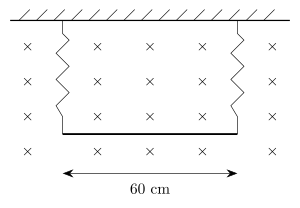
- AP EAPCET 2024Set ap-2024-05-16-FN1 markMCQQ.A wire of 60 cm length and mass 10 g is suspended by a pair of flexible leads in a magnetic field of 0.60 T as shown in the figure. The magnitude of the current required to remove the tension in the supporting leads is [FIGURE] (a horizontal wire of length 60 cm suspended by two vertical flexible leads inside a uniform magnetic field directed into the page, shown by rows of × symbols) (A) 0.47 A (B) 0.17 A (C) 0.27 A (D) 0.32 A
›Reveal solutionSolution
The key idea is that the magnetic force on the current-carrying wire must exactly balance its weight to remove tension in the leads. Using the formula F=ILB and setting it equal to mg, the required current is I=LBmg≈0.27 A, so the correct option is (C).
Concept and Intuition: Magnetic Force on a Current-Carrying Wire
When a wire carries an electric current and sits in a magnetic field, the field exerts a force on the moving charges inside the wire. This force is given by the simple but powerful equation:
F=IL×B
Here, I is the current, L is a vector pointing along the wire in the direction of the current (with magnitude equal to the wire's length), and B is the magnetic field. The magnitude of the force is F=ILBsinθ, where θ is the angle between the wire and the field.
In this problem, the wire is horizontal, and the magnetic field points directly into the page (shown by the "×" symbols). The wire is perpendicular to the field, so θ=90∘ and sinθ=1. The force is therefore F=ILB, and its direction is given by the right-hand rule: point your fingers in the direction of the current, curl them toward the field (into the page), and your thumb gives the force direction. For a current flowing left-to-right, the force points upward. That upward magnetic force can lift the wire, reducing the tension in the flexible leads. To remove the tension entirely, the magnetic force must exactly balance the wire's weight.
Step-by-Step Solution
- Identify the forces acting on the wire. The wire has weight mg pulling it downward. The flexible leads can only provide tension; if the magnetic force exactly cancels the weight, the leads go slack (tension = 0). So we require:
Fmagnetic=mg
- Write the magnetic force expression. Since the wire is perpendicular to the field, the magnitude is:
Fmagnetic=ILB
where L=60 cm=0.60 m, B=0.60 T, and I is the unknown current.
- Write the weight expression. Mass m=10 g=0.010 kg, and g=9.8 m/s2. So:
mg=(0.010)(9.8)=0.098 N
- Set the forces equal and solve for I.
ILB=mg⇒I=LBmg
Substitute the numbers:
I=0.60×0.600.098=0.360.098
I≈0.2722 A
- Round to match the options. The closest value among the choices is 0.27 A, which corresponds to option (C).
TipAlways check units: length in meters, mass in kilograms, and remember that 1 T⋅A⋅m=1 N. This quick sanity check confirms the calculation.
Watch outA common mistake is to forget to convert centimeters to meters or grams to kilograms. Using L=60 and m=10 directly would give I=60×0.610×9.8≈2.72 A, which is not among the options — a clear red flag that units were mishandled.
✓Final answerThe correct option is (C).
ANSWER: C
- AP EAPCET 2024Set ap-2024-05-17-AN1 markMCQQ.A very long straight conductor is carrying a steady current of 2.2 A. The conductor is placed on a horizontal table such that the current in the conductor is from south to north. If the horizontal component of the earth's magnetic field at the place is 3.2×10⁻⁵ T, the force per unit length on the conductor is (A) 7.04×10⁻⁵ T (B) Zero (C) 3.52×10⁻⁵ T (D) 14.08×10⁻⁵ T
›Reveal solutionSolution
The current flows exactly parallel to Earth's horizontal magnetic field (both south-to-north), so the magnetic force on it is zero.
Concept and Intuition
The force per unit length on a current-carrying wire in a magnetic field is LF=BIsinθ, where θ is the angle between the current direction and the field direction. Earth's horizontal magnetic field component at most places points from geographic south to geographic north (toward magnetic north, ignoring declination). If the wire's current also flows south to north, the current and field vectors are parallel — and a magnetic force requires a component of current perpendicular to the field, which is absent here.
Step-by-Step Solution
- Direction of current: south to north.
- Direction of Earth's horizontal field component: also south to north (that's the defining direction of the horizontal component).
- Angle between current and field: θ=0°.
- Force per unit length: F/L=BIsinθ=BIsin(0°)=0.
Common Mistakes
- Just multiplying B×I without checking the angle — that's the trap for options (C) and (A)/(D), which come from assuming a perpendicular orientation.
- Confusing the horizontal component's direction with the vertical (dip) component; only the horizontal part matters here since the conductor lies on a horizontal table.
✓Final answerThe correct option is (B) — Zero.
ANSWER: B
- AP EAPCET 2024Set eng-2024-05-21-FN1 markMCQQ.A rectangular loop of sides 25 cm and 10 cm carrying a current of 10 A is placed with its longer side parallel to a long straight conductor 10 cm apart carrying current 25 A. The net force on the loop is (A) 6.25×10⁻⁵ N (B) 5.5×10⁻⁵ N (C) 3.75×10⁻⁵ N (D) 8.75×10⁻¹¹ N
›Reveal solutionSolution
Only the two sides of the loop parallel to the wire feel a net (unbalanced) force since they're at different distances; the perpendicular sides' forces cancel by symmetry, leaving a clean two-term calculation.
Concept and Intuition
Two parallel current-carrying wires attract or repel with force per unit length 2πdμ0I1I2. For a rectangular loop near a long straight wire, the near and far sides parallel to the wire experience forces in opposite senses (because loop current flows in opposite directions along those two sides) but of different magnitude (since they're at different distances), so they don't cancel — their difference is the net force. The two sides perpendicular to the wire experience forces that are equal and opposite by symmetry (same current, mirror-image geometry along the wire's length) and cancel exactly.
Step-by-Step Solution
- Near side: 10 cm from wire, force per length =2πd1μ0I1I2.
- Far side: 10+10=20 cm from wire, force per length =2πd2μ0I1I2.
- Net force =2πμ0I1I2L(d11−d21) where L=0.25 m is the length of the parallel sides.
- Plug in: 2×10−7×25×10×0.25×(10−5)=2×10−7×62.5×5=6.25×10⁻⁵ N.
Common Mistakes
- Using the shorter side (10 cm) as L instead of the longer side (25 cm) that is parallel to the wire.
- Adding instead of subtracting the two force terms (they oppose because the loop current reverses direction on the two parallel sides).
✓Final answerThe correct option is (A) — 6.25×10⁻⁵ N.
ANSWER: A
- AP EAPCET 2023Set ap-2023-05-22-AN1 markMCQQ.A magnetic field of 1T is acting on a wire carrying current of 1A so that the wire is at rest in air. If the mass of the wire is 100 g then the length of the wire is (A) 1 m (B) 0.5 m (C) 2 m (D) 0.25 m
›Reveal solutionSolution
The magnetic force BIL on the current-carrying wire must equal its weight mg for it to float; solving for L gives about 1 m.
Concept and Intuition
A current-carrying wire in a magnetic field experiences a force F=BIL (for field perpendicular to the wire). If this force is directed upward and equals the wire's weight, the wire can remain suspended in equilibrium — a classic magnetic levitation setup.
Step-by-Step Solution
- Equilibrium condition: BIL=mg.
- m=100 g=0.1 kg, B=1 T, I=1 A, g≈9.8 ms−2.
- L=BImg=1×10.1×9.8=0.98 m≈1 m.
Common Mistakes
- Forgetting to convert the mass from grams to kilograms.
- Omitting g from the weight calculation.
✓Final answerThe correct option is (A) — 1 m.
ANSWER: A
- AP EAPCET 2023Set eng-2023-05-16-FN1 markMCQQ.The force acting per unit length when a very long straight conductor is carrying a steady current of 1 A and the direction of the current is from south to north is (The horizontal component of the earth's magnetic field at the place is 3×10⁻⁵ T and the direction of the field is from the geographical south to geographical north.) (A) 3×10⁻⁵ Nm−1 (B) 1×10⁻⁵ Nm−1 (C) 0 (D) 1.5×10⁻⁵ Nm−1
›Reveal solutionSolution
This tests the force on a current-carrying conductor in a magnetic field, F=BILsinθ, when the current and field are parallel. Answer: the force is zero.
Concept and Intuition
The magnetic force per unit length on a straight current-carrying wire is f=BIsinθ, where θ is the angle between the current's direction and the magnetic field. This force vanishes whenever the current flows parallel (or antiparallel) to the field, because F=IL×B and the cross product of two parallel vectors is zero.
Step-by-Step Solution
- The conductor carries current from south to north.
- The Earth's horizontal magnetic field at the location also points from geographic south to geographic north.
- Thus the current direction and the field direction are the same, so the angle between L (current direction) and B is θ=0∘.
- Force per unit length: f=BIsinθ=BIsin0∘=0.
Common Mistakes
- Assuming a nonzero force just because B and I are both given as nonzero — the angle between them must be checked.
- Confusing north-south alignment with east-west (which would give maximum force).
✓Final answerThe correct option is (C) — 0.
ANSWER: C
- AP EAPCET 2023Set eng-2023-05-17-AN1 markMCQQ.A wire loop of irregular shape carrying current is placed in an external magnetic field. If the wire is flexible, the shape of the loop changes to (A) helical (B) circular (C) straight line (D) parabolic
›Reveal solutionSolution
A flexible current loop free to move under the magnetic forces on it settles into a circular shape, since that shape balances the force per unit length uniformly all around.
Concept and Intuition
Each element of a current loop in a magnetic field feels a force dF=Idl×B. If the wire is rigid, its shape stays fixed and net force/torque may act on it as a whole. If instead the wire is flexible, each small segment can move independently in response to the local force on it, so the loop reshapes itself. The shape that gives a uniform, self-consistent outward force per unit length everywhere along the loop (mechanical equilibrium, like a stretched elastic band forced outward uniformly) is the circle — any irregular shape has regions of higher curvature that would keep deforming until the whole loop becomes circular.
Step-by-Step Solution
- Recognize that a flexible current loop is like an elastic ring being pushed outward (or inward) by magnetic forces at every point.
- The equilibrium shape under such uniformly-distributed radial forces is the one with constant curvature — a circle.
- Any other (irregular) shape has non-uniform curvature, so different parts feel different net tendencies to bulge or straighten, driving the shape further toward a circle until equilibrium is reached.
- Hence the loop settles into a circular shape.
Common Mistakes
- Confusing this qualitative equilibrium-shape question with calculating the force or torque on a rigid loop (a different type of problem).
- Assuming the loop would collapse to a straight line — that would require the forces to be purely attractive along one line, which is not the case for a closed current loop in an external field.
✓Final answerThe correct option is (B) — circular.
ANSWER: B
🎓Unlock everything free for 14 days
- ✓Full step-by-step solutions
- ✓Concept-first explanations
- ✓Methods, shortcuts & mistakes
- ✓PYQ mapping + timed mock tests
Full access for 14 days. No credit card required.