Q.Explain the principle and working of a nuclear reactor with the help of a labelled diagram.
You're viewing a preview — the full solution, concept, methods & PYQ mapping are locked.
Start your 14-day free trial to unlock the full solution →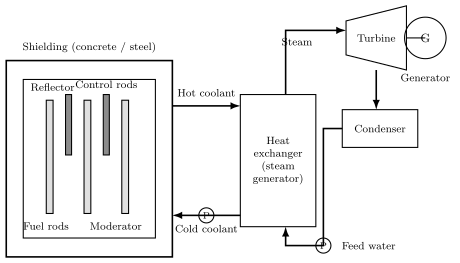
A nuclear reactor is a controlled, self-sustaining fission chain reaction: fuel nuclei split on absorbing a neutron, releasing more neutrons (moderated to thermal speed for efficient further fission) and energy, with control rods holding the reaction steady (k=1) and a coolant removing the heat produced.
Principle: A nuclear reactor works on the principle of a controlled self-sustaining nuclear fission chain reaction. A heavy, fissile nucleus (commonly ) absorbs a slow (thermal) neutron and splits (fissions) into two lighter nuclei, releasing a large amount of energy (via mass defect, ) and 2–3 fresh fast neutrons. If, on average, exactly one of these released neutrons goes on to cause a further fission, the reaction is self-sustaining at a steady rate (the multiplication factor , called critical); the reactor uses this controlled, steady-state chain reaction to release energy at a controlled, usable rate (unlike a bomb, where and the reaction is deliberately uncontrolled).
Working / main components (as in a labelled diagram):
- Fuel: fissile material (enriched , or ) in the form of rods, which undergoes fission and releases energy + neutrons.
- Moderator: a material (commonly heavy water or graphite) surrounding the fuel rods that slows down (thermalises) the fast neutrons released in fission through repeated elastic collisions, since slow (thermal) neutrons are far more likely to cause further fission in than fast ones.
- Control rods: rods of a strongly neutron-absorbing material (e.g. boron or cadmium), inserted between the fuel rods. Sliding them in/out of the core absorbs more/fewer neutrons, allowing the multiplication factor to be held precisely at 1 (steady operation), or driven below 1 to shut the reactor down. …
Unlock everything free for 14 days
- Full step-by-step solutions
- Concept-first explanations
- Methods, shortcuts & mistakes
- PYQ mapping + timed mock tests
Full access for 14 days. No credit card required.