Q.(a) Explain the principle and working of a nuclear reactor with the help of a labelled diagram.
You're viewing a preview — the full solution, concept, methods & PYQ mapping are locked.
Start your 14-day free trial to unlock the full solution →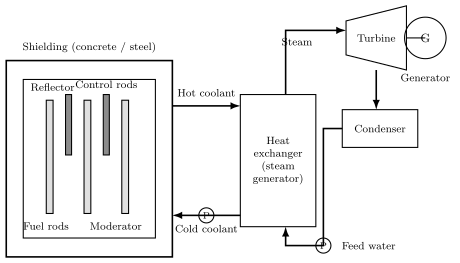
A nuclear reactor sustains and controls a fission chain reaction using fuel, a moderator to slow neutrons, control rods to regulate the reaction, and a coolant to remove heat; nuclear radius scales as R = R0 A^(1/3), giving R27:R64 = 3:4.
(a) Principle and working of a nuclear reactor:
Principle: A nuclear reactor works on the principle of a controlled, self-sustaining nuclear fission chain reaction. When a heavy fissile nucleus (such as U-235) absorbs a slow (thermal) neutron, it splits into two lighter nuclei, releasing a large amount of energy along with 2-3 fast neutrons. If, on average, exactly one of these neutrons goes on to cause another fission (the rest being absorbed or lost), the chain reaction proceeds at a steady, controlled rate — this is called maintaining the reactor at criticality.
Main components (labelled diagram description):
- Fuel — fissile material (enriched U-235 or Pu-239) shaped into rods, placed in the reactor core, which undergoes fission.
- Moderator — a material (commonly heavy water, ordinary water, or graphite) surrounding the fuel rods that slows down the fast neutrons produced in fission to thermal (slow) speeds via elastic collisions, since slow neutrons are far more likely to cause further fission in U-235.
- Control rods — rods of a strongly neutron-absorbing material (such as cadmium or boron) inserted into or withdrawn from the core to absorb excess neutrons, allowing the chain reaction rate (and hence power output) to be precisely controlled; fully inserting them can shut the reactor down.
- Coolant — a fluid (water, heavy water, liquid sodium, or gas) circulated through the core to carry away the heat generated by fission.
- Heat exchanger / steam generator — the coolant transfers its heat here to convert water into steam.
- Turbine and generator — the steam drives a turbine coupled to a generator, producing electricity, after which the steam is condensed and recirculated.
- Shielding — thick concrete and steel shielding surrounds the reactor core to absorb stray radiation and protect operating personnel. …
Unlock everything free for 14 days
- Full step-by-step solutions
- Concept-first explanations
- Methods, shortcuts & mistakes
- PYQ mapping + timed mock tests
Full access for 14 days. No credit card required.