Q.(a) Explain the principle and working of a nuclear reactor with the help of a labelled diagram.
You're viewing a preview — the full solution, concept, methods & PYQ mapping are locked.
Start your 14-day free trial to unlock the full solution →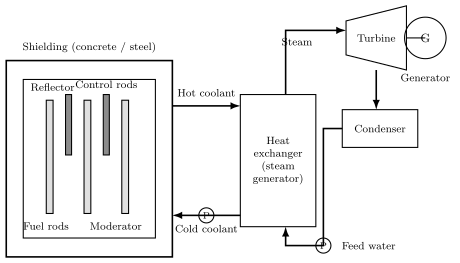
A nuclear reactor sustains a controlled fission chain reaction of U-235, using a moderator, control rods, and coolant; converting even a microgram of mass entirely to energy via releases tens of millions of joules.
(a) Principle and working of a nuclear reactor:
The principle of a nuclear reactor is the controlled, self-sustaining chain reaction of nuclear fission. When a U-235 nucleus absorbs a slow (thermal) neutron, it splits into two lighter nuclei, releasing a large amount of energy and 2–3 fast neutrons. If, on average, exactly one of these released neutrons goes on to cause another fission (a multiplication factor , called the critical condition), the reaction sustains itself at a steady, controllable rate rather than growing explosively.
Main components (labelled diagram description):
- Fuel rods: contain fissile material, usually enriched Uranium (U-235), where fission occurs.
- Moderator (e.g. heavy water or graphite) surrounds the fuel rods: it slows down the fast neutrons produced in fission to thermal (slow) speeds via repeated collisions, since slow neutrons are far more effective at causing further U-235 fission.
- Control rods (made of neutron-absorbing material like cadmium or boron), inserted between the fuel rods: by moving them in or out, the number of neutrons available for further fission is regulated, keeping and controlling the reaction rate (or shutting the reactor down by fully inserting them).
- Coolant (e.g. water, heavy water, or liquid sodium), circulated through the reactor core: carries away the heat generated by fission to a heat exchanger, where it produces steam that drives a turbine-generator to produce electricity.
- Reflector: surrounds the core to reflect escaping neutrons back in, improving efficiency.
- Shielding (thick concrete/lead): surrounds the entire reactor to absorb stray radiation and protect operators and the environment. …
Unlock everything free for 14 days
- Full step-by-step solutions
- Concept-first explanations
- Methods, shortcuts & mistakes
- PYQ mapping + timed mock tests
Full access for 14 days. No credit card required.