Q.A cylindrical jar of height h is filled to the brim with a transparent liquid of refractive index μ. A small dot is marked at the centre of the bottom surface of the jar. An opaque circular disc is to be floated flat on the top surface of the liquid, centred directly above the dot (symmetric about the vertical centre-line). Find the minimum diameter of this disc so that, viewed from above, the dot cannot be seen from any direction.
🔒You're viewing a preview — the full solution, concept, methods & PYQ mapping are locked.
🔒 Start your 14-day free trial to unlock the full solution →Concept understanding — Total Internal Reflection
Total Internal Reflection: When Light Decides to Stay Home
Imagine you're running on a beach toward the water. On sand, you run fast. The moment you hit the water, your speed drops — the water "resists" more. If you run at a shallow angle toward the waterline, your legs will suddenly slow down, and your body will twist. That twist is refraction — light bending when it changes speed between two media.
Now imagine the reverse: you're swimming in the water, heading toward the shore. You're moving slower in water, and you want to get out onto the fast sand. If you approach the shore at a very shallow angle — almost parallel to the beach — you might never make it out. The sudden speed-up as you hit the sand could "reflect" you back into the water. That's the intuition for total internal reflection.
The Core Idea
Light normally passes from one transparent medium to another (say, from water to air) and bends away from the normal — because it speeds up. But if the angle of incidence in the slower medium is large enough, the light can't escape. It gets completely reflected back inside the first medium. No light transmits. That's total internal reflection.
Total internal reflection (TIR) occurs only when light travels from a denser (slower) medium to a rarer (faster) medium, and the angle of incidence exceeds a critical value.
The Two Conditions (Memorise These)
For TIR to happen, both must be true:
-
Light must go from a denser medium to a rarer medium (e.g., glass → air, water → air, diamond → air).
Denser means higher refractive index (n). Light slows down in a denser medium.
-
Angle of incidence (i) must be greater than the critical angle (C).
The critical angle is the angle of incidence in the denser medium for which the angle of refraction in the rarer medium is exactly 90∘.
The Critical Angle — The Tipping Point
Look at the diagram in your mind: a ray in water heading toward the surface. As you increase the angle of incidence, the refracted ray in air bends more and more away from the normal. At some specific angle C, the refracted ray skims exactly along the surface — angle of refraction =90∘.
sinC=ndensernrarer
For water (n=1.33) to air (n=1.00):
sinC=1.331.00≈0.75⇒C≈48.6∘
So if you shine a light from water into air at an angle greater than about 49∘ from the normal, the light will not leave the water at all. It reflects back down — perfectly.
What Actually Happens at the Boundary?
- i<C: Most light refracts out; a little reflects (normal partial reflection).
- i=C: Refracted ray grazes the surface; transmitted intensity is nearly zero.
- i>C: No transmitted ray. All the light energy reflects back into the denser medium. The reflection is 100% — no absorption, no transmission.
TIR is not the same as ordinary reflection from a mirror. In TIR, there is no silvering or coating. The reflection happens because the wave cannot exist in the rarer medium — it's forced back. This gives perfect reflection with zero energy loss, unlike a metal mirror which absorbs some light.
--- …
Why this formula?
Total Internal Reflection: Why the Key Formulas Hold
Total Internal Reflection (TIR) is a fascinating optical phenomenon where light, instead of escaping from a denser medium into a rarer one, gets completely reflected back into the denser medium. Let's build the understanding from first principles.
1. The Foundation: Snell's Law
The entire story begins with Snell's Law:
n1sinθ1=n2sinθ2
Where:
- n1 = refractive index of the denser medium (e.g., glass, water)
- n2 = refractive index of the rarer medium (e.g., air)
- θ1 = angle of incidence (in denser medium)
- θ2 = angle of refraction (in rarer medium)
Key fact: n1>n2 (light travels from denser to rarer).
2. The Critical Angle: Where Refraction "Bends" to 90°
As θ1 increases, θ2 increases faster (because n1>n2). At some special angle, θ2 becomes exactly 90∘ — the refracted ray grazes the surface.
Set θ2=90∘ in Snell's Law:
n1sinθc=n2sin90∘
Since sin90∘=1:
sinθc=n1n2
Why this formula?
It's not arbitrary — it's the limit of Snell's Law. The critical angle θc is the largest incidence angle for which refraction is still possible. Beyond this, Snell's Law would demand sinθ2>1, which is impossible — no real angle satisfies it.
3. Beyond the Critical Angle: Why TIR Occurs
When θ1>θc:
- Snell's Law gives sinθ2=n2n1sinθ1>1
- No real θ2 exists
- Physics says: the wave cannot "fit" into the rarer medium
- Result: All energy is reflected back into the denser medium
This isn't a failure of Snell's Law — it's a physical boundary where the wave's behaviour changes from propagating to evanescent (decaying).
4. The Condition for TIR (Exam-Ready Summary)
For Total Internal Reflection to occur, both conditions must hold:
- Light travels from denser to rarer medium (n1>n2) …
The dot is hidden when every ray that could escape the top surface (those meeting it within the critical angle) is blocked by the disc. That region is a circle of radius htanθc=h/μ2−1, so the minimum diameter is 2h/μ2−1. …
Light from the dot can only leave the top surface within a cone bounded by the critical angle. Rays outside that cone are totally internally reflected and never emerge, so to hide the dot it is enough for the disc to cover the circle where the escaping rays reach the surface. That circle has radius h/μ2−1, giving a minimum disc diameter of 2h/μ2−1.
Concept: escape cone and critical angle
A ray from the dot meets the top surface at an angle θ from the vertical (the normal). Going from liquid to air it can emerge only if θ<θc, where
sinθc=μ1.
Rays with θ≥θc undergo total internal reflection and cannot carry the image of the dot out of the liquid — so they are harmless; the disc only needs to stop the rays that can escape.
Geometry
The dot is at the centre of the base, a vertical distance h below the surface. A ray leaving the dot and meeting the surface at horizontal distance r from the axis has
tanθ=hr.
The widest escaping ray corresponds to θ=θc, reaching the surface at radius
r=htanθc.
Evaluate tanθc …
Method: The "Escape Cone" Method for TIR-Based Visibility Problems
Use this method whenever a question asks what size or shape of blocker (or what viewing condition) is needed to prevent a submerged point from being seen from any direction above a liquid surface — or, conversely, to find the region from which a submerged point CAN be seen.
Steps
Step 1: Identify that only rays within the critical angle can escape
A ray from the submerged point that meets the surface at an angle (from the normal) greater than or equal to the critical angle θc, where sinθc=μ1, undergoes total internal reflection and never leaves the liquid. Only rays striking the surface at angles less than θc can refract out and be seen from above. This immediately tells you: you don't need to block every ray from the point — only the ones that could actually escape.
Step 2: Find the boundary of the region where escaping rays reach the surface
Since the point is a fixed vertical distance h below the surface, a ray leaving it at angle θ (from the vertical) reaches the surface at a horizontal distance r=htanθ from the point directly above it. The escaping rays (those with θ<θc) therefore all strike the surface within a circle of radius
rmax=htanθc
Step 3: Convert the critical angle into a usable trig ratio …
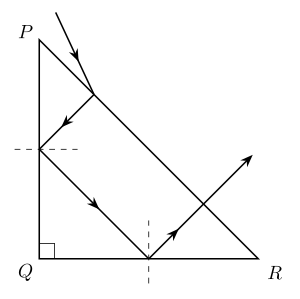
- AP EAPCET 2026Set ap-2026-05-20-FN1 markMCQQ.A light ray incidents on a prism PQR (PQ = QR) and travels as shown in the figure. The minimum refractive index of referred prism is [FIGURE] (an isosceles right-angled prism PQR, with the right angle at Q, P at the top vertex and R at the bottom-right vertex; a ray enters through face PQ, reflects internally near the midpoint of PQ, travels to the midpoint of QR and reflects again, then exits through face PR) (A) 3 (B) 23 (C) 21 (D) 2
›Reveal solutionSolution
This is the classic right-angle-prism (corner-reflector) geometry where the ray strikes each leg at 45∘; total internal reflection at that angle requires n≥2.
Concept and Intuition
In a right-angled isosceles prism with the right angle at Q and PQ=QR, a ray entering through the hypotenuse PR and reflecting off both legs PQ and QR (as shown, reflecting first off PQ then off QR before exiting through PR) does so at exactly 45∘ to the normal at each leg — this is simple geometry of the isosceles right triangle, independent of where exactly on the hypotenuse the ray enters, as long as it undergoes this two-bounce path (this is precisely the working principle of the 'porro prism' corner reflectors used in binoculars and periscopes). For the reflections to be total internal reflection (not partial, lossy reflection), the angle of incidence at each leg (45∘) must be at least the critical angle θc of the glass.
Step-by-Step Solution
- Geometry: since PQ⊥QR and the ray path is symmetric (reflecting off PQ then QR, and by symmetry of the isosceles right triangle with PQ=QR), the angle of incidence at each leg works out to 45∘ from the normal.
- For total internal reflection to actually occur (rather than the light partially escaping through the legs), we need the angle of incidence to be at least the critical angle: 45∘≥θc.
- The critical angle relates to refractive index via sinθc=n1. …
- AP EAPCET 2024Set ap-2024-05-17-AN1 markMCQQ.The following statement is true in case of total internal reflection? (A) Light must travel from rarer medium to denser medium & angle of incidence should be greater than critical angle (B) Light must travel from denser medium to rarer medium & angle of incidence should be less than critical angle (C) Light must travel from denser medium to rarer medium & angle of incidence should be > 90° (D) Light must travel from denser medium to rarer medium & angle of incidence should be greater than critical angle
›Reveal solutionSolution
Total internal reflection requires travel from denser to rarer medium with the angle of incidence exceeding the critical angle — exactly what option (D) states.
Concept and Intuition
At an interface between a denser (higher refractive index) and rarer (lower index) medium, Snell's law n1sinθ1=n2sinθ2 means the refracted ray bends away from the normal. As the incidence angle increases, the refraction angle reaches 90° at the critical angle θc (where sinθc=n2/n1). Beyond that angle no refracted ray can exist (since sinθ2 would have to exceed 1), so all the light reflects back — total internal reflection. This can only happen going from denser to rarer, and only strictly beyond the critical angle (not merely close to 90°).
Step-by-Step Solution
- Direction check: TIR needs denser → rarer (light going the other way just refracts further toward the normal, never fully reflects). This eliminates option (A), which has the direction backwards.
- Angle check: the condition is angle of incidence > critical angle, not < critical angle — this eliminates option (B). …
- AP EAPCET 2021Set ap-2021-09-06-AN1 markMCQQ.The principle used in the transmission of signals through an optical fibre is (A) Refraction (B) Dispersion (C) Total internal reflection (D) Interference
›Reveal solutionSolution
Optical fibres transmit light signals by repeated total internal reflection at the core-cladding interface.
Concept and Intuition
An optical fibre has a denser core surrounded by a rarer cladding (lower refractive index). Light entering the fibre within the acceptance angle always strikes the core-cladding boundary at an angle exceeding the critical angle for that interface. Because the angle of incidence exceeds the critical angle, all the light is reflected back into the core (none refracts out) — this is total internal reflection. The process repeats down the entire length of the fibre, letting the signal travel with very low loss even around bends.
Step-by-Step Solution
- Recall the conditions for total internal reflection: light must travel from a denser to a rarer medium, and the angle of incidence must exceed the critical angle.
- In a fibre, the core (denser) and cladding (rarer) are engineered so that guided rays always meet this condition.
- Refraction alone would let light leak out through the cladding — not usable for long-distance transmission. …
- AP EAPCET 2021Set eng-2021-08-23-FN1 markMCQQ.A well-cut diamond appears bright because ________ (A) it emits light (B) it is radioactive (C) of its total internal reflection (D) it has high density
›Reveal solutionSolution
A diamond's brilliance comes from total internal reflection at its many facets, enabled by its very high refractive index (small critical angle).
Concept and Intuition
Total internal reflection (TIR) occurs when light travelling in a denser medium strikes the boundary with a less dense medium at an angle greater than the critical angle — instead of refracting out, it reflects entirely back inside. Diamond has an unusually high refractive index (~2.42), giving it a very small critical angle (~24.4°). A skilled cutter angles the diamond's many facets so that light entering from the top undergoes multiple total internal reflections off the bottom facets before finally exiting back out the top, concentrating and scattering the light as sparkle.
Step-by-Step Solution
- Diamond does not emit its own light — it only reflects/refracts incoming light, ruling out option (A).
- Diamond's brilliance has nothing to do with radioactivity — ruling out option (B).
- High density alone (option D) doesn't explain optical brilliance; many dense materials are dull. …
🎓Unlock everything free for 14 days
- ✓Full step-by-step solutions
- ✓Concept-first explanations
- ✓Methods, shortcuts & mistakes
- ✓PYQ mapping + timed mock tests
Full access for 14 days. No credit card required.