Q.A short pulse of white light is incident from air to a glass slab at normal incidence. After travelling through the slab, the first colour to emerge is
Concept understanding — Critical Angle Comparison
Critical Angle Comparison: From Intuition to Precision
Imagine you're standing at the edge of a swimming pool, looking down at a coin at the bottom. The coin appears closer to the surface than it actually is. That's refraction — light bends when it moves from water into air. Now imagine tilting your head so you're looking at the coin from a very shallow angle. At some point, the coin suddenly vanishes. You can't see it anymore, no matter how hard you try. That vanishing point is the critical angle.
The Intuition
Light travels at different speeds in different materials. When it crosses from a denser medium (like water or glass) into a rarer medium (like air), it bends away from the normal (the imaginary line perpendicular to the surface). The larger the angle of incidence (the angle at which light hits the boundary), the more it bends away.
At a certain angle of incidence, the refracted ray bends so much that it runs exactly along the surface — it makes a 90° angle with the normal. That's the critical angle. If you increase the angle of incidence even slightly beyond this, the light can't escape at all. It reflects back into the denser medium, a phenomenon called total internal reflection.
Critical angle only exists when light travels from a denser medium to a rarer medium. Going the other way (rarer to denser), light always bends toward the normal — no critical angle, no total internal reflection.
The Precise Statement
The critical angle (θc) is the angle of incidence in the denser medium for which the angle of refraction in the rarer medium is exactly 90°.
Mathematically, from Snell's law:
n1sinθ1=n2sinθ2
Let medium 1 be the denser medium (refractive index n1) and medium 2 be the rarer medium (refractive index n2, with n2<n1). At the critical angle, θ1=θc and θ2=90∘, so sinθ2=1. This gives:
n1sinθc=n2×1
sinθc=n1n2
Where:
- θc = critical angle
- n1 = refractive index of the denser medium
- n2 = refractive index of the rarer medium
What This Tells You
The critical angle depends only on the ratio of the two refractive indices. A larger difference between n1 and n2 means a smaller critical angle — light is more "trapped" inside the denser medium. For example:
| Medium pair | n1 (denser) | n2 (rarer) | θc |
|---|---|---|---|
| Water → Air | 1.33 | 1.00 | ≈48.8∘ |
| Glass → Air | 1.50 | 1.00 | ≈41.8∘ |
| Diamond → Air | 2.42 | 1.00 | ≈24.4∘ |
Diamond's tiny critical angle is why it sparkles so brilliantly — light gets trapped inside and bounces around before escaping.
A common mistake: thinking the critical angle is measured from the surface. It is always measured from the normal (the perpendicular line), just like any other angle in optics.
The Three Regimes
For a given denser-to-rare boundary:
- θ<θc: Refraction occurs — light escapes into the rarer medium, bending away from the normal.
- θ=θc: The refracted ray grazes the surface at 90°.
- θ>θc: Total internal reflection — no light escapes; all of it reflects back into the denser medium.
This is the principle behind optical fibres, where light is kept inside a glass core by repeated total internal reflection, and behind the brilliant sparkle of a cut diamond.
"Critical angle formula total internal reflection" and "critical angle class 12 physics numericals" are commonly searched terms, both drawn from the Ray Optics and Optical Instruments chapter of the NCERT/CBSE Class 12 Physics curriculum. Comparing critical angles across water, glass, and diamond is a classic JEE Main and NEET question.
The key idea is that different colours of light travel at different speeds in glass due to dispersion, with refractive index n decreasing as wavelength increases (red has the smallest n, violet the largest).
- For a given slab thickness t, the time taken by a colour to travel through the slab is t/v, where v=c/n is the speed in glass.
- So the travel time is tn/c — directly proportional to the refractive index n of that colour.
- Since red light has the smallest n in glass, it takes the least time to cross the slab. Violet, with the largest n, takes the longest.
The first colour to emerge is red.
The key idea is that the critical angle for total internal reflection is largest for red light (because refractive index is smallest for red). Since the pulse enters at normal incidence, all colours travel the same path length inside the slab, but the group velocity (energy propagation speed) is highest for red light. Therefore, red emerges first.
Why Critical Angle Comparison Works — The Intuition
When white light enters a glass slab at normal incidence, all colours enter without bending. Inside the slab, each colour travels at a different speed because the refractive index n depends on wavelength — this is dispersion. For typical glass, n is highest for violet (shortest wavelength) and lowest for red (longest wavelength).
The speed of light in the medium is v=c/n. So red, with the smallest n, travels fastest. Over a fixed slab thickness t, the time taken is t/v=nt/c. Since red has the smallest n, it takes the least time and emerges first.
But why bring up the critical angle? Because the critical angle θc is defined by sinθc=1/n (for glass-to-air). A larger n means a smaller θc. So red, with the smallest n, has the largest critical angle. This is a handy mnemonic: the colour that bends least on entering (red) also has the largest critical angle and travels fastest inside the medium. The critical angle comparison is a quick way to rank refractive indices without memorising numbers.
A common mistake is to think that the colour with the largest refractive index (violet) emerges first because it "bends more". But bending only happens at oblique incidence. At normal incidence, there is no bending — only speed matters. The colour with the smallest n (red) is fastest.
Step-by-Step Reasoning
-
Normal incidence means no refraction at the first surface.
When light enters at 0∘ to the normal, Snell's law gives nairsin0∘=nglasssinr, so r=0∘. All colours go straight in along the same path.
-
Inside the slab, each colour travels the same geometric distance — the slab thickness d. But the optical path length is nd, and the actual time taken is t=cnd.
-
Refractive index varies with colour.
For ordinary glass, the dispersion curve is:
- Red: n≈1.51 (lowest)
- Yellow: n≈1.52
- Green: n≈1.53
- Blue: n≈1.54
- Violet: n≈1.55 (highest)
So the time order is: red < yellow < green < blue < violet.
-
Critical angle as a ranking tool.
The critical angle for the glass-air interface is θc=sin−1(1/n). Since n is smallest for red, sin−1(1/n) is largest for red. This gives the same ranking: red has the largest critical angle, hence the smallest n, hence the fastest speed.
-
The first colour to emerge is the fastest.
Therefore, red light exits the slab first.
You don't need to remember exact n values. Just recall the mnemonic: VIBGYOR — Violet has the highest refractive index (slowest), Red has the lowest (fastest). The critical angle is inversely related: larger n → smaller θc.
The first colour to emerge is red.
Method: Ranking Colours by Speed Inside a Medium (Dispersion Problems)
This method solves qualitative ranking questions — which colour of light travels fastest, arrives first, bends most, or has the largest critical angle inside a transparent medium.
Steps
Step 1: Recall how refractive index varies with colour
In ordinary dispersive media (glass, water), refractive index increases as wavelength decreases:
nviolet>nblue>ngreen>nyellow>nred
Step 2: Convert the index ranking into a speed ranking
Since v=c/n, a smaller refractive index means a higher speed inside the medium. This immediately gives the speed order: red fastest, violet slowest.
Step 3: Apply the speed ranking to the specific question being asked
For "who exits/arrives first" over an equal path length inside the medium, the fastest colour (smallest n, i.e. red) wins. For "who bends most on entering", the colour with the largest n (violet) deviates most from the incidence direction.
Step 4 (Applying to this problem): Cross-check with critical angle if the question involves TIR
The critical angle θc=sin−1(1/n) moves the opposite way to n: smaller n gives a larger critical angle. So red has the largest critical angle and violet the smallest — a consistent alternate route to the same colour ranking, useful whenever a problem phrases itself in terms of critical angle instead of speed directly.
- AP EAPCET 2026Set eng-2026-05-13-AN1 markMCQQ.A glass slab has a critical angle of 30° when placed in air. What will be the critical angle when it is placed in a liquid of refractive index 6/5? (sin53°=54) (A) 45° (B) 37° (C) 53° (D) 60°
›Reveal solutionSolution
This tests total internal reflection at an interface between two media that are both denser than air: the critical angle depends on the ratio of the two refractive indices, not on air at all.
Concept and Intuition
Total internal reflection occurs when light travels from a denser to a rarer medium and the angle of incidence exceeds the critical angle θc, where sinθc=ndensernrarer (this comes directly from Snell's law with the refracted ray at 90°). The glass's critical angle in air tells us μglass relative to air (n=1). Once we know μglass, we can find the critical angle for glass in contact with any other medium (here, a liquid of index 6/5) using the same Snell's law relation between glass and that medium — air is no longer involved.
Step-by-Step Solution
- Critical angle in air is 30°, and air has n=1, so
sin30°=μglass1⇒μglass=sin30°1=1/21=2.
- Now the glass is placed in a liquid of refractive index μliquid=6/5=1.2. The new critical angle θc′ for light going from glass into this liquid satisfies
sinθc′=μglassμliquid=26/5=106=53.
- We are given sin53°=54. Since 37° and 53° are complementary (37°+53°=90°), sin37°=cos53°=1−(54)2=1−2516=259=53.
- So sinθc′=53=sin37°, giving θc′=37°.
Common Mistakes
- Re-using air's refractive index in the second step instead of switching to the liquid's index — the critical angle for glass-to-liquid has nothing to do with air once the glass is submerged.
- Mixing up which angle corresponds to sin=3/5 versus 4/5 (i.e. picking 53° instead of 37°).
✓Final answerThe correct option is (B) — 37°.
ANSWER: B
- AP EAPCET 2025Set eng-2025-05-23-FN1 markMCQQ.A light ray falls on a rectangular glass slab as shown in the figure. If total internal reflection occurs at the vertical face of the slab at point B, the refractive index of glass is [FIGURE] (a rectangular glass slab; a light ray enters the top face at point A making a 45° angle with the vertical (normal), refracts inside the slab, and travels to point B on the left vertical face of the slab, where it undergoes total internal reflection and continues downward inside the slab) (A) 23 (B) 23+1 (C) 22+1 (D) 25
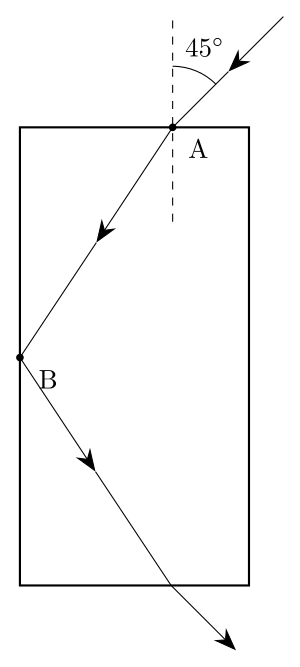
›Reveal solutionSolution
Combines Snell's law at the top face with the total-internal-reflection condition at the perpendicular side face to solve for the refractive index. Answer: 3/2.
Concept and Intuition
When light enters the top face of the slab and refracts, the geometry of the rectangular (perpendicular) faces means the angle the ray makes with the vertical-face normal is the complement of the angle it makes with the top-face normal. If total internal reflection just occurs at the side face, the angle of incidence there equals the critical angle. This links the entry refraction angle directly to the critical angle, and hence to the refractive index through both Snell's law and the critical-angle relation sinC=1/n.
Step-by-Step Solution
- At the top face: sin45∘=nsinr, where r is the refraction angle (measured from the vertical normal).
- Since the top and side faces are perpendicular, the ray's angle from the horizontal normal at the side face is 90∘−r.
- TIR occurs at B, so this angle equals the critical angle: 90∘−r=C⇒r=90∘−C.
- So sinr=sin(90∘−C)=cosC.
- Substitute into Snell's law: sin45∘=ncosC.
- Using sinC=1/n⇒cosC=1−1/n2, so sin45∘=n1−1/n2=n2−1.
- sin45∘=1/2, so n2−1=1/2⇒n2=3/2⇒n=3/2.
Common Mistakes
- Forgetting that the angle at the side face is the complement of the refraction angle at the top face, not the same angle.
- Confusing the condition "TIR just occurs" (angle = critical angle) with "angle greater than critical angle".
✓Final answerThe correct option is (A) — 23.
ANSWER: A
- AP EAPCET 2024Set eng-2024-05-21-FN1 markMCQQ.A ray of light travels from an optically denser to rarer medium. The critical angle for the two media is 'C'. The maximum possible deviation of the ray will be (A) 2π−C (B) 2C (C) π−2C (D) π−C
›Reveal solutionSolution
Comparing the largest refraction deviation (at grazing emergence) against the largest total-internal-reflection deviation (just past the critical angle) shows TIR wins; the maximum possible deviation is π−2C.
Concept and Intuition
A ray going from denser to rarer medium bends away from the normal. As the incidence angle i increases toward the critical angle C, the refraction angle approaches 90∘ and the deviation δrefr=(90∘−i) increases, topping out at 90∘−C right at i=C. Beyond C, refraction is no longer possible and the ray totally internally reflects, with deviation δTIR=180∘−2i — this is a decreasing function of i, so it is largest at i just above C, i.e. effectively 180∘−2C. Since TIR deviations are generically much larger than refraction deviations near the critical angle, the true maximum over all possible incidence angles is the TIR value.
Step-by-Step Solution
- Refraction deviation at incidence i≤C: δ=90∘−i (since refraction angle →90∘ as i→C). Maximum at i=C: δmax,refr=90∘−C.
- TIR deviation for i>C: reflection makes angle i with normal on both sides, so deviation =180∘−2i. This decreases as i increases, so its largest value (as i→C+) is 180∘−2C.
- Compare: for any C<90∘, 180∘−2C>90∘−C (equivalent to 90∘>C, always true).
- Hence overall maximum deviation =π−2C.
Common Mistakes
- Stopping at the refraction-only answer 90∘−C and missing that TIR gives a larger deviation.
- Confusing the TIR deviation formula (which is 180∘−2i, using the reflection law) with the refraction deviation formula.
✓Final answerThe correct option is (C) — π−2C.
ANSWER: C
- AP EAPCET 2024Set eng-2024-05-21-FN1 markMCQQ.The angle of polarisation for a medium with respect to air is 60°. The critical angle of this medium with respect to air is (A) Sin−13 (B) Tan−13 (C) Cos−13 (D) Sin−131
›Reveal solutionSolution
Brewster's angle gives the refractive index (n=tanip), and the critical angle follows from sinC=1/n.
Concept and Intuition
At the polarising (Brewster) angle, the reflected and refracted rays are perpendicular to each other, which leads to the simple relation n=tanip where n is the refractive index of the medium relative to the incident (air) side. The critical angle, relevant when light tries to go the other way (medium to air), is defined by sinC=1/n. Both are properties of the same pair of media, so one determines the other.
Step-by-Step Solution
- Brewster's law: n=tan(ip)=tan60∘=3.
- Critical angle relation (denser medium to air): sinC=n1=31.
- Therefore C=sin−1(31).
Common Mistakes
- Using cos or sin in Brewster's law instead of tan.
- Writing the critical angle as sin−13 (impossible, since 3>1) instead of its reciprocal.
✓Final answerThe correct option is (D) — sin−131.
ANSWER: D
- AP EAPCET 2023Set ap-2023-05-22-FN1 markMCQQ.The colour which has the highest critical angle of incidence is (A) Violet (B) Red (C) Yellow (D) Green
›Reveal solutionSolution
The colour with the lowest refractive index has the highest critical angle; among visible colours, red has the lowest refractive index in ordinary dispersive media.
Concept and Intuition
Critical angle for total internal reflection is given by sinθc=n1, where n is the refractive index of the medium for that colour of light. Because a medium's refractive index normally increases as wavelength decreases (normal dispersion), violet (shortest visible wavelength) has the highest n, and red (longest visible wavelength) has the lowest n. Since θc varies inversely with n, red — having the smallest n — has the largest critical angle.
Step-by-Step Solution
- Write θc=sin−1(1/n).
- Order refractive indices (normal dispersion): nviolet>ngreen>nyellow>nred.
- Since θc decreases as n increases, the ordering of critical angles is reversed: θc,red>θc,yellow>θc,green>θc,violet.
- So red has the highest critical angle among the given options.
Common Mistakes
- Assuming the colour with the highest refractive index (violet) has the highest critical angle — it's actually the opposite, an inverse relationship.
✓Final answerThe correct option is (B) — Red.
ANSWER: B
- AP EAPCET 2023Set eng-2023-05-18-FN1 markMCQQ.The critical angle for diamond with respect to air is nearly (A) 48.8∘ (B) 41.1∘ (C) 37.3∘ (D) 24.4∘
›Reveal solutionSolution
The critical angle relates to refractive index by sinC=1/n; using diamond's refractive index (n≈2.42) gives C≈24.4∘.
Concept and Intuition
Total internal reflection occurs beyond the critical angle, and by Snell's law applied at the critical angle (refracted ray grazing the surface at 90∘): nsinC=1×sin90∘⇒sinC=1/n.
Step-by-Step Solution
- Refractive index of diamond, n≈2.42.
- sinC=1/2.42≈0.4132.
- C=sin−1(0.4132)≈24.4∘.
Common Mistakes
- Using the refractive index of glass (≈1.5, giving C≈41.8∘, close to a distractor option) instead of diamond's much higher value.
✓Final answerThe correct option is (D) — 24.4∘.
ANSWER: D
- AP EAPCET 2023Set eng-2023-05-19-FN1 markMCQQ.With respect to air, the critical angle in a medium for red light of wave length λ1 is θ. Other facts remaining same, critical angle for yellow light of wave length λ2 will be (A) θ (B) more than θ (C) less than θ (D) λ2θλ1
›Reveal solutionSolution
This tests dispersion: shorter wavelengths have a higher refractive index and hence a
smaller critical angle. Answer: less than θ.
Concept and Intuition
The critical angle for total internal reflection depends on the refractive index via
sinθc=1/n: a larger refractive index means a smaller critical angle. In
normal dispersion, refractive index increases as wavelength decreases — violet/blue
bends more than red. Yellow light has a shorter wavelength than red, so it has a
slightly larger refractive index, and hence a slightly smaller critical angle.
Step-by-Step Solution
- Critical angle relation: sinθc=n1, so θc decreases as n increases.
- Red light (λ1, longer wavelength) has critical angle θ, i.e. sinθ=1/nred.
- Yellow light (λ2, shorter wavelength than red) has a slightly higher refractive index: nyellow>nred (normal dispersion).
- Since nyellow>nred, we get θc,yellow<θ.
Common Mistakes
- Assuming refractive index is the same for all visible colours (ignoring dispersion).
- Getting the direction of dispersion backwards (thinking longer wavelength bends more).
✓Final answerThe correct option is (C) — less than θ.
ANSWER: C
- AP EAPCET 2022Set eng-2022-07-04-FN1 markMCQQ.A ray is incident from a medium of refractive index 2 into a medium of refractive index 1. The critical angle is (A) 30∘ (B) 60∘ (C) 45∘ (D) 90∘
›Reveal solutionSolution
Direct application of the critical-angle formula for total internal reflection at the boundary between a denser and a rarer medium.
Concept and Intuition
Total internal reflection can occur only when light travels from a denser medium into a rarer one. The critical angle θc is the angle of incidence (in the denser medium) for which the refracted ray just grazes the interface at 90∘.
Step-by-Step Solution
- Snell's law: n1sinθc=n2sin90∘=n2.
- sinθc=n1n2=21.
- θc=30∘.
Common Mistakes
- Inverting the ratio (using n1/n2 instead of n2/n1), which would give an invalid sinθc>1.
✓Final answerThe correct option is (A) — 30∘.
ANSWER: A
- AP EAPCET 2022Set eng-2022-07-06-AN1 markMCQQ.A light ray is incident from a medium of refractive index 2 into a medium of refractive index 3. The critical angle is (A) 30° (B) 45° (C) 60° (D) 90°
›Reveal solutionSolution
Since light travels from a denser (n=2) to a rarer (n=3) medium, applying sinθc=n2/n1 gives a critical angle of 60∘.
Concept and Intuition
Total internal reflection (and hence a critical angle) only occurs when light travels from an optically denser medium toward a rarer one. The critical angle is defined by Snell's law applied at 90∘ refraction: n1sinθc=n2sin90∘=n2.
Step-by-Step Solution
- Here n1=2 (denser, since 2>3≈1.732) and n2=3 (rarer).
- Snell's law at the critical angle: n1sinθc=n2.
- sinθc=n1n2=23.
- θc=sin−1(23)=60∘.
Common Mistakes
- Computing n1/n2 instead of n2/n1 in the critical-angle formula.
- Forgetting that critical angle only applies going from denser to rarer medium (the direction matters).
✓Final answerThe correct option is (C) — 60°.
ANSWER: C
- AP EAPCET 2022Set eng-2022-07-07-FN1 markMCQQ.A beam of light is incident from air on the surface of a liquid. The angle of incidence is θ and the angle of refraction is α. If the critical angle for liquid when surrounded by air is θc then sinθc is (A) sin(θ)sin(α) (B) sin(α)×sin(θ) (C) sin(α)sin(θ) (D) cos(θ)sin(α)
›Reveal solutionSolution
This connects an ordinary refraction measurement (air into liquid) to the liquid's critical angle for total internal reflection; sinθc=sinα/sinθ.
Concept and Intuition
The refractive index of the liquid relative to air is fixed by Snell's law for light going from air (less dense) into the liquid (denser): n1sinθ=n2sinα, i.e. sinθ=nliquidsinα (since nair=1). The critical angle is defined for light travelling the other way (liquid to air), at which the refracted ray grazes the surface (90∘): nliquidsinθc=nairsin90∘=1.
Step-by-Step Solution
- Snell's law, air → liquid: 1⋅sinθ=nliquid⋅sinα⟹nliquid=sinαsinθ.
- Critical angle condition, liquid → air: nliquidsinθc=1⟹sinθc=nliquid1.
- Substitute: sinθc=sinθ/sinα1=sinθsinα.
Common Mistakes
- Inverting the refractive index formula (writing n=sinα/sinθ instead of sinθ/sinα) since air is the first, less dense medium.
- Confusing θ (angle of incidence in air) with θc (critical angle, a different angle defined for the reverse path).
✓Final answerThe correct option is (A) — sin(θ)sin(α).
ANSWER: A
- AP EAPCET 2021Set eng-2021-08-25-AN1 markMCQQ.If refractive index of water is 34 and that of a given slab immersed in it is 35. The value of critical angle for a ray of light tending to go from glass to water is: (A) sin−1(54) (B) sin−1(43) (C) sin−1(35) (D) sin−1(34)
›Reveal solutionSolution
Total internal reflection at a glass-water interface, going from the optically denser glass (n=5/3) to water (n=4/3), has critical angle sin−1(4/5).
Concept and Intuition
Total internal reflection (and hence a critical angle) can only occur when light travels from an optically denser medium (higher refractive index) toward a rarer medium (lower refractive index). Here the slab (n=5/3) is denser than water (n=4/3), so light going from glass to water can undergo total internal reflection beyond the critical angle.
Step-by-Step Solution
- Using Snell's law at the critical angle, the refracted ray in the rarer medium grazes along the interface (90∘):
nglasssinθc=nwatersin90∘=nwater
- Solve for sinθc:
sinθc=nglassnwater=5/34/3=54
- Hence:
θc=sin−1(54)
Common Mistakes
- Inverting the ratio (using nglass/nwater instead of nwater/nglass), which would incorrectly give a value greater than 1 for sinθc (impossible).
- Forgetting that critical angle formulas require going from denser to rarer medium — here that direction is glass→water, exactly as stated in the question.
✓Final answerThe correct option is (A) — sin−1(54).
ANSWER: A
🎓Unlock everything free for 14 days
- ✓Full step-by-step solutions
- ✓Concept-first explanations
- ✓Methods, shortcuts & mistakes
- ✓PYQ mapping + timed mock tests
Full access for 14 days. No credit card required.