Q.In a double-slit experiment the angular width of a fringe is found to be 0.2∘ on a screen placed 1 m away. The wavelength of light used is 600 nm. What will be the angular width of the fringe if the entire experimental apparatus is immersed in water? Take refractive index of water to be 34.
🔒You're viewing a preview — the full solution, concept, methods & PYQ mapping are locked.
🔒 Start your 14-day free trial to unlock the full solution →Concept understanding — Double Slit Interference
Double Slit Interference: From Ripples to Light
Imagine dropping two stones into a still pond at the same time, a short distance apart. Watch the ripples spread. Where a crest from one stone meets a crest from the other, the water rises higher. Where a crest meets a trough, the water flattens out. That is interference — waves adding or cancelling.
Now replace the water with light. Replace the stones with two narrow slits cut into a barrier. Shine a single colour of light (say, red laser light) onto the slits. On a screen behind the barrier, you do not see two bright spots. Instead, you see a pattern of alternating bright and dark bands — like a striped zebra crossing made of light.
That pattern is double slit interference. It is the single most convincing proof that light behaves as a wave.
The Core Idea
Light from a single source passes through two narrow slits. Each slit acts as a new source of waves. These two sets of waves spread out and overlap. At any point on the screen, the light you see is the sum of the waves from slit 1 and slit 2.
Whether they add (bright) or cancel (dark) depends on one thing: the path difference — how much farther one wave has travelled compared to the other.
For constructive interference (bright band): path difference = nλ (whole number of wavelengths)
For destructive interference (dark band): path difference = (n+21)λ (half-integer number of wavelengths)
Here λ is the wavelength of the light, and n=0,1,2,…
The Geometry
Let the slits be separated by distance d. The screen is far away at distance D (D≫d). For a point on the screen at angle θ from the centre:
- The path difference Δx=dsinθ
- Bright bands occur when dsinθ=nλ
- Dark bands occur when dsinθ=(n+21)λ
The position y of the n-th bright band on the screen (measured from the centre) is:
yn=dnλD
The spacing between consecutive bright bands (fringe width) is:
β=dλD
Fringe width β=dλD
What This Tells You
- Larger λ → wider fringes (red light spreads more than blue)
- Larger D → wider fringes (screen further away spreads the pattern)
- Smaller d → wider fringes (slits closer together spread the pattern more)
If you cover one slit, the pattern vanishes — you get a single blurry blob. The stripes only appear when both slits are open, proving that the light from the two slits is interfering.
Why It Matters
Double slit interference is not a classroom toy. It is the foundation of:
- Young's experiment (1801) — which settled the debate: light is a wave
- Diffraction gratings — used in spectrometers to identify elements by their light …
Why this formula?
Double Slit Interference: Why the Formula Holds
Let's build the understanding from first principles — not just memorise the formula, but see why it must be true.
1. The Core Idea: Path Difference Creates Phase Difference
Imagine two narrow slits S1 and S2, separated by distance d, illuminated by a single coherent source. Light from each slit travels to a point P on a screen at distance D (where D≫d).
- The two waves start in phase at the slits (same source).
- They travel different distances to reach P.
- This path difference Δx causes a phase difference Δϕ.
Key relation:
Δϕ=λ2π⋅Δx
Why? Because one full wavelength λ corresponds to a phase change of 2π radians.
2. Finding the Path Difference
From the geometry (see diagram in any textbook):
- For a point P at angle θ from the central axis, the extra distance travelled by the wave from the farther slit is approximately:
Δx=dsinθ
Why approximate? Because we assume D≫d, so the two paths are nearly parallel. This is the Fraunhofer (far-field) approximation — valid for most exam setups.
3. Condition for Constructive Interference (Bright Fringes)
Waves interfere constructively when they arrive in phase:
Δϕ=2πm(m=0,±1,±2,…)
Using Δϕ=λ2π⋅dsinθ, we get:
λ2π⋅dsinθ=2πm
Cancel 2π to obtain the bright fringe condition:
dsinθ=mλ
- m is called the order of the fringe.
- m=0 gives the central bright fringe (straight ahead).
4. Condition for Destructive Interference (Dark Fringes)
Waves interfere destructively when they arrive out of phase by π (half a cycle):
Δϕ=(2m+1)π
Substitute again:
λ2π⋅dsinθ=(2m+1)π
Cancel π to get the dark fringe condition:
dsinθ=(m+21)λ
5. From Angle to Position on Screen
For small angles (typical in exam problems), sinθ≈tanθ=Dy, where y is the distance from the central maximum on the screen.
Bright fringe position:
ym=dmλD
Dark fringe position:
ym=d(m+21)λD …
The angular fringe width in a double-slit setup is θ=λ/d, so it scales directly with wavelength; since light slows down and its wavelength shrinks by a factor equal to the refractive index when it enters a denser mediu …
The angular fringe width is θ=λ/d; immersing the setup in water reduces the wavelength to λ/μ, so the new angular width is 0.2∘×43=0.15∘.
Step 1: Angular fringe width formula
In Young's double-slit experiment, the linear fringe width on screen is β=dλD, so the angular fringe width (independent of the screen distance D) is
θ=Dβ=dλ
Step 2: Wavelength change in water
The frequency of light does not change when it enters a new medium, but its speed and hence wavelength do:
λwater=μwaterλair=4/3600 nm=450 nm
Step 3: New angular fringe width
Since d (the slit separation) is unchanged, and θ∝λ: …
Showing the 12 most recent of 43 on this concept.
- AP EAPCET 2026Set eng-2026-05-12-FN1 markMCQQ.Two waves of amplitude 'A' and frequency 'ν' are superimposed with each other. After super position, the maximum intensity is (A) A (B) A2 (C) 2A (D) 4A2
›Reveal solutionSolution
This tests superposition of waves: constructive interference gives resultant amplitude 2A, so maximum intensity scales as (2A)2=4A2.
Concept and Intuition
When two coherent waves of the same amplitude and frequency overlap, their displacements add algebraically. At points where they are exactly in phase, the amplitudes add directly, giving the largest possible resultant amplitude. Since intensity is proportional to the square of amplitude (not the amplitude itself), doubling the amplitude quadruples the intensity — interference is a much bigger multiplier on intensity than it is on amplitude.
Step-by-Step Solution
- Each wave has amplitude A, so its own intensity is I∝A2.
- At a point of constructive interference (path difference = integer multiple of λ), the resultant amplitude is Amax=A+A=2A. …
- AP EAPCET 2026Set eng-2026-05-12-FN1 markMCQQ.Young's double slit experiment is conducted in water. The refractive index of water is 1.33. Wavelength of incident light is 6000 Å and the separation between the slits is 2 mm. Fringe width is given by 0.63 mm. The distance between screen and slits is (A) 1.4 m (B) 1.04 m (C) 2.79 m (D) 1.72 m
›Reveal solutionSolution
This tests YDSE fringe width when the experiment is performed inside a refractive medium; the wavelength inside the medium must be used, giving D≈2.79 m.
Concept and Intuition
Fringe width in Young's double-slit experiment depends on the wavelength inside the medium where the interference actually happens, not the vacuum/air wavelength. When the whole setup is submerged in water, the effective wavelength shrinks by a factor of μ (the medium's refractive index), which in turn changes the fringe width for the same slit separation and screen distance — so we must first find the water wavelength before applying the standard fringe-width relation.
Step-by-Step Solution
- Wavelength in water: λ′=μλ=1.336000 A˚≈4511.3 A˚=4.5113×10⁻⁷ m.
- Fringe width formula: β=dλ′D, so D=λ′βd. …
- AP EAPCET 2026Set eng-2026-05-13-FN1 markMCQQ.In a Young's double slit experiment, the intensity at a point where the path difference is 6λ (λ being the wavelength of the light used) is I. If I0 denotes the maximum intensity, I0I is (A) 21 (B) 23 (C) 21 (D) 43
›Reveal solutionSolution
Converts a path difference into a phase difference and applies the two-slit interference intensity law I=I0cos2(δ/2); the answer is I/I0=3/4.
Concept and Intuition
In YDSE, the resultant intensity at any point depends on the phase difference δ between the two coherent waves arriving there, which comes directly from the path difference Δx: δ=λ2πΔx. The standard two-source interference result is
I=4a2cos2(2δ)=Imaxcos2(2δ)
where Imax=I0 is the intensity at a bright fringe (δ=0). So knowing the path difference in terms of λ immediately gives the fractional intensity, without needing the individual slit intensities.
Step-by-Step Solution
- Path difference given: Δx=λ/6.
- Phase difference: δ=λ2π⋅6λ=3π. …
- AP EAPCET 2026Set eng-2026-05-14-FN1 markMCQQ.In Young's double slit experiment, the ratio of intensities of maxima and minima in the interference experiment is 25:9. The ratio of intensities of two slits is (A) 18:3 (B) 4:1 (C) 8:1 (D) 16:1
›Reveal solutionSolution
This tests the standard fringe-visibility relation between Imax/Imin and the ratio of the two slit intensities. Answer: 16:1.
Concept and Intuition
In Young's double-slit experiment, the resultant intensity varies between Imax=(I1+I2)2 (constructive) and Imin=(I1−I2)2 (destructive). The ratio Imax/Imin depends only on the ratio of the individual slit intensities, so given the fringe contrast we can back out how unequal the two slits are.
Step-by-Step Solution
- IminImax=(I1−I2I1+I2)2=925.
- Taking square roots: I1−I2I1+I2=35.
- Let r=I1/I2. Dividing numerator and denominator by I2: r−1r+1=35.
- Cross-multiplying: 3(r+1)=5(r−1)⇒3r+3=5r−5⇒8=2r⇒r=4. …
- AP EAPCET 2026Set eng-2026-05-13-AN1 markMCQQ.The correct relation between fringe width (β) and distance between the slits(d) is (A) [FIGURE: graph of β vs d — a straight line with negative slope, decreasing] (B) [FIGURE: graph of β vs d — a curve decreasing steeply and flattening (inverse-like), concave up] (C) [FIGURE: graph of β vs d — a straight line through the origin with positive slope, increasing] (D) [FIGURE: graph of β vs d — a curve rising from the origin and flattening to a constant value]
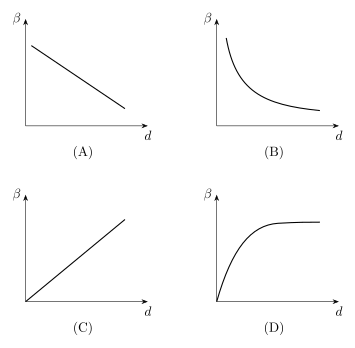
›Reveal solutionSolution
This tests the exact functional form of fringe width versus slit separation in Young's double slit experiment: β=λD/d is an inverse relationship, so its graph is a decreasing hyperbola, not a straight line.
Concept and Intuition
In Young's double-slit interference, the fringe width — the spacing between consecutive bright (or dark) fringes on the screen — is given by
β=dλD,
where λ is the wavelength of light, D is the distance from the slits to the screen, and d is the separation between the two slits. For fixed λ and D, β is inversely proportional to d: β∝1/d. This is a hyperbola-type relationship: as d→0, β→∞ (very widely spaced fringes), and as d increases, β falls off rapidly at first and then more gradually, asymptotically approaching (but never touching) the horizontal axis. It is emphatically not a straight line, since a straight line would mean β is directly proportional (or linearly related) to d, which contradicts the 1/d form.
Step-by-Step Solution
- Start from the standard fringe-width formula β=λD/d.
- Treat λD as a constant k (for fixed source wavelength and fixed screen distance), so β=k/d.
- This is the equation of a rectangular hyperbola in the β–d plane: β⋅d=k (constant). …
- AP EAPCET 2026Set eng-2026-05-15-AN1 markMCQQ.In Young's double slit experiment, the fringe width is β. If the distance between slit and screen is doubled and separation between slits is made ¼ of initial value, then new fringe width is (A) 4β (B) 4β (C) 8β (D) 8β
›Reveal solutionSolution
Direct application of the YDSE fringe-width formula's dependence on screen distance and slit separation. Doubling D and quartering d multiplies the fringe width by 8. Answer: 8β.
Concept and Intuition
In Young's double slit experiment, the fringe width (spacing between consecutive bright or dark fringes) is
β=dλD
where D is the slit-to-screen distance and d is the slit separation. Physically, moving the screen farther away (D increases) spreads the interference pattern out (fringes get wider), while moving the slits closer together (d decreases) also spreads the pattern out (the diffracted/interfering beams overlap over a wider angular range for the same fringe order). Both changes here act in the same direction — both increase β — so their effects multiply together rather than partially cancel.
Step-by-Step Solution
- Original fringe width: β=dλD.
- New conditions: D′=2D (doubled), d′=4d (quartered).
- New fringe width: …
- AP EAPCET 2026Set eng-2026-05-15-FN1 markMCQQ.Interference fringes produced by a double slit arrangement using a monochromatic light of wave length 5,890Å, have an angular fringe width 0.28∘. If the entire arrangement is immersed in water, the new angular fringe width will be (aμω=4/3) (A) 0.24∘ (B) 0.21∘ (C) 0.18∘ (D) 0.36∘
›Reveal solutionSolution
Immersing the double-slit setup in water shortens the wavelength of light by a factor 1/μw, which shrinks the angular fringe width by the same factor, from 0.28∘ to 0.21∘.
Concept and Intuition
Angular fringe width in a Young's double slit experiment is θ=λ/d, depending only on the wavelength (in the medium the light is actually traveling through) and the slit separation d (a fixed mechanical quantity, unaffected by immersion). When the whole setup (slits, screen, and the medium between them) is immersed in water, the wavelength of light in that medium shortens to λwater=λair/μw, so the fringe pattern compresses proportionally.
Step-by-Step Solution
- In air: θair=λair/d=0.28∘.
- In water: λwater=λair/μw, and d is unchanged, so θwater=λwater/d=θair/μw. …
- AP EAPCET 2026Set ap-2026-05-19-FN1 markMCQQ.If Young's double slit experiment is done in air first and then if the experiment is conducted by immersing the apparatus in water, the fringe width (A) remains same (B) decreases (C) increases (D) Becomes zero
›Reveal solutionSolution
Tests how immersing Young's double-slit setup in a medium changes fringe width — the wavelength shrinks in a denser medium, so the fringes get closer together.
Concept and Intuition
Fringe width in YDSE, β=λD/d, is set by the wavelength of light inside the medium the light is travelling through, not its vacuum/air wavelength. Water has a refractive index greater than air, so light slows down and its wavelength shrinks proportionally (λmedium=λair/n), which directly shrinks the fringe spacing since everything else (D, d) is unchanged by the medium.
Step-by-Step Solution
- Fringe width formula: β=dλD, where λ is the wavelength in the medium the interference is occurring in, D is slit-to-screen distance, d is slit separation.
- In air, λ=λair (essentially, since nair≈1).
- When immersed in water (refractive index nw≈1.33), the wavelength becomes λwater=nwλair, which is smaller than λair.
- D and d are geometric quantities of the apparatus and don't change on immersion. …
- AP EAPCET 2026Set ap-2026-05-20-FN1 markMCQQ.Young's double slit experiment setup is in such a way that, when path difference is λ, then intensity at a point is I. If the path difference is 4λ, then intensity at the same point is (A) 2I (B) 2I (C) 2I (D) 2I
›Reveal solutionSolution
Using the two-slit intensity formula I(δ)=4I0cos2(δ/2), calibrating with the given path-difference-λ case shows the intensity at path difference λ/4 is I/2.
Concept and Intuition
In Young's double slit experiment, the resultant intensity at a point depends on the phase difference δ between the two interfering waves, via I=4I0cos2(δ/2), where I0 is the intensity due to a single slit alone and δ=λ2π×Δ for a path difference Δ. A path difference of a full wavelength (Δ=λ) gives δ=2π, which is constructive interference (maximum intensity), letting us calibrate I0 from the given information.
Step-by-Step Solution
- At path difference Δ=λ: phase δ=λ2π×λ=2π.
- I=4I0cos2(2π/2)=4I0cos2(π)=4I0(1)2=4I0. Given this equals I: I0=I/4.
- At path difference Δ=λ/4: phase δ=λ2π×4λ=2π. …
- AP EAPCET 2025Set eng-2025-05-21-FN1 markMCQQ.In Young's double slit experiment, the wavelengths of red and blue lights used are 7.5×10⁻⁵ cm and 5×10⁻⁵ cm respectively. If nth bright fringe of red color coincides with (n+1)th bright fringe of blue colour, then the value of 'n' is (A) 1 (B) 2 (C) 4 (D) 8
›Reveal solutionSolution
This tests fringe coincidence in Young's double-slit experiment for two wavelengths. Answer: n=2.
Concept and Intuition
In YDSE the bright fringe positions for a given wavelength form an evenly-spaced set, yn=dnλD. Two different colours have different fringe spacings, so their bright fringes drift apart and occasionally land at the same point on the screen — this is fringe coincidence. At the coincidence point, the physical position y must be identical for both colours, even though the fringe order n differs.
Step-by-Step Solution
- Position of nth red bright fringe: y=dnλredD.
- Position of (n+1)th blue bright fringe: y=d(n+1)λblueD.
- Equate (same D,d, so they cancel): nλred=(n+1)λblue. …
- AP EAPCET 2025Set eng-2025-05-22-AN1 markMCQQ.In Young's double slit experiment, the wavelength of monochromatic light is increased by 20% and the distance between the two slits is decreased by 25%. If the initial fringe width is 0.3 mm, then the final fringe width is (A) 0.72 mm (B) 0.60 mm (C) 0.16 mm (D) 0.48 mm
›Reveal solutionSolution
Fringe width in YDSE scales directly with wavelength and inversely with slit separation. Increasing λ by 20% and decreasing d by 25% together multiply the fringe width by 1.6, giving 0.48 mm.
Concept and Intuition
In Young's double slit experiment, bright fringes form where path difference is an integer multiple of λ; the spacing between adjacent fringes on the screen is β=λD/d. Increasing the wavelength spreads the fringes further apart (a 'wider' interference pattern), while increasing slit separation squeezes them closer together — hence β scales directly with λ and inversely with d. Both changes here work in the SAME direction (increasing β): a longer wavelength directly increases it, and a smaller slit separation ALSO increases it.
Step-by-Step Solution
- Fringe width formula: β=dλD.
- New wavelength: λ′=λ+20%λ=1.2λ.
- New slit separation: d′=d−25%d=0.75d. …
- AP EAPCET 2025Set eng-2025-05-23-FN1 markMCQQ.In Young's double slit experiment, the distance between the slits is 0.2 cm, the distance between the screen and the slits is 1 m. If the wavelength of light used in the experiment is 5000 Å, then the distance between two consecutive dark fringes on the screen is (A) 0.25 mm (B) 0.26 mm (C) 0.27 mm (D) 0.28 mm
›Reveal solutionSolution
The spacing between consecutive dark (or bright) fringes in YDSE equals the fringe width β=λD/d. Answer: 0.25 mm.
Concept and Intuition
In Young's double slit experiment, both bright and dark fringes are equally spaced (they alternate), so the distance between any two consecutive dark fringes is the same as the fringe width β, which depends on the wavelength of light, the slit separation, and the screen distance.
Step-by-Step Solution
- Convert values to SI: d=0.2 cm=2×10⁻³ m; D=1 m; λ=5000 A˚=5000×10−10 m=5×10⁻⁷ m.
- Fringe width: β=dλD=2×10−35×10−7×1.
- Compute: β=2.5×10⁻⁴ m=0.25 mm. …
🎓Unlock everything free for 14 days
- ✓Full step-by-step solutions
- ✓Concept-first explanations
- ✓Methods, shortcuts & mistakes
- ✓PYQ mapping + timed mock tests
Full access for 14 days. No credit card required.