Q.Out of o- and p-dibromobenzene which one has higher melting point and why?
You're viewing a preview — the full solution, concept, methods & PYQ mapping are locked.
Start your 14-day free trial to unlock the full solution →
The key idea is that molecular symmetry in the solid state determines melting point. p-Dibromobenzene has a higher melting point than o-dibromobenzene because its symmetrical structure allows it to pack more efficiently into a crystal lattice, requiring more energy to melt.
Why Symmetry Matters for Melting Points
Melting point is not about how strongly molecules interact in general — it’s about how well they pack together in the solid state. A molecule that fits neatly into a crystal lattice (like bricks in a wall) will have strong intermolecular forces holding the crystal together. A molecule that is bent or asymmetrical creates gaps and weak points in the lattice, so less energy is needed to break it apart.
For disubstituted benzenes, the relative positions of the two bromine atoms dramatically change the molecular shape and symmetry.
Step-by-Step Reasoning
1. Identify the molecular structures
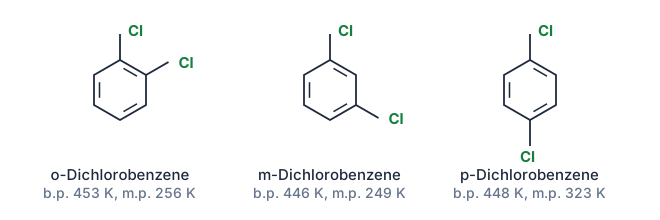
- o-Dibromobenzene (1,2-dibromobenzene): The two bromine atoms are adjacent on the benzene ring. This creates a molecule with a bent, asymmetrical shape — the bromines are on one side, making the molecule polar and lopsided.
- p-Dibromobenzene (1,4-dibromobenzene): The two bromine atoms are directly opposite each other. This gives a highly symmetrical, rod-like shape — the molecule has a centre of symmetry and is non-polar overall.
2. Consider crystal packing efficiency
In the solid state, molecules arrange themselves to minimise empty space. p-Dibromobenzene, being symmetrical and flat, can stack neatly like tiles. Its molecules fit into a regular, repeating lattice with strong intermolecular forces (primarily London dispersion forces, which are significant for large, polarisable bromine atoms) acting uniformly in all directions.
o-Dibromobenzene, with its bent shape, cannot pack as tightly. The protruding bromine atoms create steric hindrance, forcing molecules apart and leaving voids in the crystal. This looser packing means weaker overall intermolecular forces holding the crystal together.
3. Compare the actual melting points
The experimental data confirms this reasoning:
| Compound | Melting Point (°C) |
|---|---|
| o-Dibromobenzene | ≈ 7 |
| p-Dibromobenzene | 87.3 |
Unlock everything free for 14 days
- Full step-by-step solutions
- Concept-first explanations
- Methods, shortcuts & mistakes
- PYQ mapping + timed mock tests
Full access for 14 days. No credit card required.