Q.Match the reactions given in Column I with the names given in Column II.
Column I:
(i)
Column II:
You're viewing a preview — the full solution, concept, methods & PYQ mapping are locked.
Start your 14-day free trial to unlock the full solution →This is a matching problem linking four organic reactions to their standard name. The correct mapping is (i)→ (b), (ii)→ (a), (iii)→ (d), (iv)→ (c).
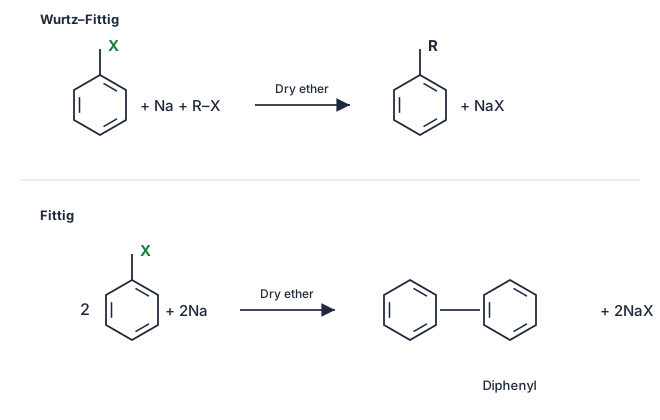
The key to solving this is recognising the reagent pattern and the product structure — each reaction has a classic signature that tells you which name it belongs to. Let’s walk through them one by one.
-
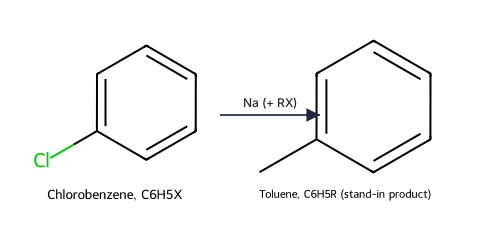
Reaction (i):
An aryl halide and an alkyl halide react with sodium metal to give an alkylbenzene. This is a cross-coupling between an aromatic and an aliphatic halide.
That’s the hallmark of the Wurtz–Fittig reaction — it’s a variant of the Wurtz reaction where one partner is aromatic.
→ Matches with (b).
-
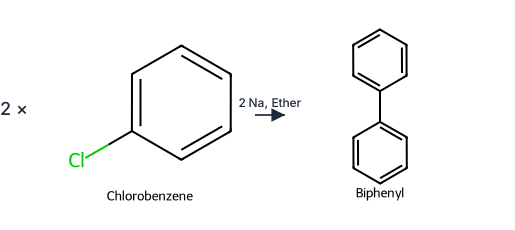
Reaction (ii):
Two aryl halides couple in the presence of sodium to form a biaryl (diphenyl). No alkyl halide is involved.
This is the Fittig reaction (sometimes called the Wurtz–Fittig reaction when alkyl halides are also present, but here it’s purely aromatic).
→ Matches with (a).
-
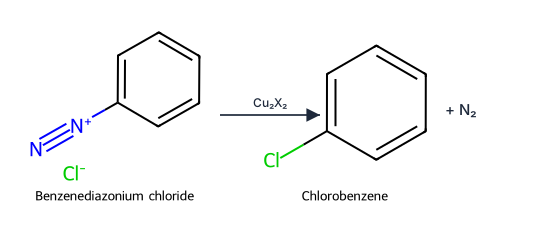
Reaction (iii):
A diazonium salt is decomposed by cuprous halide () to replace the diazonium group with a halogen. Nitrogen gas is evolved.
This is the classic Sandmeyer reaction — the copper(I) halide catalyses the substitution.
→ Matches with (d).
-
Reaction (iv): …
Unlock everything free for 14 days
- Full step-by-step solutions
- Concept-first explanations
- Methods, shortcuts & mistakes
- PYQ mapping + timed mock tests
Full access for 14 days. No credit card required.