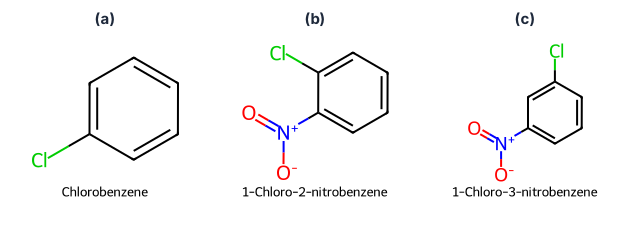
Q.Arrange the compounds in increasing order of rate of reaction towards nucleophilic substitution. (Note printed in the Exemplar for questions 26 to 29.)
You're viewing a preview — the full solution, concept, methods & PYQ mapping are locked.
Start your 14-day free trial to unlock the full solution →
The rate of nucleophilic aromatic substitution (SNAr) is controlled by the electron-withdrawing power and position of substituents. Nitro groups activate the ring toward substitution only when they are ortho or para to the leaving group. Meta-nitro groups have a much weaker effect. So the order is: chlorobenzene (slowest) < 1-chloro-3-nitrobenzene < 1-chloro-2-nitrobenzene (fastest). The correct option is (iii).
Why this approach works
Nucleophilic aromatic substitution (SNAr) follows a two-step addition-elimination mechanism. The rate-determining step is the formation of a Meisenheimer complex (a negatively charged σ-adduct). Anything that stabilizes this negative charge speeds up the reaction.
Electron-withdrawing groups (EWGs) like stabilize the negative charge by resonance and induction. But here's the key: resonance stabilization only works when the EWG is ortho or para to the leaving group. A meta-nitro group cannot delocalize the negative charge through resonance — it can only withdraw inductively, which is much weaker.
So the question reduces to: which positions of the nitro group actually help stabilize the Meisenheimer intermediate?
Step-by-step reasoning
1. Identify the reaction type and mechanism
All three compounds are aryl chlorides. In chlorobenzene, the chlorine is directly attached to an sp² carbon. Nucleophilic substitution here does not proceed via an SN1 or SN2 pathway (the C–Cl bond is too strong, and backside attack is blocked by the ring). Instead, it follows the SNAr (addition-elimination) mechanism.
The figure below shows the ground-state resonance of a halobenzene — the halogen's lone pair donating into the ring. This is background, not the reaction intermediate: it is what gives the aryl C–Cl bond its partial double-bond character, which is why the SN1/SN2 pathways are closed off. The negatively charged Meisenheimer complex discussed next is a different, separate species.
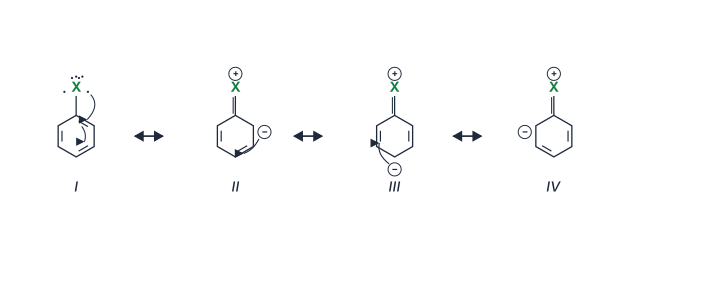
In SNAr, the rate depends on how well the ring can stabilize the negative charge that develops in the Meisenheimer complex. Electron-withdrawing groups ortho or para to the leaving group are powerfully activating. Meta groups are only weakly activating.
2. Analyze compound (a): chlorobenzene
No nitro group. No resonance or inductive stabilization of the intermediate. The negative charge is localized entirely on the ring, making the intermediate high in energy. This is the slowest of the three.
3. Analyze compound (c): 1-chloro-3-nitrobenzene (meta)
The is meta to Cl (on C3, counting the C–Cl carbon as C1). Draw the resonance structures of the Meisenheimer complex formed by nucleophilic attack at the C–Cl (ipso) carbon: the negative charge delocalises only onto the carbons ortho and para to C1 — that is, C2, C4 and C6. It never reaches C3, the carbon bearing the nitro group, so a meta nitro group gets no opportunity to accept the charge through resonance. The only stabilization it provides comes from its inductive effect (withdrawal through σ-bonds), which is modest.
So (c) is faster than (a), but not by much. …
Unlock everything free for 14 days
- Full step-by-step solutions
- Concept-first explanations
- Methods, shortcuts & mistakes
- PYQ mapping + timed mock tests
Full access for 14 days. No credit card required.