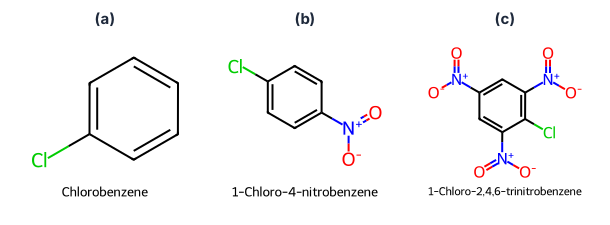
Q.Arrange the compounds in increasing order of rate of reaction towards nucleophilic substitution. (Note printed in the Exemplar for questions 26 to 29.)
You're viewing a preview — the full solution, concept, methods & PYQ mapping are locked.
Start your 14-day free trial to unlock the full solution →
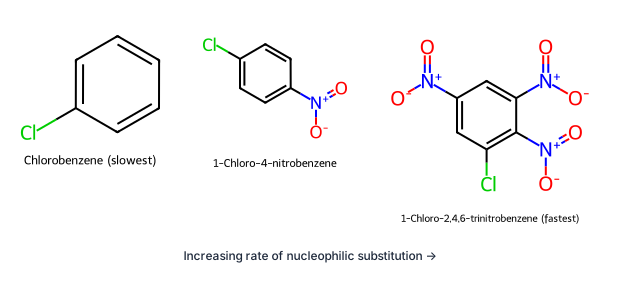
The rate of nucleophilic substitution in aryl halides increases dramatically when strong electron-withdrawing groups (like –NO₂) are present at the ortho and para positions. The correct order is chlorobenzene < 1-chloro-4-nitrobenzene < 1-chloro-2,4,6-trinitrobenzene, which corresponds to option (iv).
Why this problem is about resonance stabilisation, not just induction
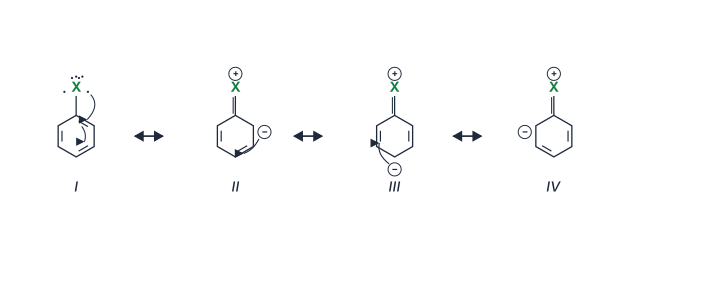
In nucleophilic substitution on aryl halides (SNAr mechanism), the rate depends on how easily the nucleophile can attack the carbon bearing the halogen. A chlorine on a plain benzene ring is quite unreactive because the lone pairs on chlorine are delocalised into the ring, giving the C–Cl bond partial double-bond character. But when nitro groups are present, they can stabilise the negative charge that builds up on the ring during the attack — and that changes everything.
The key is that nitro groups are strongly electron-withdrawing by both induction and resonance. However, for SNAr, resonance withdrawal from the ortho and para positions is what matters. A nitro group at the para position can directly accept electron density from the ring when a negative charge develops at the carbon bearing the chlorine. At the meta position, this resonance stabilisation is impossible — so meta-nitro groups are far less effective.
Let’s see how this plays out for the three compounds given.
-
Chlorobenzene (a) — no activating/withdrawing groups. The ring is electron-rich, and the nucleophile faces a high energy barrier. The intermediate Meisenheimer complex (the negatively charged σ-adduct) is not stabilised at all. This is the slowest.
-
1-Chloro-4-nitrobenzene (b) — one nitro group at the para position. When the nucleophile attacks at the carbon bearing chlorine, the negative charge can be delocalised onto the oxygen atoms of the nitro group via resonance. This stabilises the intermediate significantly. The rate is much faster than chlorobenzene — typically by a factor of or more.
-
1-Chloro-2,4,6-trinitrobenzene (c) — three nitro groups, all at positions that can stabilise the intermediate (two ortho, one para). The negative charge can be spread across three nitro groups. This compound is so reactive that it undergoes nucleophilic substitution even under mild conditions — it’s the famous picryl chloride. The rate is astronomical compared to the others. …
Unlock everything free for 14 days
- Full step-by-step solutions
- Concept-first explanations
- Methods, shortcuts & mistakes
- PYQ mapping + timed mock tests
Full access for 14 days. No credit card required.