Q.State Ampere's circuital law. Using the law calculate the magnetic field at a distance r outside an indefinitely long wire carrying current I. How does the magnetic field depend on the length of the wire? (1+1 1/2+1/2=3) OR Define magnetisation M of a substance. Draw the pattern of magnetic field lines near
You're viewing a preview — the full solution, concept, methods & PYQ mapping are locked.
Start your 14-day free trial to unlock the full solution →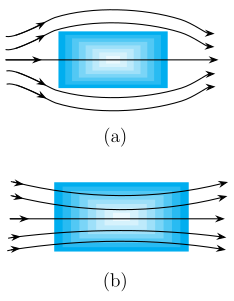
Applying Ampere's law to a circular loop around a long straight wire gives B = μ0I/2πr, independent of the wire's length. (OR: magnetisation M is dipole moment per unit volume; dia- and para-magnetic materials respectively expel and draw in field lines.)
Ampere's Circuital Law:
Statement: The line integral of the magnetic field B⃗ around any closed loop equals μ0 times the total (conduction) current threading through the loop:
(loop integral of) B⃗ · dl⃗ = μ0 Ienc
Application — field outside a long straight wire:
Consider an infinitely long straight wire carrying current I. By symmetry, the magnetic field lines form concentric circles around the wire, and B⃗ has the same magnitude at every point on a circle of radius r centred on the wire, always tangential to the circle (along dl⃗).
Choose an Amperian loop = a circle of radius r, centred on and coaxial with the wire. Then B⃗ is parallel to dl⃗ everywhere on the loop and constant in magnitude, so:
(loop integral of) B⃗·dl⃗ = B (loop integral of) dl = B(2πr)
The current enclosed by this loop is simply I (the wire's current). By Ampere's law:
B(2πr) = μ0 I
⇒ B = μ0I / (2πr)
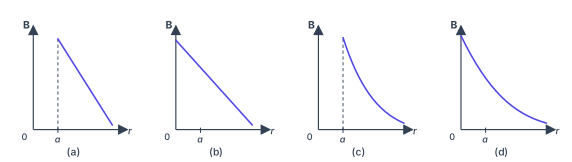
Dependence on the length of the wire: The magnetic field at distance r does NOT depend on the length of the wire at all — it depends only on the current I and the radial distance r. (The formula is derived assuming an infinitely long wire; for a wire of finite length, this expression is a good approximation as long as r is much smaller than the distance to either end of the wire.)
OR — Magnetisation and field patterns:
Magnetisation M⃗ of a substance is defined as the net magnetic moment per unit volume of the material:
M⃗ = (net magnetic dipole moment) / (volume), unit A/m.
It measures how strongly the material's atomic magnetic dipoles align (or partially align) with an applied field.
…
Unlock everything free for 14 days
- Full step-by-step solutions
- Concept-first explanations
- Methods, shortcuts & mistakes
- PYQ mapping + timed mock tests
Full access for 14 days. No credit card required.