Q.A coaxial cable consists of a central conducting core wire of radius 'a' and a coaxial cylindrical outer conductor of radius 'b'. The two conductors carry equal current in opposite directions, in and out of the plane of the paper. What will be the magnitude of magnetic induction B for
(i) a<r<b and
(ii) b<r? What will be its direction? where 'r' is the radius of the Ampere's circular loop.
Imagine you're standing in a field of grass, and you walk in a complete circle. If the grass is perfectly flat and still, your path feels the same all the way around. But if there's a strong wind blowing through the center of your circle, you'll feel it push you differently at different points along your walk.
Electric currents create magnetic fields. Ampere's Circuital Law is a way of measuring how much magnetic field is swirling around a current — like measuring how strong the "whirlpool" of field lines is around a wire.
The key idea: if you take a closed loop (any shape you like) and add up the magnetic field along every tiny piece of that loop, the total you get is directly proportional to the amount of current that passes through the loop. No current through the loop? The total is zero.
Note
This is the magnetic analogue of Gauss's Law for electricity. Gauss's Law relates the flux of electric field through a closed surface to the charge inside. Ampere's Law relates the circulation of magnetic field around a closed loop to the current inside.
The Precise Statement
Ampere's Circuital Law states:
∮B⋅dl=μ0Ienc
Let's break down every symbol:
∮ — The circle on the integral sign means you're integrating around a closed loop. You start at some point, trace a complete path, and return to where you began.
B — The magnetic field at each point on your loop.
dl — An infinitesimally small piece of your loop, treated as a vector pointing along the direction you're walking.
B⋅dl — The dot product. This picks up only the part of the magnetic field that points along your path. If the field is perpendicular to your path at some point, that piece contributes nothing.
μ0 — The permeability of free space, a fundamental constant (4π×10−7T⋅m/A). It tells you how "strongly" a current creates a magnetic field in empty space.
Ienc — The net current passing through the area bounded by your loop. "Net" means you add currents going one way and subtract currents going the opposite way.
Watch out
The current must pass through the loop's opening — not just anywhere near it. A current that runs outside the loop contributes zero to the right-hand side, even if it produces a magnetic field at points on the loop.
Why the Dot Product Matters
The dot product B⋅dl=Bdlcosθ where θ is the angle between the field and your path. This is crucial: if you walk along a path where the magnetic field is always perpendicular to your direction, you get zero contribution at every step — even if the field is huge.
This is why Ampere's Law is most useful for symmetric situations. You choose your loop so that:
The magnetic field is constant in magnitude along the loop.
The field is always parallel (or antiparallel) to your path, so cosθ=±1.
Then the integral becomes simple multiplication: B×(circumference of loop)=μ0Ienc.
The Classic Example: A Straight Wire
Consider an infinitely long, straight wire carrying current I. The magnetic field circles around the wire in concentric circles. Choose your Amperian loop to be a circle of radius r centered on the wire.
By symmetry, B is the same at every point on the circle and points tangent to it — exactly along dl. So:
∮B⋅dl=B×(2πr)=μ0I
Therefore:
B=2πrμ0I
This is the familiar formula for the field around a long straight wire. Notice: the field falls off as 1/r, not 1/r2 like the electric field from a point charge. Magnetic fields from currents have a different geometry.
Tip
| Configuration | Amperian Loop | Result |
|:---|:---|:---|
| Straight wire | Circle centered on wire | B=2πrμ0I | …
Applying Ampere's circuital law to a circular loop drawn around a coaxial cable, the current actually enclosed by the loop — and hence the field it computes — depends on whether the loop lies between the two conductors or outside both of them. …
Applying Ampere's circuital law with a circular loop of radius r: only the inner conductor's current is enclosed for a<r<b, giving a nonzero field; for r>b the equal and opposite currents cancel, giving zero field.
Let the inner core (radius a) carry current I into the page, and the outer conductor (radius b) carry the same current I out of the page. By symmetry, the magnetic field at radius r from the axis is tangential (circular field lines) and has the same magnitude everywhere on an Amperian loop of that radius, so Ampere's law gives:
∮B⋅dl=B(2πr)=μ0Ienc
(i) For a<r<b: The Amperian loop of radius r lies between the two conductors, so it encloses only the current of the inner conductor, Ienc=I:
B(2πr)=μ0I⟹B=2πrμ0I
Direction: circular field lines encircling the inner conductor, direction given by the right-hand thumb rule for the current in the inner core (e.g. anticlockwise as seen from a point towards which the inner current flows).
Same / Similar Concept — real previous-year questions on the same or a closely similar concept, not this exact question.
CBSE 2026Set 55/1/11 markMCQ
Q.A long straight wire of circular cross-section (radius a) carries a steady current I. The current is uniformly distributed across this cross-section. The magnitude of the magnetic field produced at a point at a distance (2a) from the axis of the wire will be (A) Zero (B) 2πaμ0I (C) 4πaμ0I (D) 6πaμ0I
›Reveal solutionSolution
For a current uniformly distributed across a wire's cross-section, the magnetic field inside the wire grows linearly with distance from the axis. At r=a/2, the field is half its surface value, giving 4πaμ0I, which corresponds to option (C).
The key insight here is that the magnetic field inside a current-carrying conductor depends only on the current enclosed by the Amperian loop, not the total current. For a uniform current density, the enclosed current scales with the area of the loop, so the field inside increases linearly with r.
Let's work through this systematically.
Set up the problem. We have a long straight wire of radius a carrying a steady current I, uniformly distributed over its cross-section. We need the magnetic field at a distance r=a/2 from the axis — that's a point inside the wire.
Recall Ampere's Law. For a long straight wire with cylindrical symmetry, Ampere's Law states:
∮B⋅dl=μ0Ienc
where Ienc is the current passing through the surface bounded by the Amperian loop. By symmetry, B is tangential and constant in magnitude along a circular path of radius r, so:
B⋅(2πr)=μ0Ienc
Find the current enclosed at r=a/2. Since the current is uniform, the current density is:
J=πa2I
The area enclosed by our Amperian loop of radius r is πr2, so:
Ienc=J⋅πr2=πa2I⋅πr2=Ia2r2
Apply Ampere's Law. Substitute Ienc into the equation:
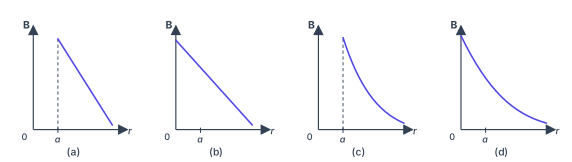
Q.Which of the following graphs correctly represents the variation of the magnitude of the magnetic field outside a straight infinite current-carrying wire as a function of the distance r from the centre of the wire ?
(a)
(b)
(c)
(d)
›Reveal solutionSolution
Figure — CBSE 2023 55/3/1 Q4
Outside an infinite current-carrying wire, Ampère's law gives B=2πrμ0I, a 1/r hyperbola starting at the surface r=a. The correct graph is (c).
The magnetic field around a long straight wire is one of the cleanest applications of Ampère's circuital law. The key insight is that the field depends only on the current enclosed by your Amperian loop, and symmetry forces the field to be tangent to circles centered on the wire.
For a wire of radius a carrying current I, the field behaves differently inside and outside. We care about the outside region, r≥a.
Why the field varies as 1/r
Ampère's law on a circular loop of radius r>a
Draw a circle of radius r centered on the wire. By symmetry, B is constant in magnitude along this circle and tangent to it. Ampère's law states:
∮B⋅dl=μ0Ienc.
The left side is simply B⋅2πr (the field magnitude times the circumference). The enclosed current is the total wire current I. So:
B⋅2πr=μ0I.
Solve for B
Rearranging:
B=2πrμ0I.
This is an inverse relationship: as you move farther from the wire, the field drops off as 1/r. Mathematically, this is a rectangular hyperbola.
The domain: r≥a
The formula B=2πrμ0I applies outside the wire, meaning r≥a. At the surface r=a, the field reaches its maximum value for the outside region:
The circulation of B around a closed path is μ0 times the current threading that path.
Ampere's circuital law relates the magnetic field around a closed loop to the electric current passing through the loop. For any closed curve (Amperian loop),
∮B⋅dl=μ0Ienc
where Ienc is the net steady current enclosed by the loop and μ0=4π×10−7T m/A is the permeability of free space. Only currents that actually pass through the surface bounded by the loop contribute to Ienc; currents outside the loop don't contribute to the line integral (though they can still affect B locally, their net contribution to the loop integral cancels).