Q.A person with a normal near point (25 cm) using a compound microscope with objective of focal length 8.0 mm and an eyepiece of focal length 2.5 cm can bring an object placed at 9.0 mm from the objective in sharp focus. What is the separation between the two lenses? Calculate the magnifying power of the microscope.
🔒You're viewing a preview — the full solution, concept, methods & PYQ mapping are locked.
🔒 Start your 14-day free trial to unlock the full solution →Concept understanding — Microscope Magnification
Microscope Magnification
A compound microscope views very small, nearby objects using two lenses in sequence: the objective (near the object) and the eyepiece (near the eye). Its total magnifying power is the product of what each lens contributes.
How the two lenses work together
- The object sits just beyond the focus of the short-focal-length objective (fo), which forms a real, inverted, magnified image inside the tube.
- That real image falls just inside the focus of the eyepiece (fe), which acts as a simple magnifier, producing a large virtual, magnified final image for the eye.
Because each stage magnifies, the effects multiply:
M=mo×me
The objective's magnification
mo=uovo≈foL
where L is the tube length (roughly the distance between the objective's second focal point and the eyepiece's first focal point). The object sits close to fo, so this approximation holds for a well-designed microscope.
The eyepiece's magnification
The eyepiece behaves as a simple magnifier:
- Final image at the near point (D=25 cm, largest magnification):
me=1+feD
- Final image at infinity (relaxed eye, "normal adjustment"):
me=feD
Total magnifying power
Image at the near point: M=foL(1+feD)
Image at infinity: M=foL⋅feD
High magnification needs short fo and fe (both sit in denominators) and a large tube length L — this is why a microscope objective is always a very short-focus lens.
Worked example
Objective fo=1.0 cm, eyepiece fe=2.5 cm, tube length L=20 cm, near point D=25 cm. Find M with the final image at the near point.
mo=1.020=20,me=1+2.525=11
M=20×11=220 …
Why this formula?
Microscope Magnification: Why the Formula Holds
Let's build the understanding from first principles — not just memorizing formulas, but seeing why they work.
1. What Does "Magnification" Mean in a Microscope?
A microscope creates a larger apparent image of a tiny object. The total magnification is the product of two stages:
- Objective lens — creates a real, enlarged, inverted image of the specimen.
- Eyepiece (ocular) — acts as a simple magnifier to view that real image.
So:
Total magnification = (magnification by objective) × (magnification by eyepiece)
2. The Key Formula
For a compound microscope in normal adjustment (final image at infinity, relaxed eye):
M=Mo×Me=(foL)×(feD)
Where:
- fo = focal length of objective
- fe = focal length of eyepiece
- L = tube length (distance between second focal point of objective and first focal point of eyepiece)
- D = near point distance of the eye (usually 25 cm)
3. Derivation of Objective Magnification Mo
Step 1: How the objective works
The objective lens forms a real, inverted, enlarged image of the specimen. The specimen is placed just outside its focal point (fo).
Step 2: Using the lens formula
For a thin lens:
vo1−uo1=fo1
(Using sign convention: uo is negative, vo is positive)
Step 3: The tube length approximation
In a standard microscope, the specimen is placed very close to fo, so:
- uo≈−fo (object just beyond focal point)
- The image is formed at the first focal point of the eyepiece, which is at a distance L from the second focal point of the objective.
Thus:
vo≈fo+L
Step 4: Magnification formula
Lateral magnification by objective:
Mo=∣uo∣vo≈fofo+L=1+foL
Since L≫fo in practice, 1 is negligible:
Mo≈foL
Why this makes sense: A shorter fo means the objective is more "powerful" — it bends light more sharply, creating a larger image at the fixed tube length.
4. Derivation of Eyepiece Magnification Me
Step 1: The eyepiece as a simple magnifier
The eyepiece takes the real image from the objective and acts like a magnifying glass. For relaxed eye (final image at infinity), the real image must be placed at the focal point of the eyepiece.
Step 2: Angular magnification
Angular magnification is defined as:
Me=angle subtended by object at near pointangle subtended by image at eye
For a simple magnifier with image at infinity:
Me=feD
Where D=25 cm (standard near point). …
Objective (fo=0.8 cm, uo=−0.9 cm): vo1=0.81−0.91⇒vo=7.2 cm.
Eyepiece (final image at near point, ve=−25 cm, fe=2.5 cm): ue≈−2.27 cm.
Separation: L=vo+∣ue∣=7.2+2.27=9.47 cm. …
The objective forms a real image vo=7.2 cm from itself; the eyepiece needs its object at ue≈−2.27 cm to place the final image at the near point. The lens separation is vo+∣ue∣≈9.47 cm, and the magnifying power is M=mo×me=−88 (magnitude 88; the negative sign shows the final image is inverted).
Step 1 — image formed by the objective
fo=8.0 mm=0.8 cm, uo=−0.9 cm (object 9.0 mm in front, negative by sign convention).
vo1−uo1=fo1⇒vo1=0.81−0.91=0.720.9−0.8=0.720.1
vo=7.2 cm
Step 2 — object distance for the eyepiece
For the final image at the near point, ve=−25 cm, fe=2.5 cm.
ve1−ue1=fe1⇒−ue1=fe1−ve1=2.51+251=2511
ue=−1125≈−2.27 cm
Step 3 — separation between the lenses
The intermediate image lies vo=7.2 cm from the objective and ∣ue∣≈2.27 cm from the eyepiece, on the same point between the two lenses, so
L=vo+∣ue∣=7.2+2.27=9.47 cm
Step 4 — magnifying power
mo=uovo=−0.97.2=−8 …
Method: Two-Lens Image Formation (Compound Microscope Analysis)
This problem uses the compound microscope as two successive lens systems — the objective forms a real, inverted image, which then acts as the object for the eyepiece.
Step 1: Understand the given data
| Quantity | Value |
|---|---|
| Near point (D) | 25 cm |
| Objective focal length (fo) | 8.0 mm=0.8 cm |
| Eyepiece focal length (fe) | 2.5 cm |
| Object distance from objective (uo) | 9.0 mm=0.9 cm |
Step 2: Find the image distance for the objective
Use the lens formula for the objective:
vo1−uo1=fo1
Sign convention: For a real object, uo is negative.
vo1−(−0.9)1=0.81
vo1+0.91=0.81
vo1=0.81−0.91=0.720.9−0.8=0.720.1
vo=0.10.72=7.2 cm
The objective forms a real image at 7.2 cm on the other side.
Step 3: Find the separation between lenses
The eyepiece is adjusted so that the final image is at the near point (25 cm from the eye) for maximum magnification.
For the eyepiece:
- Final image distance (ve) = −25 cm (virtual image, on same side as object)
- fe=2.5 cm
Using lens formula for eyepiece:
ve1−ue1=fe1
(−25)1−ue1=2.51
−251−ue1=2.51
−ue1=2.51+251=2510+251=2511
ue=−1125≈−2.27 cm
The negative sign means the object for the eyepiece is inside its focal length — as expected.
Separation between lenses = vo+∣ue∣ …
Common Mistakes & How to Avoid Them
Mistake 1: Confusing the two magnifications
Students often mix up magnifying power of the eyepiece (me) with magnification of the objective (mo), or use the wrong formula for each.
How to avoid:
- Objective magnification is always:
mo=−uovo
where vo = image distance from objective, uo = object distance from objective.
- Eyepiece magnification depends on final image condition:
- For final image at infinity (relaxed eye):
me=feD(where D=25 cm)
- For final image at near point (maximum magnification):
me=1+feD
Key insight: The problem says "sharp focus" — this usually means the final image is formed at the near point (25 cm), so use me=1+feD.
Mistake 2: Forgetting the sign convention
Students often ignore the negative sign in mo=−vo/uo, leading to wrong total magnification.
How to avoid:
- The negative sign indicates the image is inverted relative to the object.
- For total magnifying power, we take absolute values:
M=∣mo∣×me
- Always write the sign first, then take magnitude for the final answer.
Mistake 3: Using the wrong lens formula for the objective
Students sometimes plug uo=9.0 mm directly into the lens formula without checking if it's beyond the focal length.
How to avoid:
- For a real, enlarged image in a microscope, the object must be placed just beyond fo.
- Here: fo=8.0 mm, uo=9.0 mm → valid (object is beyond focal point).
- Use the lens formula correctly:
vo1−uo1=fo1
with sign convention: uo is negative (real object on left), fo positive (convex lens).
Mistake 4: Mixing units (mm vs cm)
The objective focal length is in mm, the eyepiece focal length is in cm — students often forget to convert.
How to avoid:
- Convert everything to the same unit before calculating.
- Best practice: Convert to cm (since near point D=25 cm):
- fo=8.0 mm=0.8 cm
- uo=9.0 mm=0.9 cm
- fe=2.5 cm (already in cm)
Mistake 5: Confusing "separation between lenses" with image distances
Students sometimes think the lens separation is simply vo+ve, but forget that ve is measured from the eyepiece, not from the objective.
How to avoid:
- Lens separation L = distance from objective to eyepiece = vo+ue where ue is the object distance for the eyepiece (the intermediate image formed by the objective). …
- AHSEC Higher Secondary (HS) Final Examination 2020Set ANNUAL3 marksQ.Draw a ray diagram of a compound microscope forming an inverted and magnified image of an object. Which lens in the compound microscope acts as a simple microscope? If f0=1cm, fe=2cm and L=20cm respectively, calculate the total magnification of the microscope. OR You know the phenomenon of scattering of light by the atmospheric particles. Write a few lines about the blue colour of sky and reddish colour of sky in the morning as well as in the evening.
›Reveal solutionSolution
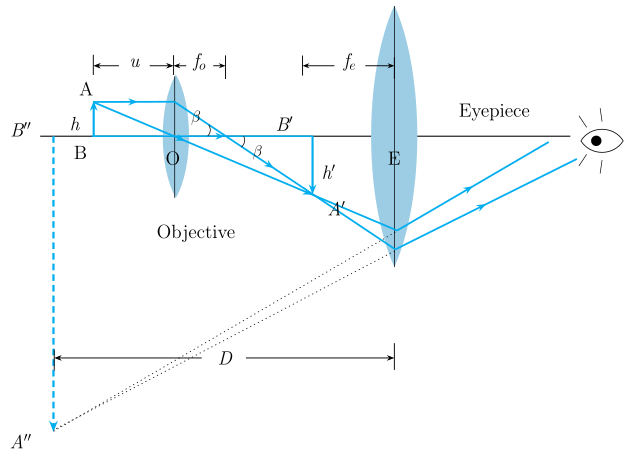
Figure — Hard draw-gate on the first alternative: 'Draw a ray diagram of a compound microscope forming an inverted and In a compound microscope the eyepiece works as a simple magnifier on the objective's real image; with the given data the overall magnification comes out to about 250.
Main question: A compound microscope has two converging lenses: the objective (near the object, short focal length) and the eyepiece/ocular (near the eye). The objective forms a real, inverted, magnified image of the tiny object just inside the focal length of the eyepiece; the eyepiece then acts exactly like a simple microscope (magnifying glass), further magnifying this intermediate image to give the final image, which is virtual, inverted (relative to the object), and highly magnified.
Using the standard approximate formula for overall magnification (normal adjustment, taking near point D=25 cm, and tube length L as the separation between the lenses):
m≈foL×feD
With fo=1 cm, fe=2 cm, L=20 cm, D=25 cm:
m≈120×225=20×12.5=250
…
🎓Unlock everything free for 14 days
- ✓Full step-by-step solutions
- ✓Concept-first explanations
- ✓Methods, shortcuts & mistakes
- ✓PYQ mapping + timed mock tests
Full access for 14 days. No credit card required.