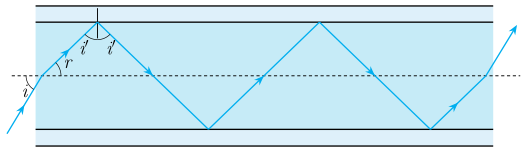
Q.(a) Figure 9.28 shows a cross-section of a 'light pipe' made of a glass fibre of refractive index 1.68. The outer covering of the pipe is made of a material of refractive index 1.44. What is the range of the angles of the incident rays with the axis of the pipe for which total reflections inside the pipe take place, as shown in the figure.
🔒You're viewing a preview — the full solution, concept, methods & PYQ mapping are locked.
🔒 Start your 14-day free trial to unlock the full solution →Concept understanding — Total Internal Reflection
Total Internal Reflection: When Light Decides to Stay Home
Imagine you're running on a beach toward the water. On sand, you run fast. The moment you hit the water, your speed drops — the water "resists" more. If you run at a shallow angle toward the waterline, your legs will suddenly slow down, and your body will twist. That twist is refraction — light bending when it changes speed between two media.
Now imagine the reverse: you're swimming in the water, heading toward the shore. You're moving slower in water, and you want to get out onto the fast sand. If you approach the shore at a very shallow angle — almost parallel to the beach — you might never make it out. The sudden speed-up as you hit the sand could "reflect" you back into the water. That's the intuition for total internal reflection.
The Core Idea
Light normally passes from one transparent medium to another (say, from water to air) and bends away from the normal — because it speeds up. But if the angle of incidence in the slower medium is large enough, the light can't escape. It gets completely reflected back inside the first medium. No light transmits. That's total internal reflection.
Total internal reflection (TIR) occurs only when light travels from a denser (slower) medium to a rarer (faster) medium, and the angle of incidence exceeds a critical value.
The Two Conditions (Memorise These)
For TIR to happen, both must be true:
-
Light must go from a denser medium to a rarer medium (e.g., glass → air, water → air, diamond → air).
Denser means higher refractive index (n). Light slows down in a denser medium.
-
Angle of incidence (i) must be greater than the critical angle (C).
The critical angle is the angle of incidence in the denser medium for which the angle of refraction in the rarer medium is exactly 90∘.
The Critical Angle — The Tipping Point
Look at the diagram in your mind: a ray in water heading toward the surface. As you increase the angle of incidence, the refracted ray in air bends more and more away from the normal. At some specific angle C, the refracted ray skims exactly along the surface — angle of refraction =90∘.
sinC=ndensernrarer
For water (n=1.33) to air (n=1.00):
sinC=1.331.00≈0.75⇒C≈48.6∘
So if you shine a light from water into air at an angle greater than about 49∘ from the normal, the light will not leave the water at all. It reflects back down — perfectly.
What Actually Happens at the Boundary?
- i<C: Most light refracts out; a little reflects (normal partial reflection).
- i=C: Refracted ray grazes the surface; transmitted intensity is nearly zero.
- i>C: No transmitted ray. All the light energy reflects back into the denser medium. The reflection is 100% — no absorption, no transmission.
TIR is not the same as ordinary reflection from a mirror. In TIR, there is no silvering or coating. The reflection happens because the wave cannot exist in the rarer medium — it's forced back. This gives perfect reflection with zero energy loss, unlike a metal mirror which absorbs some light.
--- …
Why this formula?
Total Internal Reflection: Why the Key Formulas Hold
Total Internal Reflection (TIR) is a fascinating optical phenomenon where light, instead of escaping from a denser medium into a rarer one, gets completely reflected back into the denser medium. Let's build the understanding from first principles.
1. The Foundation: Snell's Law
The entire story begins with Snell's Law:
n1sinθ1=n2sinθ2
Where:
- n1 = refractive index of the denser medium (e.g., glass, water)
- n2 = refractive index of the rarer medium (e.g., air)
- θ1 = angle of incidence (in denser medium)
- θ2 = angle of refraction (in rarer medium)
Key fact: n1>n2 (light travels from denser to rarer).
2. The Critical Angle: Where Refraction "Bends" to 90°
As θ1 increases, θ2 increases faster (because n1>n2). At some special angle, θ2 becomes exactly 90∘ — the refracted ray grazes the surface.
Set θ2=90∘ in Snell's Law:
n1sinθc=n2sin90∘
Since sin90∘=1:
sinθc=n1n2
Why this formula?
It's not arbitrary — it's the limit of Snell's Law. The critical angle θc is the largest incidence angle for which refraction is still possible. Beyond this, Snell's Law would demand sinθ2>1, which is impossible — no real angle satisfies it.
3. Beyond the Critical Angle: Why TIR Occurs
When θ1>θc:
- Snell's Law gives sinθ2=n2n1sinθ1>1
- No real θ2 exists
- Physics says: the wave cannot "fit" into the rarer medium
- Result: All energy is reflected back into the denser medium
This isn't a failure of Snell's Law — it's a physical boundary where the wave's behaviour changes from propagating to evanescent (decaying).
4. The Condition for TIR (Exam-Ready Summary)
For Total Internal Reflection to occur, both conditions must hold:
- Light travels from denser to rarer medium (n1>n2) …
For light to be piped along the fibre it must strike the core-wall at or beyond the critical angle. (a) With cladding: sinθc=1.44/1.68=0.857, θc≈59∘; the internal ray may make at most r=90∘−59∘=31∘ with the axis, and Snell's law at the face gives sinimax=1.68sin31∘≈0.865, so imax≈60∘. …
Total internal reflection needs the ray to hit the fibre wall at ≥ the critical angle. This sets a maximum entry angle with the axis: about 60∘ with cladding, and 90∘ (i.e. any ray) with no cladding.
Concept understanding
At the core-wall, TIR occurs when the angle of incidence (from the normal to the wall) is at least the critical angle θc, where sinθc=n2/n1, with n1=1.68 the core index and n2 the outer medium. If the refracted ray makes angle r with the axis, it meets the wall at (90∘−r) from the wall's normal, so TIR requires 90∘−r≥θc, i.e. r≤90∘−θc. Snell's law at the flat entrance face (n=1 to n1) then relates r to the entry angle i: sini=1.68sinr.
Part (a): with cladding (n2=1.44)
sinθc=1.681.44=0.857 ⇒ θc≈59∘.
So r≤90∘−59∘=31∘. Maximum entry angle:
sinimax=1.68sin31∘≈1.68×0.515≈0.865 ⇒ imax≈60∘.
Every ray entering within 0∘ to 60∘ of the axis is trapped.
Part (b): no cladding (air, n2=1.00)
sinθc=1.681.00=0.595 ⇒ θc≈36.5∘, …
Method: Total Internal Reflection in an Optical Fibre (Angle-with-Axis Problems)
This method solves any problem asking for the range of entry angles (measured from the fibre's axis) for which a ray stays trapped inside a light pipe by total internal reflection at the core-cladding wall.
Steps
Step 1: Find the critical angle at the core-cladding boundary
sinθc=ncorenouter
This uses the two refractive indices of the materials actually touching at that internal wall — not the entrance face.
Step 2: Convert between "angle from the axis" and "angle from the wall's normal"
Because the fibre's cylindrical wall runs parallel to the axis, the angle a ray inside the fibre makes with the axis (r) and the angle it makes with the wall's normal are complementary: angle-from-normal =90∘−r.
Step 3: Turn the TIR condition into a bound on r
TIR requires angle-from-normal ≥θc, i.e. 90∘−r≥θc, which rearranges to
r≤90∘−θc.
Step 4: Use Snell's law at the flat entrance face to convert this into a maximum entry angle …
- AHSEC Higher Secondary (HS) Final Examination 2025Set ANNUAL1 markQ.Mention the condition where Snell's law of refraction cannot be satisfied.
›Reveal solutionSolution
Snell's law cannot be satisfied beyond the critical angle, when going from denser to rarer medium — total internal reflection takes over.
Snell's law: n1 sinθ1 = n2 sinθ2, so sinθ2 = (n1/n2) sinθ1.
When light travels from a denser medium (n1) to a rarer medium (n2 < n1), (n1/n2) > 1. As the angle of incidence θ1 increases, at some angle called the critical angle θc, sinθ2 becomes exactly 1 (θ2 = 90°, the refracted ray grazes the surface).
…
- AHSEC Higher Secondary (HS) 1st Year Examination 2025Set ANNUAL1 markMCQQ.Optical fibre is based on which of the following?(a) Total internal reflection(b) Refraction(c) Diffraction(d) Polarization
›Reveal solutionSolution
Optical fibres work on the principle of total internal reflection (TIR) — a Class 12 Ray Optics topic, out of scope for the Class 11 chapter list used here.
An optical fibre consists of a thin core of high refractive index glass surrounded by a cladding of lower refractive index. Light entering the fibre strikes the core-cladding interface at an angle greater than the critical angle for that pair of media, so instead of refracting out, it undergoes total internal reflection and travels down the fibre by repeated TIR at the walls, with almost no loss of intensity, even around bends.
…
- AHSEC Higher Secondary (HS) Final Examination 2024Set ANNUAL1 markQ.If the critical angle of water with respect to air is 48.75 and sin 48.75=0.75, cos 48.75=0.65 and tan 48.75=1.14 approximately, what will be the refractive index of water?
›Reveal solutionSolution
Refractive index of water n=1/sinC≈1.33.
At the critical angle C, light travelling from the denser medium (water) to the rarer medium (air) refracts at 90∘. By Snell's law applied at the water-air interface:
nsinC=1×sin90∘=1
n=sinC1
…
- AHSEC Higher Secondary (HS) Final Examination 2023Set ANNUAL1 markMCQQ.Mirage is an optical phenomenon related to (Choose the correct option)(i) scattering(ii) total internal reflection(iii) total internal refraction
›Reveal solutionSolution
A mirage is caused by total internal reflection of light within air layers whose refractive index varies continuously with temperature.
On a hot day, the air just above a road or a desert surface is much hotter — and hence less dense, with a lower refractive index — than the air higher up. Light coming from the sky travels from a denser (cooler) layer towards progressively rarer (hotter) layers as it approaches the ground. At some layer, the angle of incidence exceeds the critical angle for that pair of layers, and the ray undergoes total internal reflection, bending back upward before it reaches the ground.
…
- AHSEC Higher Secondary (HS) Final Examination 2020Set ANNUAL1 markQ.Name the equipment which can transmit optical signal through it and are used as 'light pipe'.
›Reveal solutionSolution
Optical fibres act as 'light pipes' by trapping light inside a thin glass core through repeated total internal reflection.
An optical fibre consists of a thin cylindrical core of glass (or quartz) of high refractive index, surrounded by a cladding of lower refractive index. When light enters one end of the fibre at an angle greater than the critical angle for the core–cladding interface, it undergoes total internal reflection repeatedly at the core–cladding boundary as it travels down the fibre, so the light is guided along the length of the fibre with very little loss — effectively 'piping' the light from one end to the other, even around gentle bends. This makes optical fibres ex …
- AHSEC Higher Secondary (HS) Final Examination 2019Set ANNUAL1 markQ.The sparkle of a diamond can be explained by which phenomenon of light?
›Reveal solutionSolution
A diamond sparkles because its high refractive index gives it a very small critical angle, so light entering it undergoes multiple total internal reflections before exiting.
Diamond has a very high refractive index (about 2.42), so its critical angle θc=sin−1(1/n)≈24.4° is very small. Diamonds are faceted by jewellers so that light entering the top face strikes the internal sloped facets at angles greater than this small critical angle. At each such facet the light undergoes total internal reflection instead of escaping, bouncing repeatedly inside the stone until it eventually emerges from the top, concentrated and dispersed into its spectral colours. This trapping-and-bouncing of light, possible onl …
🎓Unlock everything free for 14 days
- ✓Full step-by-step solutions
- ✓Concept-first explanations
- ✓Methods, shortcuts & mistakes
- ✓PYQ mapping + timed mock tests
Full access for 14 days. No credit card required.