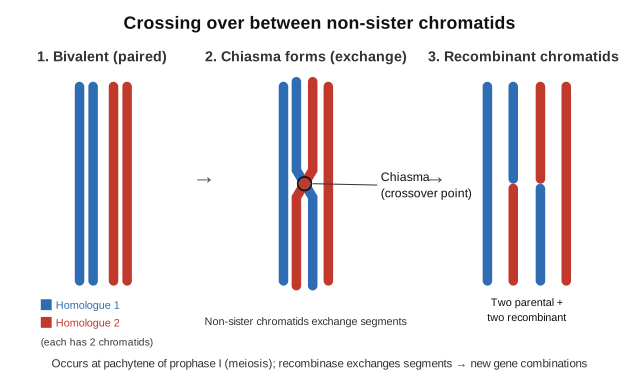
Crossing Over and Chiasmata
Imagine you have two identical shoelaces, each made of two coloured strands twisted together. Now picture taking one strand from the first lace and swapping it with the corresponding strand from the second lace, right at the same spot. That is the physical picture of crossing over.
The Intuition: Why Swap?
Your cells need to make sperm or eggs. Each sperm or egg must carry a unique mix of your parents' genes — otherwise all siblings would look identical. Crossing over is nature's shuffling machine. During the formation of these cells, the two copies of each chromosome (one from your mother, one from your father) line up side by side. They physically break at matching points and exchange segments. This creates chromosomes that are patchworks of both grandparents' DNA.
Without crossing over, each chromosome you pass on would be purely from one parent. With it, every chromosome is a mosaic. That is why you can have your mother's eyes but your father's hair colour — the genes for those traits got swapped onto the same chromosome.
The Precise Biological Event
Crossing over happens during pachytene, the third stage of prophase I in meiosis. At this point, homologous chromosomes are already paired tightly as bivalents (four chromatids total). Special protein complexes called recombination nodules form at specific sites along the paired chromosomes. These nodules orchestrate a precise breakage and reunion between non-sister chromatids — one chromatid from the maternal chromosome and one from the paternal chromosome.
The exchange is reciprocal: each chromatid gives a segment and receives a segment of equal length from its partner. The breakpoints are not random — they occur at regions called chiasma hotspots, though the exact positions vary between cells.
Crossing over involves non-sister chromatids only. Sister chromatids (the two identical copies from the same chromosome) do not cross over with each other — they are genetically identical, so swapping would accomplish nothing.
Chiasmata: The Visible Evidence
You cannot see crossing over happening in real time. But you can see its aftermath. After pachytene ends, the homologous chromosomes begin to pull apart during diplotene. They do not separate completely because they remain physically linked at the points where crossing over occurred. These visible X-shaped connections are called chiasmata (singular: chiasma).
Each chiasma marks the site of a past crossover event. The number of chiasmata per chromosome pair varies — longer chromosomes typically have more. In human cells, you usually see one to three chiasmata per bivalent.
A chiasma is not the crossover itself — it is the structural remnant of the crossover that persists after the recombination proteins have left. Think of it like a knot that remains after you have tied and released a rope.
The Critical Distinction
| Feature | Crossing Over | Chiasma |
|---|
| What it is | The process of segment exchange | The visible structure at the exchange site |
| When it occurs | Pachytene | Diplotene (and persists until metaphase I) |
| What you see | Molecular event (not visible) | Microscopically visible X-shaped connection |
| Function | Genetic recombination | Physical cohesion holding homologues together |