Chemistry · Ch 12 — Organic Chemistry – Some Basic Principles and Techniques
Hyperconjugation
Hyperconjugation
Hyperconjugation is a permanent electronic effect that stabilises molecules through the delocalisation of sigma () electrons. Unlike resonance, which involves the delocalisation of electrons or lone pairs, hyperconjugation involves the delocalisation of electrons from a carbon–hydrogen (C–H) bond of an alkyl group. This alkyl group must be directly attached to an atom that is part of an unsaturated system (like a double bond) or to an atom that possesses an unshared p orbital (like a positively charged carbon in a carbocation).
The electrons of the C–H bond enter into partial conjugation with the adjacent unsaturated system or the empty p orbital. This interaction is permanent — it is always present in the ground state of the molecule and influences its stability, bond lengths, and other properties.
Hyperconjugation is often called "no-bond resonance" because one of the contributing resonance structures shows no covalent bond between the carbon and the hydrogen involved in the delocalisation.
Understanding Hyperconjugation: The Ethyl Cation Example
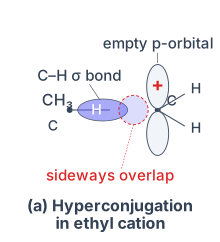
Consider the ethyl cation, . The positively charged carbon has an empty p orbital perpendicular to the plane of its three sigma bonds. One of the C–H bonds of the methyl group () can align itself so that it lies in the same plane as this empty p orbital. When this happens, the two electrons that constitute that C–H bond can be delocalised into the empty p orbital.
This overlap is not a full bond formation; it is a partial sharing of electron density. The result is that electron density from the adjacent bond moves towards the positively charged carbon, effectively dispersing the positive charge over a larger region. This dispersal of charge lowers the energy of the carbocation and stabilises it.
Drawn by us to help you understand the concept clearly, and verified to make sure it's accurate. For exams, practice from your textbook's own diagram.
In the ethyl cation () the positively charged carbon has an empty orbital, drawn as two pale lobes above and below the plane of the carbon skeleton. One C–H sigma-bond orbital of the neighbouring methyl group (the shaded, sausage-shaped lobe) is aligned parallel with that empty orbital, and the dashed region between them marks their sideways overlap. The overlap lets the sigma electrons spread onto the electron-poor carbon, dispersing the positive charge — this delocalisation of sigma electrons is hyperconjugation. …
The stabilisation arises because the positive charge is no longer concentrated on a single carbon atom. The electrons help to "spread out" the charge, making the cation more stable than it would be without this interaction.
Relative Stability of Carbocations
The stabilising effect of hyperconjugation depends directly on the number of alkyl groups attached to the positively charged carbon. Each alkyl group provides C–H bonds that can participate in hyperconjugation. More alkyl groups mean more C–H bonds available for delocalisation, and therefore greater stabilisation.
This leads to the well-established order of carbocation stability:
Let us examine each case:
-
Tertiary carbocation, : The positively charged carbon is attached to three methyl groups. Each methyl group has three C–H bonds, but only one C–H bond per methyl group can effectively align with the empty p orbital at any given time. However, through rapid rotation, all nine C–H bonds can contribute to hyperconjugation over time. This gives the maximum possible hyperconjugative stabilisation.
-
Secondary carbocation, : The positively charged carbon is attached to two methyl groups. This provides six C–H bonds that can participate in hyperconjugation, offering less stabilisation than the tertiary case.
-
Primary carbocation, : The positively charged carbon is attached to only one methyl group. This provides three C–H bonds for hyperconjugation, offering even less stabilisation.
-
Methyl carbocation, : The positively charged carbon has no alkyl groups attached to it. There are no C–H bonds from an adjacent alkyl group to delocalise its electrons. Therefore, it receives no hyperconjugative stabilisation and is the least stable of the four.
Do not confuse the number of alkyl groups with the number of carbon atoms. A methyl group () is one alkyl group. The stabilisation comes from the C–H bonds within those alkyl groups, not from the carbon atom of the alkyl group itself.
Hyperconjugation in Alkenes
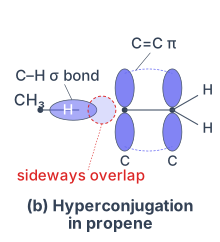
Hyperconjugation is not limited to carbocations. It also occurs in alkenes. In an alkene, the bond involves a p orbital on each of the two sp²-hybridised carbon atoms. If an alkyl group is attached to one of these sp² carbons, a C–H bond from that alkyl group can align with the system's p orbital.
The electrons from the C–H bond are delocalised into the orbital system. This interaction stabilises the alkene. A classic example is propene (). The methyl group attached to the double bond can donate electron density through hyperconjugation, making propene more stable than ethene (), which has no alkyl group attached to its double bond.
Drawn by us to help you understand the concept clearly, and verified to make sure it's accurate. For exams, practice from your textbook's own diagram.
Hyperconjugation is not limited to carbocations. In propene, the bond of C=C is built from parallel orbitals on the two carbons (the filled lobes above and below the molecular plane). The methyl group's C–H sigma-bond orbital lies parallel to the nearer orbital, and the dashed region marks their sideways overlap: the sigma electrons partially delocalise into the system. …
This stabilisation is why more highly substituted alkenes (those with more alkyl groups attached to the double-bonded carbons) are generally more stable than less substituted ones. This is summarised by Saytzeff's rule, which is a direct consequence of hyperconjugative stabilisation in the alkene product.
Hyperconjugation in Alkylarenes
Alkylarenes, such as toluene (), also exhibit hyperconjugation. The alkyl group is attached to a benzene ring. The electrons of the C–H bonds of the methyl group can delocalise into the electron system of the aromatic ring.
This interaction has several important consequences:
- It stabilises the molecule.
- It makes the alkyl group an electron-donating group, activating the benzene ring towards electrophilic substitution.
- It directs incoming electrophiles to the ortho and para positions on the ring.
The directing effect of alkyl groups in electrophilic aromatic substitution can be understood through hyperconjugation. The delocalisation of electrons into the ring increases electron density at the ortho and para positions, making them more nucleophilic and thus more reactive towards an electrophile.
The "No-Bond Resonance" View of Hyperconjugation
There are two complementary ways to visualise hyperconjugation. The first is the orbital overlap picture described above. The second is to treat it as a form of resonance, often called "no-bond resonance."
In this view, we write contributing resonance structures for the molecule. For the ethyl cation, , one of the contributing structures can be written as:
In this structure, the C–H bond has been broken. The two electrons that were in that bond now form a bond between the two carbon atoms. The hydrogen atom is left with no bond to the carbon — it is a "no-bond" structure, carrying a positive charge. The actual structure of the ethyl cation is a hybrid of the original structure and this no-bond resonance structure. …