Q.Compounds with same molecular formula but differing in their structures are said to be structural isomers. What type of structural isomerism is shown by CH3—S—CH2—CH2—CH3 and CH3—S—CH(CH3)2?
🔒You're viewing a preview — the full solution, concept, methods & PYQ mapping are locked.
🔒 Start your 10-day free trial to unlock the full solution →Concept understanding — Nucleophilic Substitution Reactions
Nucleophilic Addition – From Intuition to Precision
Imagine you have a molecule with a carbon–oxygen double bond — a carbonyl group (C=O). That oxygen is greedy for electrons; it pulls them away from carbon, leaving the carbon slightly positive (δ+) and the oxygen slightly negative (δ−). Now, if you bring a species that is rich in electrons (a nucleophile, meaning "nucleus-loving"), it will naturally be attracted to that electron-deficient carbon. The nucleophile attacks the carbon, the π bond breaks, and the oxygen picks up a proton (or some other electrophile) to become stable. That, in a nutshell, is nucleophilic addition.
The key idea: a nucleophile adds across a polar multiple bond (usually C=O or C≡N), breaking the π bond and forming two new sigma bonds.
The Precise Statement
Nucleophilic addition is a reaction in which a nucleophile (an electron-rich species) forms a sigma bond with an electrophilic carbon atom of a polar multiple bond (typically a carbonyl group, C=O, or a nitrile, C≡N), while the π bond breaks. The resulting intermediate then captures a proton (or another electrophile) to give a neutral product.
In general form:
RX2C=O+NuX−HX+RX2C(OH)Nu
The nucleophile (NuX−) attacks the carbonyl carbon; the oxygen becomes negatively charged; then a proton (HX+) from the medium attaches to the oxygen, yielding an alcohol.
Why It Happens – The Driving Force
The carbonyl carbon is electrophilic because:
- Oxygen is more electronegative than carbon, so the C=O bond is polarised: CXδ+=OXδ−.
- The π bond is weaker than a σ bond, so it can break relatively easily.
A nucleophile (like OHX−, CNX−, or NHX3) has a lone pair or a negative charge. It seeks positive centres. The attack forms a new σ bond, and the π electrons move entirely to oxygen, creating an alkoxide ion (RX2C−OX−). This intermediate is then quenched by a proton.
A common mistake: thinking the nucleophile attacks the oxygen. No — oxygen is already electron-rich; the nucleophile goes to the carbon because it is electron-deficient.
A Concrete Example – Addition of HCN to a Ketone
Take acetone (CHX3COCHX3) and hydrogen cyanide (HCN). In the presence of a base, CNX− (the nucleophile) attacks the carbonyl carbon:
CHX3COCHX3+CNX−CHX3C(OX−)(CN)CHX3
The alkoxide intermediate then picks up a proton from HCN (or from water) to give a cyanohydrin:
CHX3C(OX−)(CN)CHX3+HX+CHX3C(OH)(CN)CHX3
The product is acetone cyanohydrin. Notice: two new sigma bonds formed (C−CN and O−H), and the π bond is gone.
What Makes a Good Nucleophile?
Strong nucleophiles are usually negatively charged or have lone pairs:
- OHX−, CNX−, NHX2X−, CHX3OX−, HX− (from hydride reagents like NaBHX4 or LiAlHX4)
- Neutral but polarisable: NHX3, HX2O (weaker, but can add under acidic conditions) …
Why this formula?
Nucleophilic Substitution Reactions: Why the Key Formulas Hold
Nucleophilic substitution reactions are a cornerstone of organic chemistry. Instead of just memorizing the rate laws, let's understand why they arise from the molecular events.
1. The Two Main Mechanisms: A Tale of Timing
The key formulas (rate laws) for nucleophilic substitution come directly from how many molecules are involved in the rate-determining step (RDS) — the slowest step that controls the overall reaction speed.
SN1: Unimolecular — The Leaving Group Goes First
The Rate Law:
Rate=k[RX]
Why?
The reaction happens in two steps:
- Slow step (RDS): The C–X bond breaks spontaneously, forming a carbocation intermediate. Only the substrate (RX) is involved.
RXslowR++X−
- Fast step: The nucleophile (Nu−) attacks the carbocation.
R++Nu−fastRNu
Since the slow step depends only on the concentration of RX, the rate law has no dependence on [Nu−]. The nucleophile arrives after the carbocation is formed — it cannot affect the speed of the first step.
Key insight: The rate is determined by how easily the leaving group leaves, not by how fast the nucleophile attacks.
SN2: Bimolecular — Simultaneous Attack and Departure
The Rate Law:
Rate=k[RX][Nu−]
Why?
The reaction occurs in one concerted step:
- The nucleophile attacks the carbon from one side at the same time as the leaving group departs from the opposite side.
- Both RX and Nu− must collide with the correct orientation and sufficient energy.
The rate depends on the frequency of productive collisions between the two molecules. This is directly proportional to the product of their concentrations:
Rate∝[RX]×[Nu−]
Key insight: Both partners are involved in the transition state simultaneously — if either is missing, the reaction cannot proceed.
2. The Transition State: Why the Formulas Are Not Just "Given"
For SN2, the transition state has a pentavalent carbon (five bonds partially formed/broken). The energy barrier depends on steric hindrance — bulkier groups around carbon make it harder for the nucleophile to approach, which is why SN2 is favored at primary carbons. …
Both compounds are thioethers (R−S−RX′) with the same molecular formula
CX4HX10S and the same functional group. They differ only in the alkyl groups attached to the divalent sulphur:
- CHX3−S−CHX2CHX2CHX3: methyl and n-propyl.
- CHX3−S−CH(CHX3)X2: methyl and isopropyl. …
The two compounds are metamers — same molecular formula (CX4HX10S), same
functional group (a thioether, R−S−RX′), but different alkyl groups on either side of the divalent sulphur. That is metamerism, a type of structural isomerism.
Both molecules are thioethers (sulphides): a sulphur atom flanked by two carbon groups.
- CHX3−S−CHX2−CHX2−CHX3 — methyl on one side, n-propyl on the other.
- CHX3−S−CH(CHX3)X2 — methyl on one side, isopropyl on the other.
Both are CX4HX10S and both keep the same functional group. What differs is the
identity of the alkyl groups attached to the polyvalent (divalent) sulphur atom:
n-propyl in the first, isopropyl in the second. Isomerism arising from different alkyl …
- JEE Main 2025Set 2025-01-28-s14 marksMCQQ.The products A and B in the following reactions, respectively are A ←(Ag-NO2) CH3-CH2-CH2-Br →(AgCN) B (A) CH3-CH2-CH2-ONO, CH3-CH2-CH2-CN (B) CH3-CH2-CH2-NO2, CH3-CH2-CH2-CN (C) CH3-CH2-CH2-ONO, CH3-CH2-CH2-NC (D) CH3-CH2-CH2-NO2, CH3-CH2-CH2-NC
›Reveal solutionSolution
Nitrite (NO2⁻) and cyanide (CN⁻) are ambident nucleophiles with two possible attacking atoms; whether the alkyl halide ends up bonded through one atom or the other depends on which end stays "free" once Ag⁺ coordinates to the other end.
- CH3CH2CH2Br reacts with AgNO2: in this largely covalent silver salt, Ag+ coordinates through the oxygen end of the nitrite ion, leaving nitrogen as the exposed, more nucleophilic site.
- Nitrogen attacks the alkyl halide's electrophilic carbon (SN2, with Ag⁺ assisting halide departure), forming a C–N bond: the product is the nitroalkane CH3−CH2−CH2−NO2 (A).
- CH3CH2CH2Br reacts with AgCN: Ag+ (a soft acid) coordinates through the carbon end of cyanide (matching the known Ag–C≡N bonding), leaving nitrogen exposed.
- Nitrogen again attacks the alkyl halide carbon, forming a C–N bond: the product is the alkyl isocyanide CH3−CH2−CH2−N=C (B), not the "normal" nitrile. …
- JEE Main 2022Set 2022-06-28-s14 marksMCQQ.A primary aliphatic amine on reaction with nitrous acid in cold (273 K), and thereafter raising the temperature of the reaction mixture to room temperature (298 K), gives (A) nitrile (B) alcohol (C) diazonium salt (D) secondary amine
›Reveal solutionSolution
Unlike aromatic diazonium salts, aliphatic diazonium salts are too unstable to isolate even in the cold, decomposing rapidly to release N2 and give an alcohol as the main product.
- Nitrous acid (generated in situ from NaNO2/HCl) reacts with a primary aliphatic amine to initially form an alkyl diazonium salt, R-N2+.
- Unlike aromatic diazonium salts (stable at 273 K), aliphatic diazonium salts are extremely unstable and decompose essentially immediately, releasing N2 gas and generating a carbocation (or a closely related species). …
- JEE Main 2022Set 2022-07-26-s14 marksMCQQ.The major product of the following reaction is: [FIGURE] A benzene ring bearing OCH3 at one position and O2N (nitro) at the adjacent (ortho) position is treated with(i) Na/liq. NH3(ii) CH3CH2OH. (A) [FIGURE] (B) [FIGURE] (C) [FIGURE] (D) [FIGURE]
›Reveal solutionSolution
Birch reduction converts this nitro-anisole-type ring into a cyclohexadiene, with the methoxy-bearing carbon reduced to sp3 and the nitro group left intact.
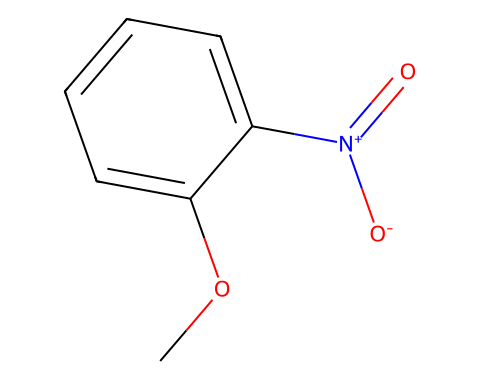
Starting material: 2-methoxynitrobenzene (ortho-nitroanisole) — benzene ring with OCH3 and NO2 on adjacent ring carbons, before Birch reduction (Na/liq. NH3) then CH3CH2OH - Na dissolved in liquid NH3 generates solvated electrons which add to an aromatic ring, with a proton source (here CH3CH2OH, added in the second step) quenching the resulting radical-anion intermediates to complete the reduction to a non-aromatic 1,4-diene.
- The regiochemistry of Birch reduction (which ring carbons end up sp3 versus remaining as part of a double bond) depends on the electronic nature of the ring substituents. …
- JEE Main 2021Set 2021-03-18-s14 marksMCQQ.The reagent 1-naphthylamine and sulphanilic acid in acetic acid is used for detection of: (A) N2O (B) NO3- (C) NO (D) NO2-
›Reveal solutionSolution
The sulphanilic acid + 1-naphthylamine reagent (Griess reagent) is the standard test for detecting nitrite ion, NO₂⁻.
- The combination of sulphanilic acid and 1-naphthylamine (in acetic acid) constitutes the classic Griess reagent, widely used in analytical chemistry.
- This reagent specifically detects the nitrite ion (NO2−): nitrite first diazotizes sulphanilic acid under the acidic conditions, and the resulting diazonium salt then couples with 1-naphthylamine to form an intensely coloured (pink/red) azo dye. …
- JEE Main 2021Set 2021-07-25-s24 marksMCQQ.What is the major product "P" of the following reaction: a cyclohexane ring bearing both a −CH3 group and an −NH2 group on the same ring carbon (1-methylcyclohexan-1-amine) is treated with(i) NaNO2, HCl, 218K,(ii) H2O, to give P (major product)? [FIGURE] (A) A cyclohexane ring bearing two −CH3 groups on the same ring carbon (1,1-dimethylcyclohexane, via a methyl/hydride shift rearrangement) (B) A cyclohexane ring bearing a −CH3 group and a −Cl group on the same ring carbon (1-chloro-1-methylcyclohexane) (C) A cyclohexane ring bearing an −OH group and an −N2⁺Cl⁻ (diazonium) group on the same ring carbon (D) A cyclohexane ring bearing an −OH group and a −CH3 group on the same ring carbon (1-methylcyclohexan-1-ol)
›Reveal solutionSolution
Diazotizing this tertiary amine gives an unstable diazonium ion that loses N₂ to a tertiary carbocation, which water captures directly to give the tertiary alcohol — no rearrangement needed.
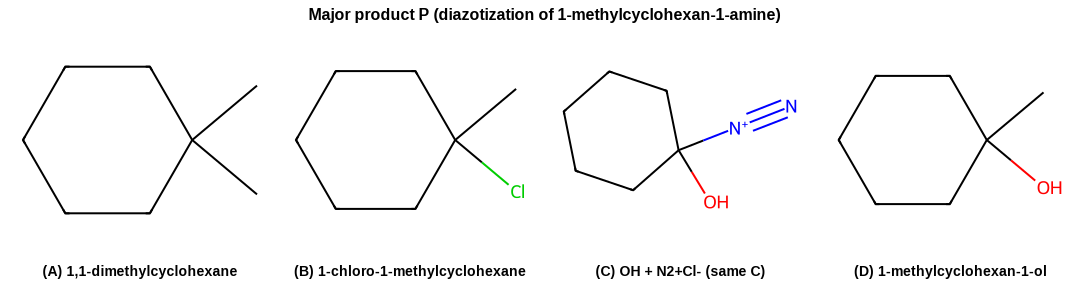
Four candidate products of diazotization of 1-methylcyclohexan-1-amine: 1,1-dimethylcyclohexane, 1-chloro-1-methylcyclohexane, the diazonium/hydroxy intermediate, 1-methylcyclohexan-1-ol - The starting amine, 1-methylcyclohexan-1-amine, has its -NH2 on a ring carbon that also bears a -CH3 group — this carbon is tertiary (attached to two ring carbons + CH3 + NH2).
- Unlike aromatic amines (which give stable, isolable diazonium salts), aliphatic primary amines form diazonium salts that are highly unstable even at low temperature (218 K) and decompose essentially immediately, losing N2 gas. …
🎓Unlock everything free for 10 days
- ✓Full step-by-step solutions
- ✓Concept-first explanations
- ✓Methods, shortcuts & mistakes
- ✓PYQ mapping + timed mock tests
Full access for 10 days. No credit card required.