Q.An electrochemical cell can behave like an electrolytic cell when ____________.
🔒You're viewing a preview — the full solution, concept, methods & PYQ mapping are locked.
🔒 Start your 10-day free trial to unlock the full solution →Concept understanding — Cell Representation Nernst Equation
Cell Representation and the Nernst Equation: From Intuition to Precision
Imagine you have a Daniell cell — a zinc rod in zinc sulphate solution connected by a salt bridge to a copper rod in copper sulphate solution. You know it produces a voltage. But what happens if you dilute the copper sulphate solution? Or if you change the temperature? The voltage changes. The Nernst equation is the tool that tells you exactly how much it changes.
The Intuition First
A battery works because the two half-cells "want" to react — zinc wants to lose electrons, copper ions want to gain them. This "want" is measured as a tendency, or potential. But the strength of that tendency depends on how crowded the ions are.
Think of it like this: If you have a room full of people who all want to leave (like zinc ions wanting to form), the push to get out is stronger when the room is packed. If the room is nearly empty, the push is weaker. Similarly, for copper ions wanting to enter the metal (gain electrons), the pull is stronger when there are many copper ions around, and weaker when there are few.
The Nernst equation quantifies this: the actual cell potential depends on the concentrations (or activities) of the ions involved.
The Precise Statement
For a general cell reaction:
aA+bB→cC+dD
The cell potential E under non-standard conditions is given by:
E=E∘−nFRTlnQ
Where:
- E = cell potential under the given conditions (in volts)
- E∘ = standard cell potential (when all reactants/products are at 1 M, 1 atm, 25°C)
- R = universal gas constant (8.314 J/mol·K)
- T = temperature in Kelvin
- n = number of moles of electrons transferred in the balanced half-reactions
- F = Faraday constant (96,485 C/mol)
- Q = reaction quotient = [A]a[B]b[C]c[D]d (using concentrations for dilute solutions)
At 25°C (298 K), the equation simplifies to a very practical form:
E=E∘−n0.0591log10Q
The 0.0591 comes from F2.303RT at 298 K. Notice it uses log10 (common log), not natural log.
Cell Representation: How We Write It
In electrochemistry, we represent a cell with a shorthand notation. For the Daniell cell:
Zn(s)∣Zn2+(aq)∥Cu2+(aq)∣Cu(s)
The single vertical line ∣ represents a phase boundary (solid electrode | solution). The double line ∥ represents the salt bridge.
The anode (oxidation) is written on the left, the cathode (reduction) on the right. Electrons flow from left to right in the external circuit.
Applying the Nernst Equation to a Cell Representation
For the Daniell cell, the half-reactions are:
- Anode (oxidation): Zn(s)→Zn2+(aq)+2e−
- Cathode (reduction): Cu2+(aq)+2e−→Cu(s)
Overall: Zn(s)+Cu2+(aq)→Zn2+(aq)+Cu(s)
Here n=2 (two electrons transferred). The reaction quotient is:
Q=[Cu2+][Zn2+]
So the Nernst equation becomes:
E=E∘−20.0591log10[Cu2+][Zn2+]
Solids (Zn, Cu) do not appear in Q because their concentrations are constant (activity = 1).
A Worked Example
Suppose you have a Daniell cell where [Zn2+]=0.1 M and [Cu2+]=1.0 M at 25°C. E∘ for the cell is 1.10 V.
E=1.10−20.0591log101.00.1 …
Why this formula?
Cell Representation & the Nernst Equation: Why It Works
The Core Question
Why does a cell's voltage change when concentrations change? The Nernst equation answers this — but the reason lies in the link between chemical free energy and electrical work.
1. The Fundamental Link: Gibbs Free Energy & Cell Potential
A galvanic cell does electrical work. The maximum useful work a cell can do equals the change in Gibbs free energy (ΔG):
ΔG=−nFEcell
Where:
- n = moles of electrons transferred
- F = Faraday constant (96,485C mol−1)
- Ecell = cell potential (volts)
Why negative? A spontaneous reaction has ΔG<0 and Ecell>0 — the negative sign makes this consistent.
2. The Chemical Side: ΔG Depends on Concentration
For a general redox reaction:
aA+bB→cC+dD
The Gibbs free energy under non-standard conditions is:
ΔG=ΔG∘+RTlnQ
Where Q is the reaction quotient:
Q=[A]a[B]b[C]c[D]d
Why this form? It comes from the relationship between chemical potential and concentration — the entropy of mixing drives concentration dependence.
3. Combining Both Sides: The Derivation
Set the electrical work equal to the chemical free energy change:
−nFEcell=−nFEcell∘+RTlnQ
Divide both sides by −nF:
Ecell=Ecell∘−nFRTlnQ
This is the Nernst equation.
4. The "Why" in Plain Terms
| Concept | Physical Meaning |
|---|---|
| Ecell∘ | Voltage when all species are at 1 M (standard state) |
| −nFRTlnQ | Correction factor — adjusts voltage for real concentrations |
| Q | Tells you how far the reaction is from equilibrium |
Key insight: When Q=K (equilibrium), Ecell=0 — the battery is dead because no net reaction occurs.
5. The Common Form (log base 10)
At 25∘C (298K):
FRTln10≈0.0592V
So:
Ecell=Ecell∘−n0.0592log10Q
Why convert to log? Exam convenience — most concentration values are powers of 10.
--- …
The key idea is that an electrochemical cell becomes an electrolytic cell when an external voltage opposes the cell’s spontaneous emf and overcomes it, forcing a non-spontaneous reaction.
Reasoning:
- A galvanic cell produces current spontaneously when Ecell>0.
- If an external voltage Eext is applied opposite to the cell’s direction, the net driving force is Ecell−Eext. …
An electrochemical cell behaves like an electrolytic cell when an external voltage greater than the cell’s emf is applied in opposition — forcing the cell reaction to reverse. The correct condition is Eext>Ecell, which corresponds to option (iii).
The key idea is simple: an electrochemical cell normally produces electricity spontaneously. But if you connect it to a stronger external battery in the opposite direction, you can overpower it and force the current to flow backwards — turning the cell into an electrolytic cell where the reaction is driven non-spontaneously.
This is exactly how electrolysis works: you apply an external voltage larger than the cell’s natural emf to reverse the redox reaction. The Nernst equation for cell potential tells us the driving force for the spontaneous direction. When Eext exceeds Ecell, the net potential becomes negative for the spontaneous direction, meaning the reaction now runs in reverse.
Let’s walk through each option carefully.
-
Option (i): Ecell=0
This means the cell is at equilibrium — no net reaction occurs. It’s neither a galvanic nor an electrolytic cell in action. So this is not the condition.
-
Option (ii): Ecell>Eext
Here the cell’s own emf is larger than the opposing external voltage. The cell still wins — current flows in the spontaneous (galvanic) direction. No reversal happens.
-
Option (iii): Eext>Ecell
The external voltage overpowers the cell. The net driving force is now opposite to the spontaneous direction. The cell reaction is forced to go backwards — exactly what happens in an electrolytic cell. This is the correct condition.
-
Option (iv): Ecell=Eext …
Concept: Electrochemical vs. Electrolytic Cell Behaviour
An electrochemical cell (galvanic/voltaic cell) produces electricity spontaneously. An electrolytic cell consumes electricity to drive a non-spontaneous reaction. The key is the opposing external voltage (Eext).
Method: Comparison of Cell EMF and External Voltage
Step 1 — Recall the spontaneous direction
In a galvanic cell, the cell potential Ecell>0 and the reaction proceeds spontaneously.
Step 2 — Apply an external voltage
If an external voltage Eext is applied opposing the cell's natural direction:
- When Eext<Ecell → cell still discharges spontaneously (galvanic behaviour).
- When Eext=Ecell → no net reaction (equilibrium). …
Common Mistakes & How to Avoid Them
Concept First: What the Question Tests
An electrochemical cell (galvanic/voltaic cell) produces electricity spontaneously. An electrolytic cell consumes electricity to drive a non-spontaneous reaction.
The key condition for a cell to behave like an electrolytic cell is when an external voltage (Eext) is applied greater than the cell's own emf (Ecell), forcing the reverse reaction.
Mistake #1: Confusing the direction of inequality
The error: Students often pick option (ii) Ecell>Eext, thinking "if the cell is stronger, it will behave like an electrolytic cell."
Why it's wrong: A larger Ecell means the spontaneous reaction is even more favoured — it remains an electrochemical cell, not an electrolytic one.
How to avoid:
- Remember: Electrolytic = external source overpowers the cell.
- Visualise a tug-of-war:
- Ecell pulls one way (spontaneous).
- Eext pulls the opposite way (forced).
- Only when Eext is larger does the direction reverse.
Correct choice: (iii) Eext>Ecell
Mistake #2: Thinking Ecell=0 means electrolytic behaviour
The error: Some students associate Ecell=0 with "no reaction" and assume that's when an external source is needed.
Why it's wrong: Ecell=0 means equilibrium — the cell is dead (no net reaction). An external voltage can indeed drive a reaction, but the cell is not "behaving like an electrolytic cell" at Ecell=0; it's simply at equilibrium.
How to avoid:
- Ecell=0 → equilibrium, not electrolytic mode.
- Electrolytic behaviour requires overcoming the cell's emf, not being at zero.
Mistake #3: Picking Ecell=Eext (option D)
The error: Students think "equal voltages cancel out, so the cell becomes electrolytic." …
- JEE Main 2026Set 2026-04-06-s24 marksMCQQ.For a general redox reaction Anode Red1 -> Ox1^n1+ + n1 e- Cathode Ox2 + n2 e- -> Red2^n2- Which of the following statement is incorrect ? (A) The overall reaction can be written as n2 Red1 + n1 Ox2 <=> n2 Ox1^n1+ + n1 Red2^n2- (B) The electrons do not appear in the overall reaction because electrons produced at the anode are consumed at the cathode. (C) [Graph: (E - E-standard)/(RT/F) on the y-axis vs log10 Q on the x-axis, showing three straight lines of decreasing slope magnitude for n=1, n=2, n=3, all passing through the origin region, labelled 'Slope proportional to 1/n'.] Here n is the number of electrons transferred in redox reaction. (D) If the reaction is carried out reversibly, the electrical work done is equal to the ratio of charge and potential difference through which charge is moved.
›Reveal solutionSolution
Statements A, B and C all check out against standard electrochemistry relations (electron balancing, Nernst-equation slope); statement D misstates electrical work as a ratio of charge to potential difference instead of their product — making D the incorrect statement.
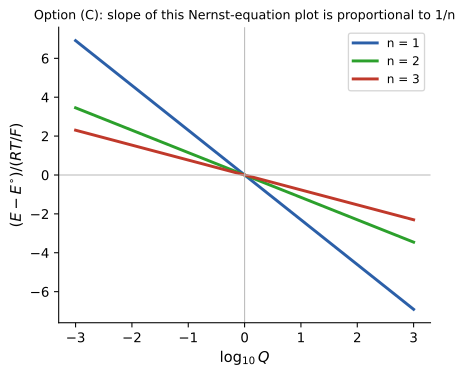
Graph of E minus E standard over RT by F versus log base 10 of Q, three straight lines for n equals 1, 2 and 3 with slope proportional to 1 by n Intuition: Three of the four statements are routine bookkeeping / Nernst-equation facts. The flaw in the fourth is a basic physics definition: electrical work is charge times potential difference (W = QΔV), never charge divided by potential difference — a units check alone (coulomb·volt = joule, vs coulomb/volt = farad) exposes the error.
Step-by-step derivation:
- (A) Overall reaction: To balance electrons, scale the anode half-reaction by n2 and the cathode half-reaction by n1:
n2Red1→n2Ox1n1++n1n2e−
n1Ox2+n1n2e−→n1Red2n2−
Adding: n2Red1+n1Ox2⇌n2Ox1n1++n1Red2n2− — matches exactly. Correct.
-
(B) Since the n1n2e− terms cancel from both sides when adding the half-reactions, electrons never appear in the net ionic equation. Correct.
-
(C) The Nernst equation: E=E∘−nF2.303RTlog10Q, so …
- JEE Main 2026Set 2026-01-21-s24 marksMCQQ.For a closed circuit Daniell cell, which of the following plots is the accurate one at a given temperature? (Each option is a graph of E°cell on the vertical axis against time on the horizontal axis.) (A) Graph: E°cell is constant (a flat horizontal line) as time increases. (B) Graph: E°cell decreases linearly as time increases, sloping down from a higher value at t=0 to a lower value. (C) Graph: E°cell increases linearly as time increases, sloping up from a lower value at t=0 to a higher value. (D) Graph: E°cell drops abruptly (shown as a near-vertical line) immediately after t=0, with no further line drawn afterward, i.e. the cell potential falls to zero almost instantly and stays there.
›Reveal solutionSolution
Changing ion concentrations during discharge steadily reduce the cell's EMF via the Nernst equation, giving a gradually declining Ecell-vs-time curve.
A working galvanic cell is not at equilibrium — its concentrations evolve continuously as current flows, which the Nernst equation directly ties to a changing cell potential.
- Daniell cell: Zn(s)+Cu2+(aq)→Zn2+(aq)+Cu(s); as current flows, [Cu2+] falls and [Zn2+] rises. …
- JEE Main 2024Set 2024-04-05-s24 marksMCQQ.For the electrochemical cell M|M^2+||X|X^2-: given E°(M^2+/M) = 0.46 V and E°(X/X^2-) = 0.34 V. Which of the following is correct? (A) E_cell = -0.80 V (B) M + X -> M^2+ + X^2- is a spontaneous reaction (C) M^2+ + X^2- -> M + X is a spontaneous reaction (D) E_cell = 0.80 V
›Reveal solutionSolution
Compute E°cell = E°cathode − E°anode = 0.34 − 0.46 = −0.12 V; a negative E°cell means the forward reaction is non-spontaneous, so the reverse (M²⁺ + X²⁻ → M + X) is spontaneous.
Identify the electrodes from the cell notation and then apply E°cell = E°cathode − E°anode.
-
Cell: M|M²⁺||X|X²⁻. Left electrode M is the anode (oxidation): M→M2++2e−, Eox∘=−0.46 V (since E∘(M2+/M)=0.46 V).
-
Right electrode X is the cathode (reduction): X+2e−→X2−, Ered∘=0.34 V. …
-
- JEE Main 2024Set 2024-04-08-s24 marksMCQQ.The reaction 21H2(g)+AgCl(s)→H+(aq)+Cl−(aq)+Ag(s) occurs in which of the following galvanic cells? (A) [distractor galvanic-cell notation — full text not recoverable from available source] (B) [distractor galvanic-cell notation — full text not recoverable from available source] (C) [distractor galvanic-cell notation — full text not recoverable from available source] (D) Pt(s)∣H2(g)∣HCl(aq)∣AgCl(s)∣Ag(s)
›Reveal solutionSolution
Split the given reaction into half-reactions: HX22HX++2eX− (hydrogen electrode, anode) and 2AgCl+2eX−2Ag+2ClX− (silver–silver chloride electrode, cathode); the cell notation must contain Pt∣HX2∣HCl∣AgCl∣Ag.
- Oxidation half-reaction: HX2(g)2HX+(aq)+2eX− — needs an inert Pt electrode dipping in HX2 over acidic solution.
- Reduction half-reaction: 2AgCl(s)+2eX−2Ag(s)+2ClX−(aq) — a AgCl(s)∣Ag(s) electrode in ClX− solution. …
- JEE Main 2023Set 2023-04-08-s14 marksMCQQ.The reaction 21H2(g)+AgCl(s)⇌H+(aq)+Cl−(aq)+Ag(s) occurs in which of the given galvanic cell. (A) Pt | H₂(g) | HCl(soln) | AgNO₃(soln) | Ag (B) Pt | H₂(g) | HCl(soln) | AgCl(s) | Ag (C) Pt | H₂(g) | KCl(soln) | AgCl(s) | Ag (D) Ag | AgCl(s) | KCl(soln) | AgNO₃ | Ag
›Reveal solutionSolution
The anode is a hydrogen electrode (oxidation of H₂ to H⁺) and the cathode is a Ag/AgCl electrode (reduction of AgCl to Ag + Cl⁻); since the same HCl solution supplies both H⁺ and Cl⁻, the cell needs only one electrolyte compartment, no salt bridge.
- Split the overall reaction into two half-reactions: at the anode, oxidation gives 21H2(g)→H+(aq)+e−; at the cathode, reduction gives AgCl(s)+e−→Ag(s)+Cl−(aq).
- Adding these two half-reactions reproduces the given overall cell reaction exactly, confirming the anode is a hydrogen electrode and the cathode is a silver-silver chloride electrode. …
- JEE Main 2022Set 2022-06-27-s24 marksQ.For the reaction taking place in the cell: Pt(s) | H2(g) | H⁺(aq) || Ag⁺(aq) | Ag(s). E°cell = +0.5332 V. The value of ΔrG° is ______ kJ mol⁻¹. (in nearest integer)
›Reveal solutionSolution
Using ΔrG∘=−nFE∘ with n=1 (per electron transferred to reduce one Ag+) gives ΔrG∘≈−51 kJ/mol.
- The cell is Pt(s)∣H2(g)∣H+(aq)∣∣Ag+(aq)∣Ag(s), with H2→2H++2e− at the anode and Ag++e−→Ag at the cathode.
- Taking the cell reaction on a per-electron basis (n=1, i.e. 21H2+Ag+→H++Ag): ΔrG∘=−nFEcell∘=−(1)(96500C/mol)(0.5332V).
- =−51455 J/mol=−51.46 kJ/mol, which to the nearest integer is −51 kJ/mol. …
- JEE Main 2020Set 2020-09-05-s14 marksQ.An oxidation-reduction reaction in which 3 electrons are transferred has a ΔG0 of 17.37 kJ mol−1 at 25∘C. The value of Ecell0 (in V) is _____ ×10−2 (1 F = 96,500 C mol−1)
›Reveal solutionSolution
Using ΔG0=−nFE0 gives Ecell0≈−6×10⁻²V.
- The relation between standard Gibbs energy change and standard cell potential is ΔG0=−nFEcell0.
- Rearranging: Ecell0=−nFΔG0. …
🎓Unlock everything free for 10 days
- ✓Full step-by-step solutions
- ✓Concept-first explanations
- ✓Methods, shortcuts & mistakes
- ✓PYQ mapping + timed mock tests
Full access for 10 days. No credit card required.