Q.Λm(H2O)0 is equal to _______________. (Two or more than two options may be correct.)
🔒You're viewing a preview — the full solution, concept, methods & PYQ mapping are locked.
🔒 Start your 10-day free trial to unlock the full solution →Concept understanding — Molar Conductivity
From Resistance to Conductance: Flipping the Idea
You already know resistance (R) — it tells you how much a material opposes the flow of current. A high resistance means the wire fights the current; a low resistance means it lets current through easily.
Now flip that thought. Instead of asking "how much does it resist?", ask "how easily does it let current flow?" That's exactly what conductance measures.
Conductance (G) is the reciprocal of resistance:
G=R1
Unit: siemens (S) — named after Werner von Siemens. 1 S = 1 A/V (ampere per volt).
If a wire has R=10 Ω, its conductance is G=0.1 S. If R=0.5 Ω, G=2 S — it conducts twice as well.
Ohm's Law in Conductance Form
You know V=IR. Rearranging:
I=RV=GV
So current = conductance × voltage. A high-conductance material draws a large current for the same voltage — it's a "good conductor."
Now, Conductivity: The Material's Intrinsic Property
Resistance depends on two things: the material itself (its "resistivity" ρ) and the geometry (length L, cross-sectional area A):
R=ρAL
Conductance also depends on geometry. A thicker wire (larger A) or a shorter wire (smaller L) has higher conductance. To isolate the material's inherent ability to conduct, we define conductivity (σ):
σ=ρ1
And for a uniform wire:
G=σLA
Conductivity is the reciprocal of resistivity. It tells you how well the material itself conducts, independent of shape and size.
- Unit: siemens per metre (S/m).
- High σ → good conductor (copper: ≈5.8×10⁷ S/m).
- Low σ → poor conductor / insulator (glass: ≈10−12 S/m).
Don't confuse conductance (property of a specific object, depends on geometry) with conductivity (property of the material, independent of geometry). A short thick copper wire has high conductance; a long thin copper wire has lower conductance — but both have the same conductivity.
The Big Picture in One Table
| Quantity | Symbol | Definition | Depends on | Unit |
|---|---|---|---|---|
| Resistance | R | V/I | Material + geometry | Ω |
| Resistivity | ρ | RA/L | Material only | Ω⋅m |
| Conductance | G | 1/R | Material + geometry | S |
| Conductivity | σ | 1/ρ | Material only | S/m |
Intuitive Analogy
Think of a water pipe:
- Resistance = how hard it is to push water through (narrow, long pipe).
- Conductance = how easily water flows (wide, short pipe). …
Why this formula?
Conductance and Conductivity: Why the Formulas Hold
Let's build this from first principles — understanding the why before the what.
1. The Core Idea: How Easily Does Current Flow?
Think of a conductor (like a copper wire). When you apply a voltage across it, electrons drift through the material. Two questions arise:
- How much current flows for a given voltage? → This is conductance (G).
- How well does the material itself allow current? → This is conductivity (σ).
The key distinction: Conductance depends on the size and shape of the object. Conductivity is an intrinsic property of the material.
2. Ohm's Law in Terms of Conductance
You know Ohm's law:
V=IR
But we can rewrite it as:
I=RV
Define conductance G as the reciprocal of resistance:
G=R1
So:
I=GV
Why this makes sense:
- A larger G means more current for the same voltage — the conductor "conducts" better.
- G has units of siemens (S) = A/V.
3. From Resistance to Conductivity: The Geometry Factor
Resistance of a uniform conductor depends on:
- Length L (longer → more resistance)
- Cross-sectional area A (thicker → less resistance)
- Material property ρ (resistivity)
The formula:
R=ρAL
Now, conductivity σ is the reciprocal of resistivity:
σ=ρ1
So:
R=σ1⋅AL
Why this form?
- If you double the length, electrons have to travel twice as far, colliding more → resistance doubles.
- If you double the area, there's twice as many "lanes" for electrons → resistance halves.
4. The Key Formula: Conductance in Terms of Conductivity
Since G=1/R, we get:
G=σLA
This is the central relationship. Let's see why it holds:
- σ tells you how well the material conducts (intrinsic).
- A/L tells you how the geometry amplifies or reduces that.
Intuition:
- A fat, short wire (A large, L small) has high conductance.
- A thin, long wire (A small, L large) has low conductance.
- A material with high σ (like copper) gives higher G than one with low σ (like iron), for the same shape.
5. Microscopic Derivation (Why σ Exists)
At the microscopic level, conductivity arises from electron motion:
σ=neμ
Where:
- n = number of free electrons per unit volume
- e = electron charge …
Concept: Molar Conductivity at infinite dilution — Kohlrausch’s law states that Λm0 of an electrolyte is the sum of the limiting molar conductivities of its constituent ions. For water, Λm(H2O)0=λH+0+λOH−0. Only combinations built from strong electrolytes count, since a strong electrolyte's Λm0 is the only kind that can be measured directly.
We need to combine strong electrolytes so that the net ionic sum equals λH+0+λOH−0.
Step 1: Write the ionic contributions for each option.
For (i):
Λm(HCl)0=λH+0+λCl−0
Λm(NaOH)0=λNa+0+λOH−0
Λm(NaCl)0=λNa+0+λCl−0
Sum: (λH+0+λCl−0)+(λNa+0+λOH−0)−(λNa+0+λCl−0)=λH+0+λOH−0 ✓
Step 2: Check (ii):
Λm(HNO3)0=λH+0+λNO3−0
Λm(NaNO3)0=λNa+0+λNO3−0
Λm(NaOH)0=λNa+0+λOH−0
Sum: (λH+0+λNO3−0)+(λNa+0+λNO3−0)−(λNa+0+λOH−0)=λH+0+2λNO3−0−λOH−0 ✗
Step 3: Check (iii):
Λm(HNO3)0=λH+0+λNO3−0
Λm(NaOH)0=λNa+0+λOH−0
Λm(NaNO3)0=λNa+0+λNO3−0 …
The limiting molar conductivity of water, Λm(H2O)0, is found by applying Kohlrausch’s law of independent migration of ions. It equals the sum of the limiting conductivities of its constituent ions, H+ and OH−, which can be obtained by combining the conductivities of strong electrolytes. The correct expressions are (i) and (iii).
The key idea here is Kohlrausch’s law: at infinite dilution, each ion contributes a fixed amount to the molar conductivity of an electrolyte, independent of the other ion it travels with. So Λm0 for any electrolyte is simply the sum of the limiting conductivities of its cation and anion.
For water, which dissociates as H2O⇌H++OH−, its limiting molar conductivity is:
Λm(H2O)0=λH+0+λOH−0
We don’t know these individual ionic conductivities directly, but we can get them by combining data from strong electrolytes that contain these ions — strong electrolytes are the ones whose Λm0 can actually be measured directly, by extrapolating Λm vs c to zero concentration.
Let’s check each option step by step.
-
Option (i): Λm(HCl)0+Λm(NaOH)0−Λm(NaCl)0
Write each in terms of ionic conductivities:
- Λm(HCl)0=λH+0+λCl−0
- Λm(NaOH)0=λNa+0+λOH−0
- Λm(NaCl)0=λNa+0+λCl−0
Adding the first two and subtracting the third:
(λH+0+λCl−0)+(λNa+0+λOH−0)−(λNa+0+λCl−0)
The λNa+0 and λCl−0 cancel, leaving λH+0+λOH−0, which is exactly Λm(H2O)0. HCl, NaOH and NaCl are all strong electrolytes, so this is a legitimate calculation. (i) is correct.
-
Option (ii): Λm(HNO3)0+Λm(NaNO3)0−Λm(NaOH)0
Write them out:
- Λm(HNO3)0=λH+0+λNO3−0
- Λm(NaNO3)0=λNa+0+λNO3−0
- Λm(NaOH)0=λNa+0+λOH−0
Sum the first two and subtract the third:
(λH+0+λNO3−0)+(λNa+0+λNO3−0)−(λNa+0+λOH−0)
The λNa+0 cancels, but we get λH+0+2λNO3−0−λOH−0, which is not λH+0+λOH−0. So (ii) is incorrect.
-
Option (iii): Λm(HNO3)0+Λm(NaOH)0−Λm(NaNO3)0
Write:
- Λm(HNO3)0=λH+0+λNO3−0
- Λm(NaOH)0=λNa+0+λOH−0
- Λm(NaNO3)0=λNa+0+λNO3−0
Adding the first two and subtracting the third:
(λH+0+λNO3−0)+(λNa+0+λOH−0)−(λNa+0+λNO3−0)
The λNa+0 and λNO3−0 cancel, leaving λH+0+λOH−0. HNO₃, NaOH and NaNO₃ are all strong electrolytes, so this is also legitimate. (iii) is correct.
- Option (iv): Λm(NH4OH)0+Λm(HCl)0−Λm(NH4Cl)0
Write:
- Λm(NH4OH)0=λNH4+0+λOH−0
- Λm(HCl)0=λH+0+λCl−0
- Λm(NH4Cl)0=λNH4+0+λCl−0 …
Method: Kohlrausch’s Law of Independent Migration of Ions
Concept: At infinite dilution, each ion contributes a fixed amount to the molar conductivity of an electrolyte, independent of the other ion it is paired with. This lets you build Λm0 of one substance from other substances' Λm0 values — provided every substance used is a strong electrolyte (only strong-electrolyte Λm0 can be measured directly, by extrapolating Λm vs c to c=0).
Steps:
- Write the expression for Λm0 of water Water dissociates as:
H2O⇌H++OH−
So,
Λm(H2O)0=λH+0+λOH−0
-
Express each given electrolyte in terms of ionic conductivities
For example:
- Λm(HCl)0=λH+0+λCl−0
- Λm(NaOH)0=λNa+0+λOH−0
- Λm(NaCl)0=λNa+0+λCl−0
-
Combine to isolate λH+0+λOH−0
Take option (i):
Λm(HCl)0+Λm(NaOH)0−Λm(NaCl)0
Substitute:
=(λH+0+λCl−0)+(λNa+0+λOH−0)−(λNa+0+λCl−0)
Cancel λNa+0 and λCl−0:
=λH+0+λOH−0=Λm(H2O)0
HCl, NaOH, NaCl are all strong electrolytes — valid.
- Check other options similarly
- Option (iii) also works, using only strong electrolytes HNO₃, NaOH, NaNO₃: …
Common Mistakes & How to Avoid Them
Mistake 1: Not recognising Kohlrausch’s Law of independent migration of ions
Students often try to memorise the formula without understanding the logic behind it.
How to avoid:
Kohlrausch’s law says:
Λm0=λ+0+λ−0
For water (H2O), the ions are H+ and OH−. So:
Λm(H2O)0=λH+0+λOH−0
Now, any combination of strong electrolytes that gives you λH+0+λOH−0 is correct.
Mistake 2: Confusing addition/subtraction signs
Students often misplace the signs when combining electrolytes.
How to avoid:
Write each electrolyte’s ionic contributions explicitly:
- Λm(HCl)0=λH+0+λCl−0
- Λm(NaOH)0=λNa+0+λOH−0
- Λm(NaCl)0=λNa+0+λCl−0
Now compute:
Λm(HCl)0+Λm(NaOH)0−Λm(NaCl)0=(λH+0+λCl−0)+(λNa+0+λOH−0)−(λNa+0+λCl−0)
Cancel λNa+0 and λCl−0 → λH+0+λOH−0 ✓
Mistake 3: Assuming only one combination is correct
The question says two or more options may be correct, but students often stop after finding one.
How to avoid:
Check every option using the same method. For option (iii):
Λm(HNO3)0+Λm(NaOH)0−Λm(NaNO3)0
- Λm(HNO3)0=λH+0+λNO3−0
- Λm(NaOH)0=λNa+0+λOH−0
- Λm(NaNO3)0=λNa+0+λNO3−0
Cancel λNa+0 and λNO3−0 → λH+0+λOH−0 ✓
So both (i) and (iii) are correct.
Mistake 4: Wrongly accepting option (iv) because the ion algebra 'cancels'
Option (iv) is Λm(NH4OH)0+Λm(HCl)0−Λm(NH4Cl)0. If you write it out formally:
(λNH4+0+λOH−0)+(λH+0+λCl−0)−(λNH4+0+λCl−0)=λH+0+λOH−0
This LOOKS identical to (i) and (iii) — but it is not accepted as a valid answer, and it's a genuine trap.
Why it's wrong: …
Showing the 12 most recent of 27 on this concept.
- JEE Main 2026Set 2026-04-05-s24 marksQ.At 298 K, the molar conductivity of x% (w/w) MX solution (aqueous) is 123.5 S cm2 mol^-1. The conductance of same solution is 1.9 x 10^-3 S. The value of x is __________ x 10^-2. (Given : cell constant = 1.3 cm^-1; molar mass of MX is 75 g mol^-1, density of aqueous solution of MX at 298 K is 1.0 g mL^-1)
›Reveal solutionSolution
Converting the measured conductance to molarity via the cell constant and Lambda-m, then to mass percent using the density and molar mass, gives x% = 0.15%, so x = 15.
- Conductivity from conductance: kappa = G x (cell constant) = (1.9x10^-3 S)(1.3 cm^-1) = 2.47x10^-3 S cm^-1.
- Molarity from molar conductivity: Lambda-m = kappa x 1000/C, so C = kappa*1000/Lambda-m = (2.47x10^-3 x 1000)/123.5 = 2.47/123.5 = 0.02 mol/L.
- Mass of solute per litre: mass = C x M = 0.02 mol/L x 75 g/mol = 1.5 g/L. …
- JEE Main 2026Set 2026-01-21-s14 marksQ.The pH and conductance of a weak acid (HX) was found to be 5 and 4 × 10⁻⁵ S, respectively. The conductance was measured under standard condition using a cell where the electrode plates having a surface area of 1 cm² were at a distance of 15 cm apart. The value of the limiting molar conductivity is __ S m² mol⁻¹. (nearest integer) (Given : degree of dissociation of the weak acid (α) ≪ 1)
›Reveal solutionSolution
Combining the cell-geometry conductivity with the pH-derived [H+]=Cα gives the limiting molar conductivity directly as κ/[H+]=6 S m²/mol.
For a weak electrolyte with α≪1, Cα≈[H+] exactly, which lets the limiting molar conductivity be found without separately knowing C and α.
- Cell constant =Al=1×10⁻⁴ m20.15 m=1500 m−1.
- Conductivity κ=G×Al=4×10−5×1500=0.06 S/m.
- From pH=5: [H+]=10−5 M =10−2 mol/m³ (converting L to m³). …
- JEE Main 2026Set 2026-01-24-s24 marksQ.Molar conductivity of a weak acid HQ of concentration 0.18 M was found to be 1/30 of the molar conductivity of another weak acid HZ with concentration of 0.02 M . If (lambda-degree)Q- happened to be equal with (lambda-degree)Z-, then the difference of the pKa values of the two weak acids (pKa(HQ) - pKa(HZ)) is _____ (Nearest integer). [Given: degree of dissociation (alpha) << 1 for both weak acids, lambda-degree : limiting molar conductivity of ions]
›Reveal solutionSolution
The degree-of-dissociation ratio works out to αQ=αZ/30, giving Ka(HQ)/Ka(HZ)=10−2 and hence pKa(HQ)−pKa(HZ)=2.
For weak electrolytes, molar conductivity at a given concentration is the limiting molar conductivity scaled by the degree of dissociation, so equal limiting ionic conductivities let the dissociation degrees be compared directly.
Λm=αΛm∘;Ka≈cα2 (for α≪1)
- Since λQ−∘=λZ−∘, both acids share the same Λm∘, so Λm(HQ)/Λm(HZ)=αQ/αZ=1/30. …
- JEE Main 2026Set 2026-01-28-s24 marksQ.For strong electrolyte Λm increases slowly with dilution and can be represented by the equation Λm = Λ°m − Ac^1/2 Molar conductivity values of the solutions of strong electrolyte AB at 18°C are given below : c [molL−1]: 0.04, 0.09, 0.16, 0.25 Λm [Scm2 mol−1]: 96.1, 95.7, 95.3, 94.9 The value of constant A based on the above data [Scm2 mol−1/(mol/L)^1/2 ] unit is ____.
›Reveal solutionSolution
The Onsager equation is linear in c, so A is simply the magnitude of the slope of Λm plotted against c.
- Compute c for each row: 0.04=0.2, 0.09=0.3, 0.16=0.4, 0.25=0.5.
- Tabulate Λm against c: (0.2,96.1),(0.3,95.7),(0.4,95.3),(0.5,94.9). …
- JEE Main 2025Set 2025-01-28-s14 marksQ.Given below is the plot of the molar conductivity vs √concentration for KCl in aqueous solution. [Graph: y-axis is Molar Conductivity, Λm (S cm² mol⁻¹), with gridlines/dashed guides at 100 and 150; x-axis is √C (mol/L)^(1/2), with dashed guides at 0.1 and 0.15; a straight line decreasing from upper-left to lower-right, passing near (0.1, 150) and (0.15, 100), consistent with the Debye-Hückel-Onsager limiting law for a strong electrolyte] If, for the higher concentration of KCl solution, the resistance of the conductivity cell is 100Ω, then the resistance of the same cell with the dilute solution is ' x ' Ω The value of x is ________ (Nearest integer)
›Reveal solutionSolution
Use molar conductivity's definition to extract the actual conductivities at the two concentrations, derive the (constant) cell constant from the known resistance at one concentration, and apply it to find the unknown resistance at the other.
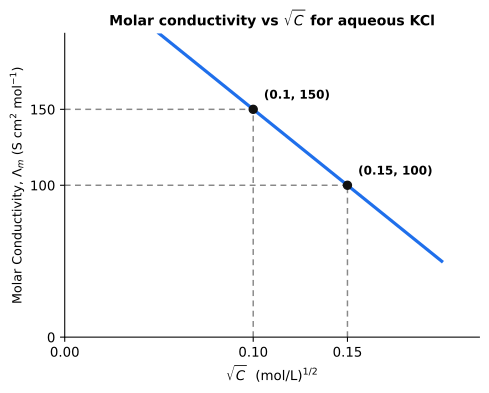
Molar conductivity vs square-root concentration graph for aqueous KCl - From the graph: at C=0.15 (the higher concentration, C1=0.0225 mol/L), Λm,1=100 S cm² mol⁻¹. At C=0.1 (the dilute concentration, C2=0.01 mol/L), Λm,2=150 S cm² mol⁻¹.
- Molar conductivity relates to specific conductivity κ (S/cm) and concentration (mol/L) via Λm=C1000κ, so κ=1000ΛmC. …
- JEE Main 2025Set 2025-04-02-s24 marksQ.0.2% (w/v) solution of NaOH is measured to have resistivity 870.0 mΩ m. The molar conductivity of the solution will be__________ ×10^2 mS dm^2 mol^-1. (Nearest integer)
›Reveal solutionSolution
Λm = κ/c works out to ≈ 2299 mS dm² mol⁻¹, i.e. 23 × 10² mS dm² mol⁻¹.
- Concentration: 0.2% w/v = 0.2 g NaOH per 100 mL = 2 g/L. Molar mass NaOH = 40 g/mol, so c = 2/40 = 0.05 mol/dm³ = 50 mol/m³ (since 1 mol/dm³ = 1000 mol/m³).
- Resistivity ρ = 870.0 mΩ·m = 0.870 Ω·m, so conductivity κ = 1/ρ = 1/0.870 = 1.1494 S/m.
- Molar conductivity: Λm = κ/c = 1.1494 / 50 = 0.022989 S·m²·mol⁻¹.
Λm = κ/c, with κ = 1/ρ …
- JEE Main 2025Set 2025-04-03-s14 marksMCQQ.Correct order of limiting molar conductivity for cations in water at 298 K is : (A) H+ > Na+ > K+ > Ca2+ > Mg2+ (B) H+ > Ca2+ > Mg2+ > K+ > Na+ (C) Mg2+ > H+ > Ca2+ > K+ > Na+ (D) H+ > Na+ > Ca2+ > Mg2+ > K+
›Reveal solutionSolution
H+ conducts anomalously fast via proton hopping, placing it far above the rest; among the remaining cations the standard limiting molar conductivities at 298 K follow Ca2+ > Mg2+ > K+ > Na+, giving overall H+ > Ca2+ > Mg2+ > K+ > Na+.
- H+ (as H3O+ in water) does not migrate by simple diffusion through the solvent; it moves via the Grotthuss (proton-hopping) mechanism, where protons hop between hydrogen-bonded water molecules. This makes its limiting molar conductivity (λ∘≈349.8 Scm2mol−1) far larger than any ordinary cation's.
- Among the remaining ions, standard tabulated limiting molar conductivities at 298 K (Scm2mol−1) are approximately: Ca2+≈119, Mg2+≈106, K+≈73.5, Na+≈50.1. …
- JEE Main 2024Set 2024-04-04-s24 marksMCQQ.For a strong electrolyte, a plot of molar conductivity against (concentration)1/2 is a straight line, with a negative slope. The correct unit for the slope is (A) Scm2mol−3/2L1/2 (B) Scm2mol−1L1/2 (C) Scm2mol−3/2L (D) Scm2mol−3/2L−1/2
›Reveal solutionSolution
Use Kohlrausch's law Λm=Λm∘−Ac; the slope −A has units of Λm per c, i.e. S cm2 mol−3/2 L1/2.
For strong electrolytes the molar conductivity falls linearly with c, and the slope's units follow from dividing the units of Λm by those of c.
- Kohlrausch's law: Λm=Λm∘−Ac, so slope =−A.
- Units of Λm: S cm2 mol−1. …
- JEE Main 2024Set 2024-04-05-s14 marksMCQQ.Molar ionic conductivities of a divalent cation and an anion are 57 Scm2mol−1 and 73 Scm2mol−1 respectively. The molar conductivity of the solution of an electrolyte with the above cation and anion will be: (A) 65 Scm2mol−1 (B) 130 Scm2mol−1 (C) 187 Scm2mol−1 (D) 260 Scm2mol−1
›Reveal solutionSolution
By Kohlrausch's law of independent migration of ions, the molar conductivity is the direct sum of the two given ionic conductivities, 57+73=130.
- Kohlrausch's law states that the molar conductivity of an electrolyte at infinite dilution is the sum of the individual molar ionic conductivities of its constituent ions: Λm0=λ+0+λ−0. …
- JEE Main 2024Set 2024-04-09-s24 marksMCQQ.Which out of the following is a correct equation to show change in molar conductivity with respect to concentration for a weak electrolyte, if the symbols carry their usual meaning : (A) Λm2C−KaΛm∘2+KaΛmΛm∘=0 (B) Λm−Λm∘+AC1/2=0 (C) Λm−Λm∘−AC1/2=0 (D) Λm2C+KaΛm∘2−KaΛmΛm∘=0
›Reveal solutionSolution
Use Ostwald's dilution law for a weak electrolyte, α=Λm/Λm∘ and Ka=1−αCα2, then rearrange to match the given options.
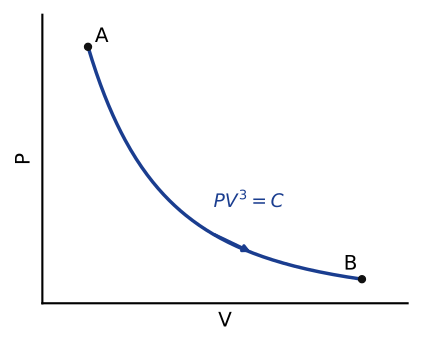
A P-V curve for the process PV^3 = C, running from point A (high P, low V, top-left) to point B (low P, high V, bottom-right), with an arrow - For a weak electrolyte the degree of dissociation is α=Λm∘Λm.
- Ostwald's dilution law: Ka=1−αCα2.
- Substitute α: Ka=1−Λm/Λm∘CΛm2/Λm∘2=Λm∘(Λm∘−Λm)CΛm2. …
- JEE Main 2023Set 2023-04-10-s24 marksQ.The specific conductance of 0.0025M acetic acid is 5 × 10^{-5} S cm^{-1} at a certain temperature. The dissociation constant of acetic acid is _________ × 10^{-7}. (Nearest integer) Consider limiting molar conductivity of CH3COOH as 400 S cm^2 mol^{-1}.
›Reveal solutionSolution
Get the molar conductance from the specific conductance and concentration, find the degree of dissociation relative to the limiting value, then apply Ostwald's dilution law.
- Λm=cκ×1000=0.00255×10−5×1000=20S cm2mol−1.
- Degree of dissociation: α=Λm/Λm∘=20/400=0.05. …
- JEE Main 2023Set 2023-01-31-s24 marksQ.The resistivity of a 0.8 M solution of an electrolyte is 5×10^{-3} Ω cm. Its molar conductivity is _______ ×10^{4} Ω^{-1} cm^{2} mol^{-1}. (Nearest integer)
›Reveal solutionSolution
First find conductivity from resistivity, then convert to molar conductivity using the molarity.
- κ=ρ1=5×10−31=200S cm−1. …
🎓Unlock everything free for 10 days
- ✓Full step-by-step solutions
- ✓Concept-first explanations
- ✓Methods, shortcuts & mistakes
- ✓PYQ mapping + timed mock tests
Full access for 10 days. No credit card required.