Q.Sulphide ores are concentrated by
🔒You're viewing a preview — the full solution, concept, methods & PYQ mapping are locked.
🔒 Start your 14-day free trial to unlock the full solution →Concept understanding — Froth Flotation
Froth Flotation: Separating Minerals by Making Them Choose Sides
Imagine you have a bowl of mixed nuts — cashews, almonds, and peanuts — all floating in water. If you could somehow make the cashews want to stick to air bubbles and ride them to the surface, while the almonds and peanuts stay sunk, you'd have a perfect separation. That's the core idea behind froth flotation.
Nature gives us a clue: some minerals are naturally water-repelling (hydrophobic), while others are water-loving (hydrophilic). Sulphide ores — like galena (PbS), zinc blende (ZnS), and copper pyrites (CuFeS₂) — are hydrophobic. The worthless rocky material (gangue) is hydrophilic. Froth flotation exploits this difference in wettability.
How It Works: The Three Ingredients
The process uses three things working together:
- Finely crushed ore mixed with water to form a slurry.
- A frothing agent (like pine oil or eucalyptus oil) that stabilises air bubbles.
- A collector (like sodium ethyl xanthate) that coats the ore particles, making them even more hydrophobic.
Air is blown through the slurry. The collector molecules attach their polar end to the ore particle and stick their non-polar tail outward — so the particle now behaves like an oily speck. When an air bubble rises, that oily speck clings to it. The bubble carries the ore particle all the way up to the surface, where it collects in a froth layer.
The gangue, being hydrophilic, stays wet and sinks to the bottom.
The froth is scraped off, dried, and the ore is recovered. The gangue is discarded as tailings.
The Precise Statement
Froth flotation is a physico-chemical method for concentrating sulphide ores. It separates ore particles from gangue based on differences in their wettability. The ore particles are made hydrophobic by adding collectors, then carried to the surface by air bubbles stabilised by frothing agents, forming a froth that is skimmed off.
Why It Works for Sulphides
Sulphide minerals have surfaces that readily adsorb collector molecules. The collector's polar group binds to the metal ion on the mineral surface, while its hydrocarbon chain points outward — making the particle effectively "oily" and hydrophobic.
Froth flotation works only when the ore particles are selectively coated by the collector. Gangue particles do not adsorb the collector and remain hydrophilic.
A Common Exam Detail …
Sulphide-ore particles have a surface property that lets them be selectively separated from earthy gangue using a specific concentration technique. …
Sulphide ores are concentrated by the froth floatation process, which exploits the preferential wetting of sulphide particles by oil.
The froth floatation process is used to concentrate sulphide ores (e.g. galena PbS, zinc blende ZnS, copper pyrites). The finely ground ore is suspended in water with pine oil (collector) and air is blown through. The sulphide ore particles are preferentially wetted by the oil and rise up with the froth, while the gangue (wetted by wate …
- CBSE 2024Set ANNUAL1 markMCQQ.Concentration of ore by froth floatation method is mainly used for .........(a) Hydrated ores(b) Sulphide ores(c) Oxide ores(d) Carbonate ores
›Reveal solutionSolution
Froth flotation is the standard concentration method for sulphide ores.
Froth flotation works because sulphide-ore particles are preferentially wetted by an oil/collector (e.g. pine oil, xanthates) and NOT by water, while the gangue (impurities) is wetted by water. When air is blown through a suspension of the finely powdered ore in water containing a collector and a frothing agent, the sulphide particles stick to the rising air bubbles and are carried up as froth, which is skimmed off; the water-wetted gangue settles at the bottom. This selective-wetting behaviour is characteristic of sulphide ores (e.g. galena PbS, zinc blende ZnS, copper pyrites CuFeS2), whic …
- CBSE 2023Set ANNUAL1 markQ.Draw labeled diagram of frouth [froth] floatation process.
›Reveal solutionSolution
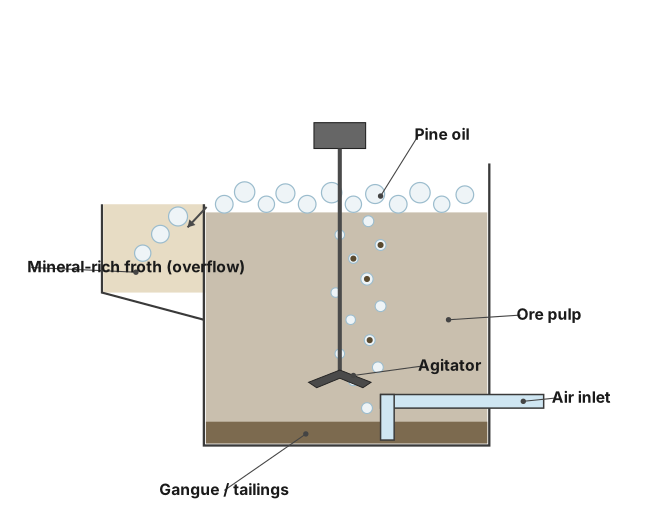
Figure — Labelled froth-flotation cell for ore concentration. A rectangular tank holds the pulp of finely pow Froth flotation is used to concentrate sulphide ores by exploiting the difference in wettability of the ore particles and the gangue.
Apparatus/diagram description (labelled parts):
- A flotation cell/tank containing a suspension of finely powdered ore in water.
- A small quantity of pine oil (or other collector such as xanthates) is added, which coats/wets the sulphide ore particles preferentially, making them water-repelling (hydrophobic); the gangue particles remain water-wetted (hydrophilic).
- Air is blown/agitated vigorously into the mixture through a rotating paddle/impeller (or an air jet), generating a froth of fine air bubbles.
- The hydrophobic ore particles attach themselves to the air bubbles and are carried upward, forming a stable mineral-rich froth layer at the surface of the tank.
- The froth (carrying the concentrated sulphide ore) is continuously skimmed/overflowed off the top of the cell and collected. …
- CBSE 2022Set E1 markMCQQ.Sulphide ores are generally concentrated by which of the following ?(a) Gravity separation process(b) Magnetic separation process(c) Froth floatation process(d) Carbon reduction process
›Reveal solutionSolution
Sulphide ores are concentrated by the froth floatation process, which exploits the preferential wetting of sulphide particles by oil.
Sulphide ore particles are preferentially wetted by oil (they are hydrophobic), while the gangue is wetted by water. In froth floatation, the powdered ore is agitated with water, pine oil, and air; the sulphide particles cling to the oily froth and float to the top, where they are skimmed off, separating them from the gangue.
- Gravity separation suits denser oxide ores. …
- CBSE 2022Set ANNUAL1 markMCQQ.The method used for the concentration of sulphide ores is(a) Hydraulic washing(b) Leaching(c) Magnetic separation(d) Froth flotation
›Reveal solutionSolution
Sulphide ores are concentrated by the froth flotation method, which exploits the preferential wetting of sulphide particles by oil/pine oil (and by frothing agents) over water.
In froth flotation, the finely powdered sulphide ore is mixed with water and a small amount of pine oil/collector (e.g. xanthates), then agitated with air. The sulphide ore particles are preferentially wetted by the oil and stick to the air bubbles, rising to the surface as a stable froth that is skimmed off. The gangue (impurity, e.g. silica), being preferentially wetted by water, settles at the bottom.
…
- CBSE 2021Set A1 markMCQQ.Sulphide ores are concentrated by(a) Froth floatation process(b) Electrolysis(c) Roasting(d) none of these
›Reveal solutionSolution
Sulphide ores are concentrated by the froth floatation process, which exploits the preferential wetting of sulphide particles by oil.
The froth floatation process is used to concentrate sulphide ores (e.g. galena PbS, zinc blende ZnS, copper pyrites). The finely ground ore is suspended in water with pine oil (collector) and air is blown through. The sulphide ore particles are preferentially wetted by the oil and rise up with the froth, while the gangue (wetted by wate …
- CBSE 2019Set ANNUAL1 markMCQQ.In the froth floatation process NaCN is used as a ................. .(a) stabiliser(b) collector(c) depressant(d) leaching agent
›Reveal solutionSolution
In the froth flotation process, sodium cyanide (NaCN) acts as a depressant — it selectively holds back one sulphide (ZnS) so that another sulphide (PbS) can be concentrated first. The correct alternative is therefore (c) depressant.
Froth flotation is used to concentrate sulphide ores. The finely powdered ore is suspended in water with a little oil, and air is blown through so that the water-repellent mineral particles rise with the froth. Different reagents play different roles:
- Collectors (e.g. pine oil, fatty acids, xanthates) — make the desired mineral particles water-repellent (hydrophobic) so they attach to the air bubbles and rise as froth.
- Froth stabilisers (e.g. cresols, aniline) — stabilise the froth so that it does not collapse too soon.
- Depressants — selectively prevent one sulphide mineral from forming froth so that it stays behind in the gangue. …
- CBSE 2018Set ANNUAL1 markQ.Sulphide ores are concentrated by froth floatation process only. Why ?
›Reveal solutionSolution
Froth flotation works precisely because sulphide-ore particles are oil-loving (not water-loving), a property gangue particles lack.
Sulphide ore particles have a natural surface affinity for oil (they are preferentially wetted by oil rather than water), while the gangue (impurity) particles are preferentially wetted by water. In froth flotation, the powdered ore is agitated in water with a pine-oil/collector; sulphide mineral particles get coated with oil and stick to the air bubbles, rising to the surface as a stable froth, which is skimmed off, while the water-wetted gangue settles at the bottom. Since this method relies specifically on differential wettability by oil vs water — a property characteristic of sulphide minerals — froth flotation is uniquely …
🎓Unlock everything free for 14 days
- ✓Full step-by-step solutions
- ✓Concept-first explanations
- ✓Methods, shortcuts & mistakes
- ✓PYQ mapping + timed mock tests
Full access for 14 days. No credit card required.