Q.A hydrocarbon does not react with chlorine in dark but gives a single monochloro compound in bright sunlight. Identify the hydrocarbon.
You're viewing a preview — the full solution, concept, methods & PYQ mapping are locked.
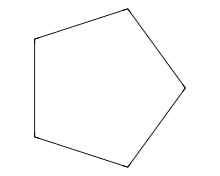
Start your 14-day free trial to unlock the full solution →The hydrocarbon is cyclopentane. It does not react with chlorine in the dark (no addition across a double bond) but undergoes free‑radical substitution in sunlight to give a single monochloro product because all 10 hydrogen atoms are equivalent.
Why this approach works
The problem tests two key ideas: structural isomerism and reactivity patterns of hydrocarbons.
First, the molecular formula fits either an alkene (with one double bond) or a cycloalkane (saturated ring). Both have the same degree of unsaturation: one ring or one ‑bond.
Second, the clue about chlorine:
- In the dark, chlorine adds across a double bond (electrophilic addition) but does not react with a saturated hydrocarbon.
- In bright sunlight, chlorine undergoes free‑radical substitution with alkanes/cycloalkanes, replacing a hydrogen atom with chlorine.
So the hydrocarbon must be a cycloalkane (no reaction in dark) that gives only one monochloro product (all hydrogens are equivalent).
Step‑by‑step reasoning
-
Identify the possible isomers of
The formula has one degree of unsaturation. The main families are:
- Alkenes (e.g., pent‑1‑ene, pent‑2‑ene, 2‑methylbut‑1‑ene, etc.)
- Cycloalkanes (cyclopentane, methylcyclobutane, ethylcyclopropane, dimethylcyclopropanes)
Alkenes would react with chlorine in the dark (addition across the double bond), so they are ruled out.
-
Focus on cycloalkanes
Cycloalkanes do not react with chlorine in the dark — they need UV light for substitution. So the hydrocarbon must be a cycloalkane.
-
Check which cycloalkane gives a single monochloro product
In free‑radical substitution, the number of monochloro isomers equals the number of distinct types of hydrogen atoms in the molecule.
- Cyclopentane (): a regular pentagon. All 10 hydrogens are equivalent (each carbon has two identical hydrogens, and all carbons are identical). → Only one monochloro product.
- Methylcyclobutane: has a methyl group and ring hydrogens — at least 3 different types of H → multiple products.
- Ethylcyclopropane: even more distinct H types.
- Dimethylcyclopropanes: also give multiple isomers.
Only cyclopentane satisfies the “single monochloro compound” condition.
Unlock everything free for 14 days
- Full step-by-step solutions
- Concept-first explanations
- Methods, shortcuts & mistakes
- PYQ mapping + timed mock tests
Full access for 14 days. No credit card required.