Geography · Ch 20 — Biodiversity and Conservation
Vulnerable Species
Vulnerable Species
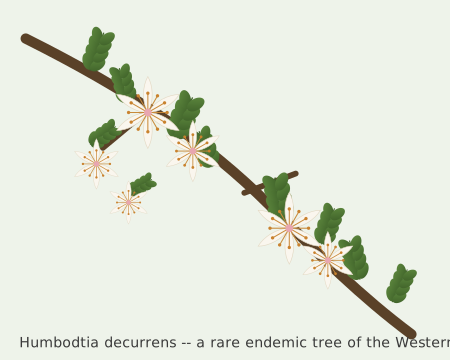
The diagram shows a single flowering branch of Humboldtia decurrens, drawn as a stylised botanical illustration. The branch runs diagonally across the frame, woody and slightly curved, with elongated green leaves arranged along its length. Clusters of white, star-shaped flowers emerge from the branch, each flower carrying a pink-tinged centre. The overall effect is a clean, scientific sketch of a tree in bloom, not a landscape or habitat scene.
The caption identifies the plant as Humboldtia decurrens Bedd., a tree that is both highly rare and endemic to the Southern Western Ghats of India. Endemic means it occurs nowhere else on Earth — its entire wild population is confined to that mountain range. The "Bedd." after the species name honours Richard Henry Beddome, the botanist who formally described it. The illustration itself is not a photograph but an artist's rendering, which is typical of older taxonomic records where a clear drawing served as the visual record of a species.
What the diagram teaches is the concept of a vulnerable species in action. The plant looks healthy and complete in the drawing, yet its status is precarious. The text accompanying this section explains that vulnerable species are those likely to slip into danger of extinction in the near future if the threats against them continue. Their populations have already fallen greatly, so survival is not assured. Humboldtia decurrens fits this category precisely: it is restricted to a narrow geographic belt, which makes it especially sensitive to habitat loss, and its rarity means even small disturbances could push it toward the next, more severe category of threat. …
The idea behind a “vulnerable” species is that it is not yet extinct, and not even necessarily on the very brink, but its future is genuinely uncertain. The category sits below “endangered” in severity, yet it carries a clear warning: if nothing changes, these species are likely to slide into real danger of extinction in the near future.
The key condition is that the threats are ongoing. A species is classified as vulnerable only when the factors endangering its survival continue to operate — if those pressures were removed, the species might recover, but as long as they persist, the risk keeps building. The classification is therefore not about current numbers alone, but about the trajectory those numbers are on.
The most telling sign of a vulnerable species is the state of its population. Its numbers have already reduced greatly from what they once were, and because of that decline, its survival is not assured. Even if the species is not vanishing overnight, the reduced population leaves it exposed — a small population is far more fragile than a large one, more susceptible to disease, inbreeding, and sudden environmental shocks. …
This includes the species which are likely to be in danger of extinction in near future if the factors threatening to their extinction continue. Survival of these species is not assured as the …