Geography · Ch 19 — Movements of Ocean Water
Tides
Tides
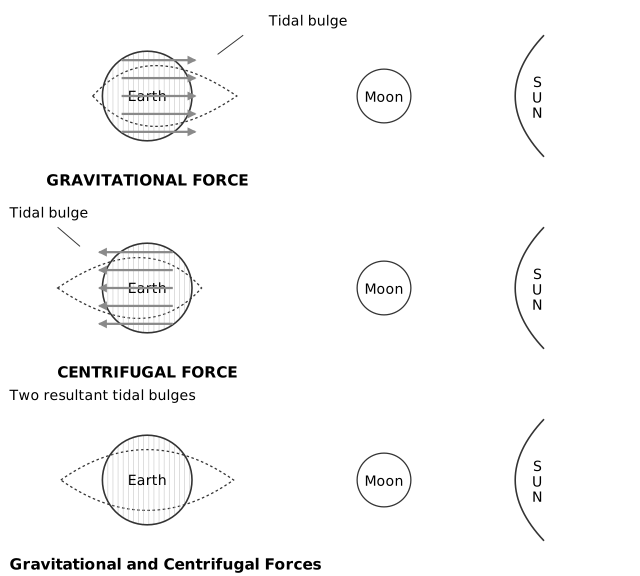
The diagram is built as three stacked panels, each showing the same basic scene: a hatched circle representing the Earth, with a Moon circle and a Sun symbol fixed to the right. The Sun is drawn as a curved bracket with the letters S, U, N stacked inside it. The three panels are meant to be read top to bottom, as a step-by-step build-up of the forces that create tides.
The top panel is labelled Gravitational Force. Five evenly spaced horizontal grey arrows point to the right, away from the Earth's centre, toward the Moon. Around the Earth, a dotted boundary marks the tidal bulge, and this boundary bulges noticeably toward the right — the side facing the Moon. A leader line labels this bulge "Tidal bulge." The message is straightforward: the Moon's gravitational pull draws water toward it, piling it up on the near side of the Earth.
The middle panel is labelled Centrifugal Force. The same five arrows now point to the left, away from the Moon. The dotted tidal-bulge boundary bulges toward the left — the side opposite the Moon — and is again labelled "Tidal bulge." This panel isolates the second force at work: the centrifugal effect, which flings water outward on the far side of the Earth, away from the Moon.
The bottom panel is captioned Gravitational and Centrifugal Forces, with the sub-caption "Two resultant tidal bulges." Here no arrows are shown. The dotted boundary bulges symmetrically on both sides of the Earth, forming a lens or eye shape. This is the synthesis: the two forces acting together produce two bulges — one facing the Moon, one opposite it.
What the diagram teaches is the core idea behind the equilibrium theory of tides. The Moon's gravity pulls water on the near side toward it, creating one bulge. On the far side, the Moon's pull is weaker (because that water is farther away), so the centrifugal force dominates and creates a second bulge away from the Moon. The two bulges are not caused by the same mechanism, but they are equal partners in producing the familiar pattern of two high tides and two low tides each day. The Earth rotates beneath these bulges, so any point on the coast passes through a bulge (high tide) and then through the region between bulges (low tide) roughly every six hours. …
A tide is the periodical rise and fall of sea level, occurring once or twice a day, caused mainly by the gravitational attraction of the sun and the moon. This is different from a surge, which is water movement caused by meteorological effects like winds and atmospheric pressure changes. Surges are not regular like tides. The study of tides is complex, both in space and time, because tides vary greatly in frequency, magnitude, and height.
What Causes Tides
The moon’s gravitational pull is the major cause of tides, with the sun’s pull playing a lesser role. Another factor is centrifugal force, which acts to counterbalance gravity. Together, gravitational pull and centrifugal force create two major tidal bulges on the earth.
On the side of the earth facing the moon, a tidal bulge occurs because the moon’s attractive force is greater than the centrifugal force. On the opposite side, the moon’s gravitational attraction is weaker since it is farther away, so the centrifugal force dominates and creates a second bulge away from the moon. The ‘tide-generating’ force is the difference between these two forces — the moon’s gravitational attraction and the centrifugal force.
On the earth’s surface, the horizontal tide-generating forces are more important than the vertical forces in creating tidal bulges.
How Tides Behave Along Coasts
Tidal bulges on wide continental shelves have greater height, but when they hit mid-oceanic islands they become low. The shape of bays and estuaries along a coastline can magnify the intensity of tides. Funnel-shaped bays greatly change tidal magnitudes. When the tide is channelled between islands or into bays and estuaries, it is called a tidal current.
The highest tides in the world occur in the Bay of Fundy in Nova Scotia, Canada, where the tidal bulge reaches 15–16 metres. Since there are two high tides and two low tides every day, a tide must come in within about a six-hour period. As a rough estimate, the tide rises about 240 cm per hour. The book warns that if you walk down a beach with a steep cliff alongside — common in that area — and the tide starts coming in, the water will be over your head before you get back to where you started.
Types of Tides
Tides vary in frequency, direction, and movement from place to place and from time to time. They can be grouped based on their frequency of occurrence in one day (24 hours) or based on their height.
Based on Frequency
| Type | Description |
|---|---|
| Semi-diurnal tide | The most common tidal pattern, with two high tides and two low tides each day. Successive high or low tides are approximately the same height. |
| Diurnal tide | Only one high tide and one low tide during each day. Successive high and low tides are approximately the same height. |
| Mixed tide | Tides with variations in height. These generally occur along the west coast of North America and on many islands of the Pacific Ocean. |
Based on the Sun, Moon, and Earth Positions
The height of rising water (high tide) varies appreciably depending on the position of the sun and moon relative to the earth. Spring tides and neap tides fall under this category.
Spring tides: When the sun, the moon, and the earth are in a straight line, the tide height is higher. These are called spring tides, and they occur twice a month — once during the full moon period and once during the new moon period.
Neap tides: There is normally a seven-day interval between spring tides and neap tides. At this time, the sun and moon are at right angles to each other, and their forces tend to counteract one another. The moon’s attraction, though more than twice as strong as the sun’s, is diminished by the counteracting force of the sun’s gravitational pull.
Perigee and apogee: Once a month, when the moon’s orbit is closest to the earth (perigee), unusually high and low tides occur, and the tidal range is greater than normal. Two weeks later, when the moon is farthest from the earth (apogee), the moon’s gravitational force is limited and tidal ranges are less than their average heights.
Perihelion and aphelion: When the earth is closest to the sun (perihelion), around 3rd January each year, tidal ranges are much greater, with unusually high and unusually low tides. When the earth is farthest from the sun (aphelion), around 4th July each year, tidal ranges are much less than average. …
The periodical rise and fall of the sea level, once or twice a day, mainly due to the attraction of the sun and the moon, is called a tide. Movement of water caused by meteorological effects (winds and atmospheric pressure changes) are called surges. Surges are not regular like tides. The study of tides is very complex, spatially and temporally, as it has great variations in frequency, magnitude and height.
The moon's gravitational pull to a great extent and to a lesser extent the sun's gravitational pull, are the major causes for the occurrence of tides. Another factor is centrifugal force, which is the force that acts to counter balance the gravity. Together, the gravitational pull and the centrifugal force are responsible for creating the two major tidal bulges on the earth. On the side of the earth facing the moon, a tidal bulge occurs while on the opposite side though the gravitational attraction of the moon is less as it is farther away, the centrifugal force causes tidal bulge on the other side. …
The highest tides in the world occur in the Bay of Fundy in Nova Scotia, Canada. The tidal bulge is 15-16 m. Because there are two high tides and two low tides every day (roughly a 24 hour period); then a tide must come in within about a six hour period. As a rough estimate, the tide rises about 240 cm an hour (1,440 cm divided by 6 hours). If you have walked down a beach with a steep cliff alongside (which is common there), make sure you watch the tides. If you walk for about an hour and then notice that the t …