Geography · Ch 19 — Movements of Ocean Water
Waves
Waves
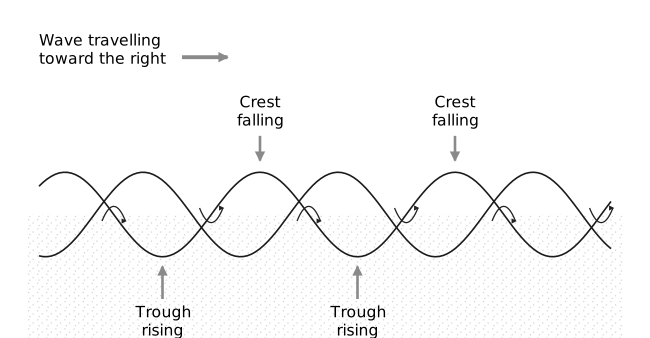
The diagram is built around two overlapping wave curves that share the same wavelength but are shifted out of phase, so they cross each other repeatedly across the panel. The whole pattern sits over a stippled band meant to suggest the water body itself. At the top-left, a rightward arrow carries the label "Wave travelling toward the right," telling you the direction of energy transfer — not the movement of the water itself.
The labels do the real teaching. Two crests are marked "Crest falling," each with a downward arrow, and two troughs are marked "Trough rising," each with an upward arrow. That pairing is the heart of the figure: a crest does not stay put, it collapses downward, and the water pushed out of it forces the neighbouring trough upward. This is exactly what the text describes — gravity pulls the crest down, the falling water shoves the former trough up, and the wave shifts to a new position. The wave form moves, but no water travels with it.
The small hooked arrows at the points where the two curves cross trace the path of a single water particle. Those crossings are the mid-height positions between crest and trough, and the curved arrows there show a near-circular orbit. As the wave approaches, the particle is carried up and forward; as the wave passes, it moves down and back. Over one full wave period the particle completes the circle and returns to where it started. That is the diagram's central claim: the surface water moves in small closed loops, while the wave's energy travels horizontally across the ocean. …
What a wave really is
A wave moving across the ocean surface is not water travelling from one place to another — it is energy that moves. The water particles themselves only travel in a small circle as the wave passes. The energy source is the wind, which drives the waves across the ocean and releases that energy when the wave finally reaches the shoreline.
The motion of surface water rarely affects the deep, stagnant water at the ocean bottom. So even when the surface is churning with waves, the deep water below remains largely undisturbed.
Why waves break near the shore
As a wave approaches the beach, it slows down. The reason is friction between the moving water and the sea floor. When the depth of the water becomes less than half the wavelength of the wave, the wave breaks.
The largest waves are found in the open oceans. Waves keep growing larger as they travel because they continue to absorb energy from the wind. Most waves are caused by the wind driving against the water.
How waves form and grow
When a breeze of two knots or less blows over calm water, small ripples form. As the wind speed increases, these ripples grow larger until white caps appear in the breaking waves. A wave may travel thousands of kilometres before rolling ashore, breaking and dissolving as surf.
A wave's size and shape reveal its origin:
- Steep waves are fairly young waves, probably formed by local wind.
- Slow and steady waves originate from far-away places, possibly even from another hemisphere.
The maximum height a wave can reach is determined by three factors: the strength of the wind, how long it blows, and the area over which it blows in a single direction.
How a wave moves forward
Waves travel because wind pushes the water body in its course, while gravity pulls the crests of the waves downward. The falling water pushes the former troughs upward, and the wave moves to a new position. The actual motion of the water beneath the waves is circular — things are carried up and forward as the wave approaches, and down and back as it passes.
Characteristics of waves
| Characteristic | What it means |
|---|---|
| Wave crest and trough | The highest and lowest points of a wave |
| Wave height | The vertical distance from the bottom of a trough to the top of a crest |
Waves are actually the energy, not the water as such, which moves across the ocean surface. Water particles only travel in a small circle as a wave passes. Wind provides energy to the waves. Wind causes waves to travel in the ocean and the energy is released on shorelines. The motion of the surface water seldom affects the stagnant deep bottom water of the oceans. As a wave approaches the beach, it slows down. This is due to the friction occurring between the dynamic water and the sea floor. And, when the depth of water is less than half the wavelength of the wave, the wave breaks. The largest waves are found in the open oceans. Waves continue to grow larger as they move and absorb energy from the wind.
Most of the waves are caused by the wind driving against water. When a breeze of two knots or less blows over calm water, small ripples form and grow as the wind speed increases until white caps appear in the breaking waves. Waves may travel thousands of km before rolling ashore, breaking and dissolving as surf.
A wave's size and shape reveal its origin. Steep waves are fairly young ones and are probably formed by local wind. Slow and steady waves originate from far away places, possibly from another hemisphere. The maximum wave height is determined by the strength of the wind, i.e. how long it blows and the area over which it blows in a single direction. …
Wave crest and trough: The highest and lowest points of a wave are called the crest and trough respectively.
Wave height: It is the vertical distance from the bottom of a trough to the top of a crest of a wave.
Wave amplitude: It is one-half of the wave height.
Wave period: It is merely the time interval between two successive wave crests or troughs as they pass a fixed point.
Wavelength: It is the horizontal distance between two successive crests.
Wave speed: It is the rate at which the wave moves through the water, and is measured in knots. …