Geography · Ch 14 — Solar Radiation, Heat Balance and Temperature
Heat Budget of the Planet Earth
Heat Budget of the Planet Earth
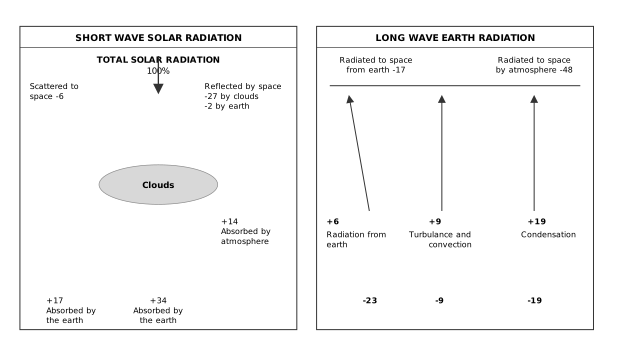
The diagram is split into two side-by-side panels that together tell the complete story of how the Earth balances its energy. The left panel, headed SHORT WAVE SOLAR RADIATION, starts with the total incoming solar energy at the top of the atmosphere set at 100 units. As this radiation travels downward, the atmosphere and surface strip away most of it. Clouds reflect 27 units back to space, the Earth's surface reflects another 2 units, and scattering sends 6 units back out to space — these three losses together are labelled as "Reflected by space." Meanwhile, the atmosphere itself absorbs 14 units directly. What finally reaches the ground is the remainder: 17 units arrive as direct radiation, and another 34 units come down as scattered or diffuse radiation, both absorbed by the Earth's surface. The arrows in this panel pass through a drawn cloud layer, making it clear that the atmosphere is not a passive filter but an active participant in intercepting and redirecting sunlight.
The right panel, headed LONG WAVE EARTH RADIATION, shows what happens after the surface has absorbed that energy. The Earth now radiates heat back upward, but it does not all escape to space in one go. The surface sends out radiation, of which 17 units go directly to space. The rest is taken up by the atmosphere through three distinct mechanisms: 6 units of radiation absorbed directly from the ground, 9 units transferred by turbulence and convection (the physical rising of warm air), and 19 units released when water vapour condenses — the latent heat of condensation. These three inputs, totalling 34 units, are shown as upward arrows entering the atmosphere layer. The atmosphere then radiates 48 units out to space. On the Earth's own side of the ledger, the diagram labels the corresponding losses as −23, −9, and −19, which account for the energy the surface gives up through these same three pathways. …
The Earth as a whole neither gains nor loses heat over time — it maintains a stable temperature. This balance is possible only because the heat the planet receives as insolation is exactly equal to the heat it loses through terrestrial radiation. This equality of incoming and outgoing energy is called the heat budget of the planet Earth.
To understand how this balance works, consider the insolation received at the top of the atmosphere as 100 per cent. As this incoming solar radiation passes through the atmosphere, a part of it is reflected, a part is scattered, and a part is absorbed by the atmosphere itself. Only the remaining portion actually reaches the Earth's surface.
The heat budget is depicted in a figure showing the flow of this 100 per cent insolation through the atmosphere and back out to space. The key idea is that although different components of the Earth system — the atmosphere, the oceans, and the land surface — may gain or lose heat at different rates and at different times, the planet as a whole remains in thermal equilibrium. Whatever energy enters the Earth system eventually leaves it, keeping the average temperature of the planet steady over long periods. …
The earth as a whole does not accumulate or lose heat -- it maintains its temperature. This can happen only if the amount of heat received in the form of insolation equals the amount lost by the earth through terrestrial radiation. Consider that the insolation received at the top of the atmosphere is 100 per cent. While passing through the atmosphere, some amount of energy is reflected, scattered and absorbed; only the remaining part reaches the earth's surface. Roughly 35 units are reflected back to space even before reaching the earth's surface -- of these, 27 units are reflected back from the top of the clouds and 2 units from the snow and ice-covered areas of the earth. The reflected amount of radiation is called the albedo of the earth. …