Political Science · Ch 3 — Election and Representation
Independent Election Commission
Independent Election Commission
Guaranteeing the right to vote and the right to contest still leaves the question of who actually runs the election honestly. Many countries have no independent body for this at all — elections are conducted by the government of the day, which creates an obvious temptation to tilt the process. India's Constitution avoids this by creating an independent Election Commission.
Drawn by us to help you understand the concept clearly, and verified to make sure it's accurate. For exams, practice from your NCERT textbook's own diagram.
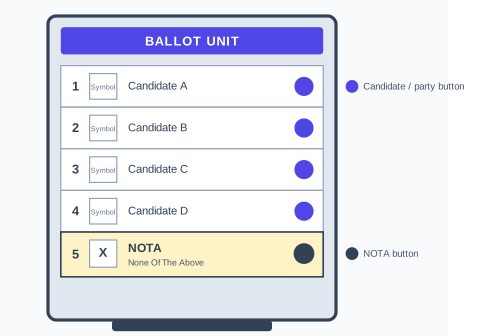
Schematic diagram of an EVM ballot unit's button layout, showing numbered candidate/party rows each with its own press button and, as the last option, the clearly labelled NOTA (None Of The Above) button. Own-illustrated for this platform from the real NCERT page's own facts (composition, labels, and content are recreated; the specific artistic rendering of any re …
The constitutional basis. Article 324(1) vests "the superintendence, direction and control of the preparation of the electoral rolls for, and the conduct of, all elections to Parliament and to the Legislature of every State and of elections to the offices of President and Vice-President" in the Election Commission. The Supreme Court has read this language broadly, giving the Commission a decisive role over virtually every aspect of conducting elections. A Chief Electoral Officer assists it in each State, though the Commission itself is not responsible for local body (Panchayat and Municipal) elections — those are run by separate, independently functioning State Election Commissioners, covered in the chapter on Local Government.
One member, or several? The Commission has not always looked the way it does today. It was a single-member body until just before the 1989 general election, when two more Election Commissioners were added, making it briefly multi-member; it reverted to a single member soon after. In 1993 it was made multi-member again, and has remained so since, after a dispute between the then Chief Election Commissioner and the other Commissioners over how much power each held was settled by the Supreme Court. There is now broad agreement that a multi-member Commission is preferable, since power is shared and accountability is greater.
Composition, appointment, and protection. The Commission today has a Chief Election Commissioner (CEC) and two other Election Commissioners, all with equal decision-making powers as a collective body — the CEC merely presides, without extra authority. All three are appointed by the President on the advice of the Council of Ministers, which — since the ruling party effectively controls that advice — has led many to argue that appointments should instead require consultation with the Leader of the Opposition and the Chief Justice of India, to guard against a partisan appointment. Once appointed, a CEC or Election Commissioner serves a six-year term or until age 65, whichever comes first. An Election Commissioner can be removed by the President, but a CEC enjoys stronger protection: removal requires a recommendation by both Houses of Parliament passed with a special majority — precisely so a ruling party cannot remove a CEC simply for refusing to favour it. …