Political Science · Ch 13 — Equality
What Is Equality?
What Is Equality?
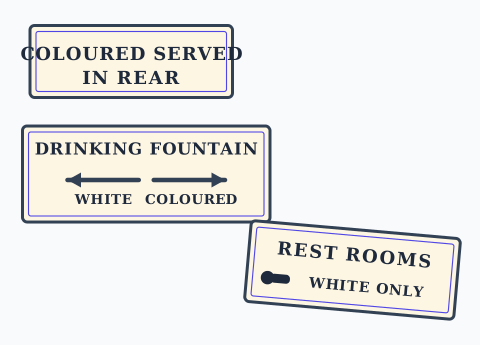
Think about signs that were once common in parts of the American South: "Coloured Served in Rear," separate drinking fountains marked "White" and "Coloured," and rest rooms marked "White Only." Every one of these signs draws a line between human beings purely on the basis of race and colour. Almost all of us find such distinctions unacceptable today — they violate our basic intuition that all human beings deserve the same respect and consideration simply because of their shared humanity.
Drawn by us to help you understand the concept clearly, and verified to make sure it's accurate. For exams, practice from your NCERT textbook's own diagram.
Historical US Jim Crow-era segregation signs — "Coloured Served in Rear," a drinking-fountain sign with separate arrows for "White" and "Coloured," and a "Rest Rooms — White Only" sign — recreated here to show how differences of race and colour were once written into everyday public facilities as unequal treatment. Own-illustrated for this platform from the real NCERT page's own facts (composition, labels, and content are recreated; the specific artistic re …
But this does not mean that treating people with equal respect requires treating them in an absolutely identical way in every situation. No society actually functions like that. The smooth working of any society depends on some division of roles and functions, and people often end up with different status and rewards as a result. We do not usually feel that giving a prime minister or an army general a special official rank and status goes against equality, as long as that privilege is not misused. At the same time, some other kinds of differential treatment do feel unjust — for instance, if a child born in a slum is denied nutritious food or a good education through no fault of their own, that plainly feels unfair. …