Political Science · Ch 5 — Legislature
How does the Parliament make Laws?
How does the Parliament make Laws?
Making laws is the most basic function of any legislature, and Parliament follows a fairly elaborate, sometimes technical, procedure to do it — part of it laid down directly in the Constitution, and part of it built up over time through convention and practice.
Drawn by us to help you understand the concept clearly, and verified to make sure it's accurate. For exams, practice from your NCERT textbook's own diagram.
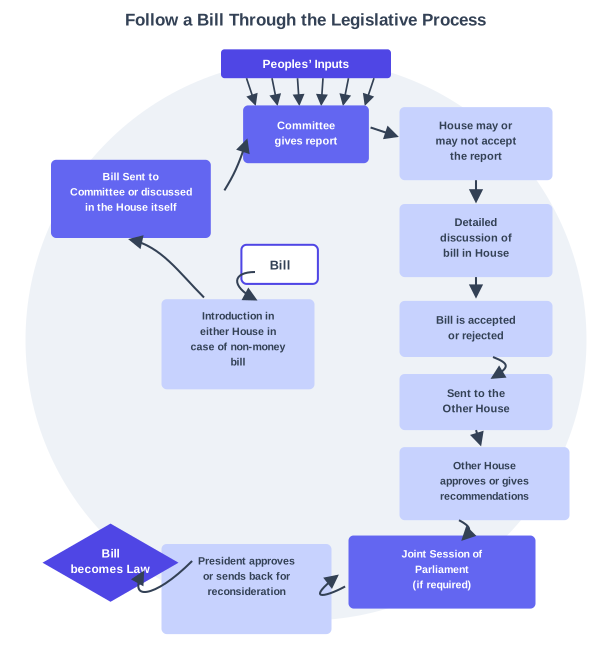
Flowchart of a bill's journey through the Indian legislative process, from Peoples' inputs and committee report through House discussion, the other House, a joint session if needed, and presidential assent, ending in the bill becoming law. Own-illustrated for this platform from the real NCERT page's own facts (composition, labels, and content are recreated; the specific artistic rendering of a …
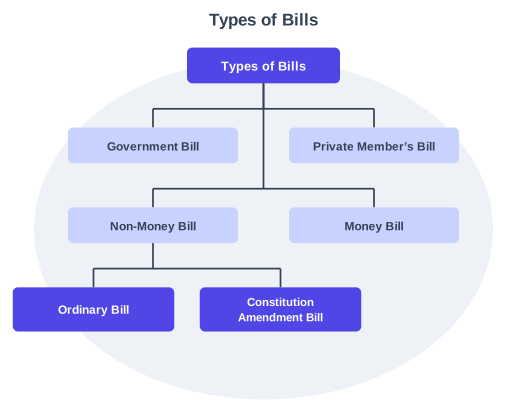
What is a bill? A bill is simply the draft of a proposed law. Bills come in two broad categories based on who introduces them: a bill proposed by a minister is called a Government Bill, while a bill proposed by any other member is called a Private Member's Bill. Bills can also be classified by subject matter — as Money Bills or Non-Money Bills — and, separately, as Ordinary Bills or Constitution Amendment Bills.
Drawn by us to help you understand the concept clearly, and verified to make sure it's accurate. For exams, practice from your NCERT textbook's own diagram.
Classification chart of Types of Bills in Indian Parliament, split into Government Bill vs Private Member's Bill, Non-Money Bill vs Money Bill, and Ordinary Bill vs Constitution Amendment Bill. Own-illustrated for this platform from the real NCERT page's own facts (composition, labels, and content are recreated; the specific artistic rendering of any real …
Where does a bill come from? Long before a bill is formally introduced in Parliament, there is usually a great deal of debate about whether it is needed at all. A political party may pressure the government to bring in a bill to fulfil an election promise or to strengthen its chances in an upcoming election; interest groups, the media, and citizens' forums can also push the government toward a particular piece of legislation. Law-making is therefore as much a political process as a legal one. Drafting a bill also involves weighing practical considerations — what resources implementing the law will require, how much support or opposition it is likely to generate, and how it might affect the ruling party's electoral prospects — especially in an era of coalition politics, where a government bill also has to be acceptable to every partner in the coalition. The Cabinet weighs all of this before finally deciding to enact a law.
The stages of a bill. Once the Cabinet approves the underlying policy, the actual drafting begins — carried out by the ministry concerned (for example, a bill raising the minimum age of marriage for girls would be drafted by the law ministry, in consultation with the ministry of women and child development). The process then broadly moves through these stages:
- The concerned minister proposes the need for the bill, and the legislative department in the law ministry drafts it.
- A resolution is passed to formally admit the bill for discussion (its introduction, or "first reading") — a bill may be introduced in either the Lok Sabha or the Rajya Sabha by any member of that House, though it is usually the minister responsible for the subject who does so. A Money Bill, however, can only be introduced in the Lok Sabha.
- A large part of the real discussion happens away from the floor — the bill is sent to a parliamentary committee, which examines it in detail and reports back its recommendations. This is why committees are often called "miniature legislatures."
- The House then decides whether or not to accept the committee's report, followed by a detailed, clause-by-clause discussion of the bill in the House itself, with each clause put to a vote.
- Once the bill is accepted (or, at this stage, rejected) by the House in which it was introduced, it is sent to the other House, which repeats essentially the same process — introduction, committee, discussion, and a vote.
- If the two Houses disagree over a non-money bill, an attempt is made to resolve the deadlock through a Joint Session of Parliament. On the rare occasions a Joint Session has actually been called, the outcome has always favoured the Lok Sabha, simply because it has many more members than the Rajya Sabha.
- Once a bill is passed by both Houses (or resolved through a Joint Session), it is sent to the President for assent. It is the President's assent that formally turns a bill into law. For an ordinary bill, the President may return it once for the Houses to reconsider — but if Parliament passes it again, with or without the suggested changes, the President is then bound to give assent. …