Political Science · Ch 17 — Nationalism
National Self-determination
National Self-determination
Unlike other social groups, nations claim the right to govern themselves and to determine their own future — the right to what is called national self-determination. In making this claim, a nation seeks recognition and acceptance by the international community of its status as a distinct political entity, or state. Most often, such claims come from people who have lived together on a given piece of land for a long period of time and who share a sense of common identity; in some cases, the claim to self-determination is also linked to a desire to form a state in which the group's own culture is specifically protected, or at least not disadvantaged.
Drawn by us to help you understand the concept clearly, and verified to make sure it's accurate. For exams, practice from your NCERT textbook's own diagram.
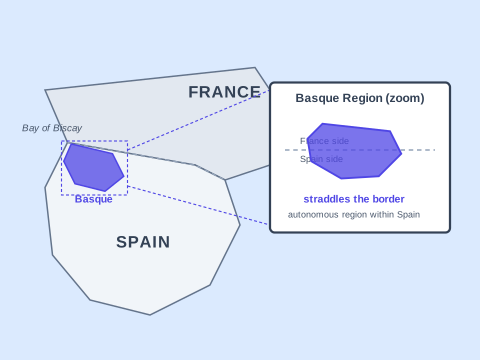
Schematic locator map of Spain and France showing the Basque region straddling the border near the Bay of Biscay, with a zoomed inset highlighting how the region sits across both countries as an autonomous territory within Spain. Own-illustrated for this platform from the real NCERT page's own facts (composition, labels, and content are recreated; the specific artistic rendering of an …
Claims of this second kind were made frequently in nineteenth-century Europe, where the idea of "one culture, one state" began to gain wide acceptance. The same idea was used again after the First World War, when the Treaty of Versailles redrew the map of Europe and created a number of small, newly independent states. Even so, it proved virtually impossible to satisfy every demand for self-determination that had been raised at the time. Worse, reorganising state boundaries to try to match one culture to one state led to mass migration of populations across the new borders: millions of people were displaced from homes their families had lived in for generations, and many others became victims of communal violence. Humanity paid a heavy price for this kind of boundary re-organisation — and even after all of it, it was still not possible to ensure that any of the newly created states contained only a single ethnic community. Most states ended up, as before, with more than one ethnic and cultural community inside their borders; these communities were often small in number, formed a minority within the state, and were frequently disadvantaged as a result. The one real gain from this period was that it did grant political recognition to various groups who saw themselves as distinct nations and wanted the opportunity to govern themselves and determine their own future.
The same right to national self-determination has also been claimed by national liberation movements across Asia and Africa in their struggles against colonial rule. These movements argued that political independence would restore dignity and recognition to colonised peoples and would help protect their collective interests; most of them were driven by the goal of bringing justice, rights and prosperity to their nation. Yet here too it proved almost impossible to ensure that every cultural group that saw itself as a distinct nation could achieve political independence and statehood. As a result, migration of populations, border wars and violence have continued to trouble many countries in these regions. The outcome is often paradoxical: nation-states that themselves won independence through nationalist struggle now find themselves acting against minorities within their own territory who raise the very same claim to national self-determination that they themselves once made.
Virtually every state in the world today faces some version of this dilemma — how to respond, in a fair and democratic way, to movements for self-determination within its own borders. Increasingly, people are coming to realise that the answer does not lie in creating ever more new states, but in making existing states more democratic and more equal — ensuring that people with different cultural and ethnic identities can live and co-exist within a country as partners and as equal citizens. This may well be essential not only for resolving fresh claims to self-determination as they arise, but also for building a strong and genuinely united state in the first place: a nation-state that fails to respect the rights and cultural identity of its minorities will always find it difficult to retain their loyalty.
One instructive real case is the demand raised by the Basque region of Spain. Basque is a hilly and prosperous region that the Spanish government formally recognises as an 'autonomous' region within the Spanish federation. That recognition, however, has not satisfied the leaders of the Basque Nationalist Movement, who want the region to become a fully separate country, and who have used both constitutional and, until recently, violent means to press this demand. Basque nationalists point to real cultural differences from the rest of Spain: they have their own language, unrelated to Spanish, though today only around a third of people in the Basque region actually understand it; the region's hilly terrain also makes it geographically distinct from the rest of the country. Ever since Roman times, the Basque region never fully surrendered its autonomy to whichever rulers governed Spain — its systems of justice, administration and finance were historically governed by its own distinct arrangements. …