Psychology · Ch 1 — What is Psychology?
Psychology and Other Disciplines
Psychology and Other Disciplines
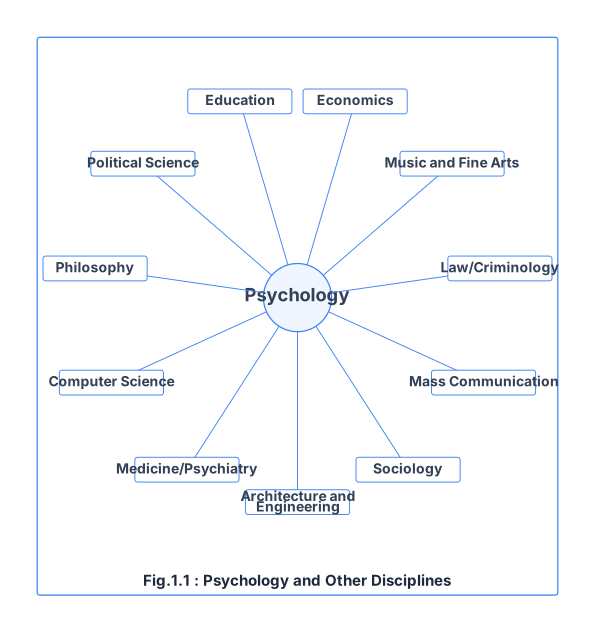
Because any discipline concerned with people inevitably touches on psychology, and because psychologists in turn draw on other fields to understand human behaviour, an interdisciplinary approach has become a defining feature of contemporary psychology. Figure 1.
Drawn by us to help you understand the concept clearly, and verified to make sure it's accurate. For exams, practice from your NCERT textbook's own diagram.
Fig.1.1: Psychology and Other Disciplines — a radial diagram showing eleven fields (Political Science, Education, Economics, Music and Fine Arts, Law/Criminology, Mass Communication, Sociology, Architecture and Engineering, Medicine/Psychiatry, Computer Science, Philosophy) each connected by a spoke to a central circle labelled 'Psychology'. Own-illustrated for this platform from the real NCERT page's own facts (composition, labels, and layout are recreated …
1 sets this out visually, showing eleven fields connected to a central node labelled 'Psychology': Political Science, Education, and Economics along the top; Philosophy and Music and Fine Arts a step below; Computer Science and Law/Criminology further along; Medicine/Psychiatry and Mass Communication below that; and Architecture and Engineering together with Sociology at the base -- each field shown alongside a small illustrative sketch of where that connection plays out. Broadly, when studying the brain and behaviour, psychology shares ground with neurology, physiology, biology, medicine, and computer science; when studying human behaviour's meaning, growth, and development within a socio-cultural context, it shares ground with anthropology, sociology, social work, political science, and economics; and when studying the mental activity behind the creation of literary texts, music, and drama, it shares ground with literature, art, and music.
Philosophy is where many of psychology's oldest questions originated -- the nature of the mind, or how humans come to know their own motivations and emotions -- questions that stayed with philosophers until the late nineteenth century, when Wundt and others began studying them experimentally instead; psychology still draws heavily on philosophy's methods of knowing and its broader exploration of human nature. Medicine has increasingly recognised that a healthy body needs a healthy mind, and hospitals now widely employ psychologists to help prevent health-hazardous behaviour, support adherence to a doctor's prescribed treatment, and provide psychological counselling to patients being treated for conditions such as cancer or AIDS, or undergoing intensive or post-operative care. Economics, political science, and sociology, as sister social sciences, have both drawn from psychology and enriched it in turn -- psychology has contributed substantially to understanding micro-level economic behaviour such as consumer spending, saving, and decision-making (three Nobel laureates in Economics, Herbert Simon, Daniel Kahneman, and Thomas Schelling, all worked at exactly this intersection); political science similarly draws on psychology to understand the exercise of power and authority, the nature and resolution of political conflict, and voting behaviour; and sociology and psychology together help explain socialisation, group and collective behaviour, and conflict between groups. Computer science and psychology have influenced each other from computer science's earliest days, since building a computer has always involved trying to mimic aspects of how the human mind works -- how it organises memory and processes information both sequentially and in parallel -- and today computer scientists and engineers are working toward machines that can not just think but, in some sense, sense and feel, a pursuit that has driven real advances in the broader field of cognitive science. Law and criminology depend on psychological knowledge to answer practical questions such as how reliably a witness remembers and reports an accident or a crime, what factors sway a jury's decision, what signs are taken as evidence of guilt or deception, and what degree of punishment is considered just for a given offence -- questions a growing number of psychologists now research directly, with implications for how the legal system itself might improve. Mass communication and psychology intersect because print and electronic media exert a major influence on people's thinking, attitudes, and emotions, including on children's attitudes and behaviour; psychology also helps in designing more effective communication strategies, since a journalist reporting a story that concerns human motives and emotions needs some real insight into both. Music and fine arts converge with psychology in areas such as using music to improve work performance and studying the relationship between music and emotion; some Indian musicians have begun experimenting with what they call …