Sociology · Ch 5 — Social Change and Social Order in Rural and Urban Society
Environment
Environment
Drawn by us to help you understand the concept clearly, and verified to make sure it's accurate. For exams, practice from your NCERT textbook's own diagram.
A teacher and students gathered around industrial training equipment shows technology entering education directly -- students being trained on the very machinery that reshapes work and the economy. It sits alongside the chapter's discussion of environment as a driver of social change, making the point that technological change and environmental/material c …
Drawn by us to help you understand the concept clearly, and verified to make sure it's accurate. For exams, practice from your NCERT textbook's own diagram.
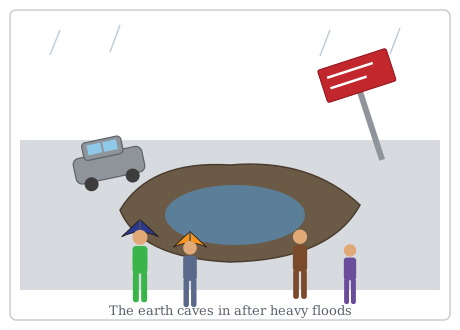
A road collapsed into a flooded crater, with damaged vehicles and onlookers under umbrellas, is the chapter's concrete illustration of environment as a cause of social change: a natural disaster can irreversibly alter livelihoods, infrastructure, and social structure in an area, exactly the kind of envi …
The physical environment -- climate, geography, natural resources -- has always exerted a strong pull on how societies organise themselves. This was truest in earlier periods, when people had little ability to control or work around nature. A community living in a desert could not practise the kind of settled, irrigation-fed agriculture that was natural to a river plain; a community in a bitterly cold climate, a busy port town, or along a mountain pass developed its food habits, clothing, livelihood, and even patterns of social interaction around those physical constraints. In each case, environment was not a backdrop to social life -- it actively shaped it.
Over time, this grip has loosened as technology has given societies more tools to resist, adapt to, or actively harness natural conditions, narrowing some of the differences that once separated societies living in very different physical settings. But it would be wrong to say environment's influence has simply disappeared. It is more accurate to say the relationship has changed in character: technology does not remove nature from the picture, it also reshapes nature and how societies relate to it, in ways that can create entirely new environmental pressures.
Environment continues to act as a genuine engine of social change in two very different ways. The first is destructive and sudden: natural disasters -- earthquakes, volcanic eruptions, floods, tsunamis -- can transform a society almost overnight, and the resulting change is often irreversible. A coastal community whose livelihood depends on fishing or farming may never be able to return to its earlier way of life once that base is destroyed; entire settlements can have their social structure permanently altered by a single catastrophic event. …