Sociology · Ch 5 — Social Change and Social Order in Rural and Urban Society
Social Order and Social Change in Urban Areas
Social Order and Social Change in Urban Areas
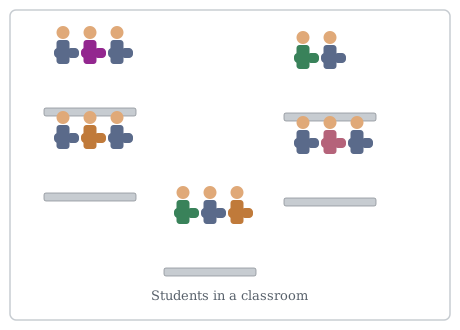
Drawn by us to help you understand the concept clearly, and verified to make sure it's accurate. For exams, practice from your NCERT textbook's own diagram.
Rows of seated students facing a teacher and a blackboard represent formal, organised schooling in an urban setting -- one of the many ways urban areas offer institutionalised, universal access to services in a way rural areas do not always match, which is part of what the cha …

Drawn by us to help you understand the concept clearly, and verified to make sure it's accurate. For exams, practice from your NCERT textbook's own diagram.
A doctor examining a patient using proper medical apparatus represents access to organised, professional healthcare -- one of the institutional advantages that tends to concentrate in urban areas, part of the chapter's picture of how urban social order is organised a …
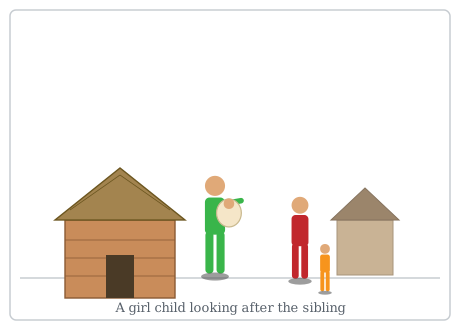
Drawn by us to help you understand the concept clearly, and verified to make sure it's accurate. For exams, practice from your NCERT textbook's own diagram.
A girl outside a modest dwelling holding a baby, in a slum-like setting, illustrates that urban life is not uniformly prosperous -- child caregiving responsibilities and informal, resource-poor housing exist within the same cities as the malls and hospitals shown elsewhere on the page, a reminder …
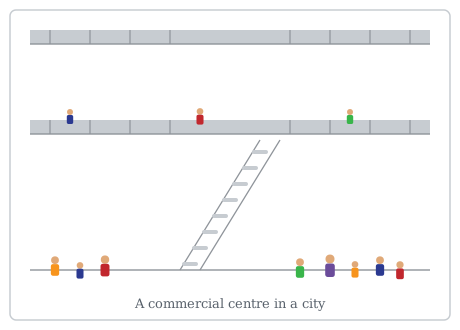
Drawn by us to help you understand the concept clearly, and verified to make sure it's accurate. For exams, practice from your NCERT textbook's own diagram.
A crowded, multi-level shopping mall represents the modern commercial spaces that have become central to urban social life -- new kinds of public space built around consumption, leisure and commerce that did not exist in this form b …
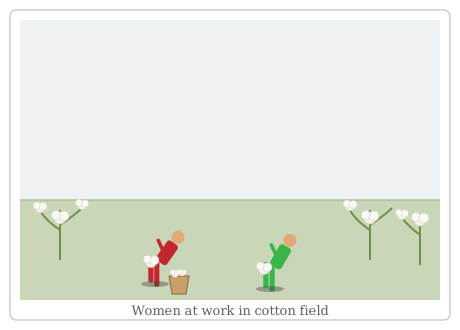
Drawn by us to help you understand the concept clearly, and verified to make sure it's accurate. For exams, practice from your NCERT textbook's own diagram.
Two women picking cotton bolls by hand is placed deliberately alongside the urban commercial-centre image to contrast rural agricultural labour with urban commercial life -- the chapter's way of showing the real, everyday differences in work and socia …
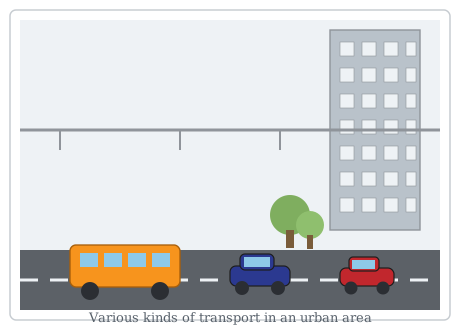
Drawn by us to help you understand the concept clearly, and verified to make sure it's accurate. For exams, practice from your NCERT textbook's own diagram.
An elevated view of a busy urban street -- buses, cars, ongoing construction, and high-rise housing -- captures how urban areas develop dense, varied transport infrastructure to move large populations, a visible marker of …
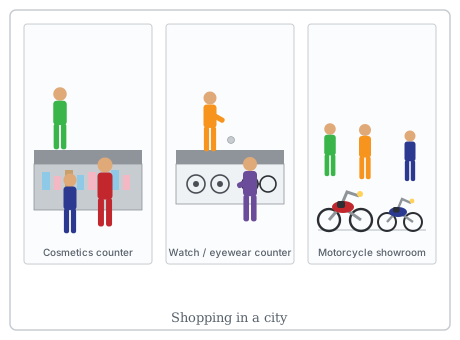
Drawn by us to help you understand the concept clearly, and verified to make sure it's accurate. For exams, practice from your NCERT textbook's own diagram.
A cosmetics counter, a watch/eyewear counter, and a motorcycle showroom together show the range of specialised commercial spaces a city supports -- each catering to a distinct kind of consumer need, illustrating how urban commercial life has grown more different …
Cities themselves are ancient -- built historically around trade routes, ports, defensible or strategically located sites, and religious pilgrimage centres -- but urbanism as a way of life for large sections of a population is a distinctly modern phenomenon. Sociologically, the city is often described as the natural home of the modern individual: its combination of anonymity and the concentration of institutions and amenities that only large populations can support offers real possibilities for personal freedom and self-expression that village life, with its close scrutiny and traditional constraints, does not easily allow. But this freedom is not evenly available -- in practice, only a socially and economically privileged minority enjoys a genuinely unconstrained urban life, while most city residents live within real economic and social limits set by the very group memberships (race, religion, ethnicity, caste, class) that the city, paradoxically, also intensifies. The dense concentration of people in a small space tends to sharpen these identities rather than dissolve them, since group identity often becomes central to strategies of survival, resistance and self-assertion in a crowded urban setting.
Most of the practical challenges of urban social order revolve around one central problem: space. High population density places enormous pressure on housing, transport, land use, sanitation, public health, and policing, and managing all of this is the core task of urban governance -- made harder still because it has to be done in a setting where class, ethnic, religious and caste tensions remain active. Housing shortages, for instance, produce homelessness and "street people," and are a major cause of slums -- dense, under-serviced neighbourhoods lacking basic civic facilities, which, because they typically lack secure property rights, can become breeding grounds for informal "strongman" control and extra-legal activity. At the other end of the spectrum, gated communities represent affluent self-segregation -- walled, security-controlled neighbourhoods with their own private civic infrastructure, physically separated from their surroundings. Transport is closely tied to this same spatial problem: when residential areas are located far from workplaces, elaborate mass transit systems become necessary, and a city's reliance on private cars versus public transport has real consequences for congestion, pollution, and quality of life -- sometimes producing distinctive commuter subcultures, as with Mumbai's suburban "local" trains. …