Applied Mathematics · Ch 9 — Probability
Theorem of Total Probability
Theorem of Total Probability
The Theorem of Total Probability is a powerful tool that lets you find the probability of an event by breaking it into cases — each case being a different "path" through a partition of the sample space. Think of it as a weighted average of conditional probabilities, where the weights are the probabilities of the mutually exclusive and exhaustive scenarios. This theorem becomes essential when an event can happen in several distinct ways, and you know the probability of each way separately. It directly sets the stage for Bayes' Theorem, whi …
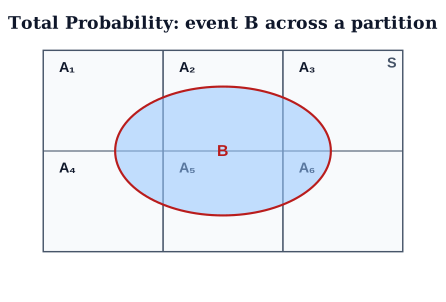
Drawn by us to help you understand the concept clearly, and verified to make sure it's accurate. For exams, practice from your NCERT textbook's own diagram.
The sample space S is partitioned into mutually exclusive events A₁…A₆; event B is the union of its overl …