English (Core) · Ch 4 — Discovering Tut: the Saga Continues
About the Author and the Text
About the Author and the Text
A. R. Williams is a journalist and writer whose work appears in National Geographic, the magazine that first carried this piece (National Geographic, Vol 207, No. 6). Writing in the tradition of popular science journalism, she blends careful reporting with vivid, atmospheric description so that a scientific investigation reads almost like a story.
What the lesson is about. Discovering Tut: the Saga Continues is an informational essay about the boy pharaoh Tutankhamun — 'King Tut' — the last ruler of a powerful family that governed Egypt and its empire for centuries. Tut died as a teenager more than 3,300 years ago and was buried, laden with gold, in the Valley of the Kings. His tomb lay hidden until the British archaeologist Howard Carter discovered it in 1922.
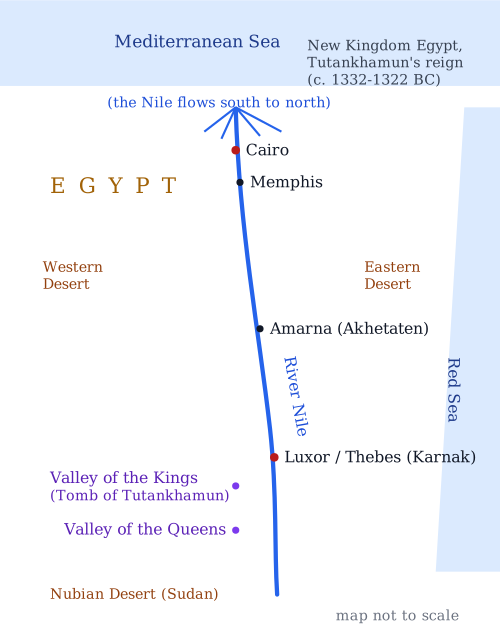
Drawn by us to help you understand the concept clearly, and verified to make sure it's accurate. For exams, practice from your NCERT textbook's own diagram.
A locator map of ancient Egypt during the New Kingdom: the River Nile flows south to north into the Mediterranean, with Memphis and Cairo in the north, Amarna in the middle, and Luxor/Thebes and the Valley of the Kings — where Tutankhamun's tomb was found — in the south. (Our own sketch map, drawn to help you place the sites; not to scale.)
The essay moves between two moments in time. It describes how, on the night of 5 January 2005, Tut's mummy was carried from its tomb and passed through a portable CT (computed tomography) scanner to look for answers to two lingering questions — how did he die, and how old was he when he died? It then looks back at how Carter, decades earlier, had to cut and chisel the resin-cemented mummy apart to reach its golden treasures. Along the way the writer sketches Tut's strange royal lineage, the changing aims of archaeology, and the playful talk of a 'curse of the pharaoh' when the scanner briefly failed. The 'saga' of the title is the continuing, ever-changing effort of the modern world to understand this young ruler.
Notice these expressions in the text. Infer their meaning from the context.
- forensic reconstruction — rebuilding what a person looked like, using scientific and medical evidence
- funerary treasures — the valuable objects buried with a dead person for use in the afterlife
- scudded across — moved swiftly and lightly across (here, wind-driven clouds racing over the sky)
- circumvented — got around, bypassed or evaded (as thieves might slip past guards)
- casket grey — a dull, coffin-like shade of grey
- computed tomography — a medical imaging method that stacks many cross-sectional X-rays into a 3-D picture (CT)
- resurrection — rising again to life after death
- eerie detail — a strange, ghostly, unsettling clarity of detail