Biology · Ch 4 — Animal Kingdom
Class – Aves
Class – Aves
Class Aves contains the birds. Their body plan is thoroughly adapted for flight, and this shapes almost every characteristic of the class. Aves belongs to the super class Tetrapoda.
Feathers, beak and limbs
The most obvious features of birds are their feathers and, in most cases, the ability to fly — the exceptions being flightless birds such as the ostrich. Birds possess a beak. The forelimbs are modified into wings, while the hind limbs are typically covered with scales and are adapted for walking, swimming or grasping tree branches.
Skin and skeleton
The skin is dry and has no glands, apart from a single oil gland at the base of the tail. The skeleton is fully ossified (bony), and the long bones are hollow and filled with air cavities (pneumatic bones) — a weight-saving adaptation that assists flight.
Digestion, heart and temperature
- The digestive tract carries additional chambers, the crop and the gizzard.
- The heart is completely four-chambered.
- Birds are warm-blooded (homoiothermous), able to keep their body temperature constant.
Respiration and reproduction …
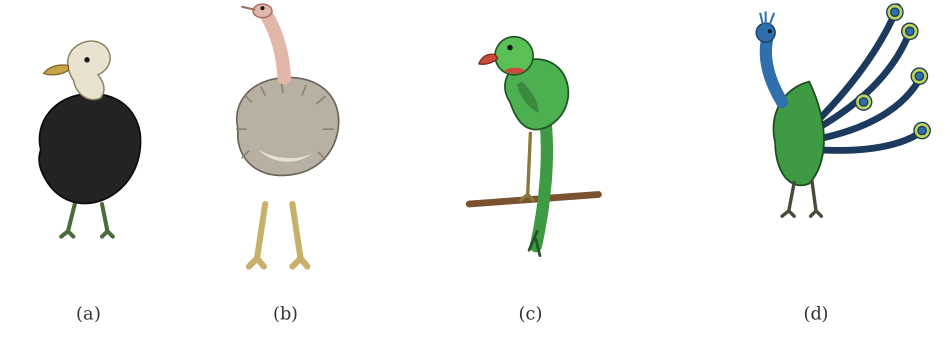
Drawn by us to help you understand the concept clearly, and verified to make sure it's accurate. For exams, practice from your NCERT textbook's own diagram.
These belong to class Aves, the birds, easily recognised by their covering of feathers. Their forelimbs are modified into wings, most used for flight, and their jaws are drawn out into a toothless beak. Birds are warm-blooded, meaning they keep a steady body temperature regardless of their surroundings, a feature they share only with mammals. Their bones are often hollow and light, an adaptation for flying, and they lay hard-shelled eggs. Neophron is a vulture, Struthio is the ostrich, a large flightless bird, Psittacu …