Biology · Ch 4 — Animal Kingdom
Phylum – Annelida
Phylum – Annelida
Annelids live in many settings: some are aquatic, in the sea or in fresh water, while others are terrestrial. Most are free-living, though a few are parasitic.
Body organisation, symmetry, layers and cavity
- They show an organ-system level of body organisation.
- They are bilaterally symmetrical.
- They are triploblastic, built from three germ layers.
- They are coelomate, possessing a true body cavity.
Metameric segmentation
The defining feature is that the body surface is clearly divided into a series of rings or segments called metameres, a repeated pattern known as metameric segmentation. This ringed appearance gives the phylum its name, which comes from the Latin word annulus, meaning little ring.
Locomotion
They have both longitudinal and circular muscles in the body wall, and the coordinated action of these muscles produces movement. Aquatic annelids such as Nereis also bear lateral projections called parapodia, which assist in swimming.
Circulation, excretion and nervous system
- A closed circulatory system is present, in which blood stays within vessels.
- Structures called nephridia carry out osmoregulation and excretion.
- The nervous system is made of paired ganglia joined by lateral nerves to a double ventral nerve cord that runs along the underside of the body.
Reproduction …
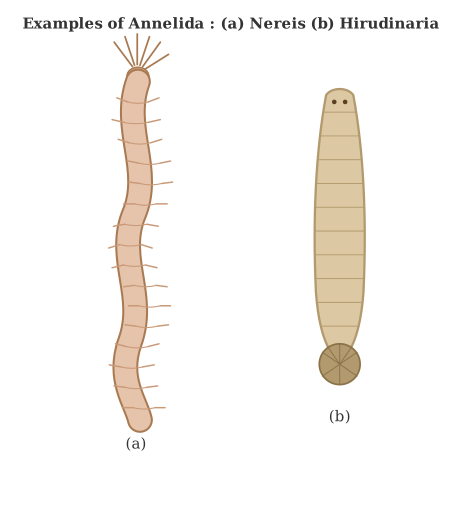
Drawn by us to help you understand the concept clearly, and verified to make sure it's accurate. For exams, practice from your NCERT textbook's own diagram.
These are segmented worms of phylum Annelida. Their key feature is metameric segmentation, meaning the body is divided into a series of similar ring-like segments arranged one behind the other, seen as the rings along an earthworm. They are bilaterally symmetrical, triploblastic and, importantly, are the first group to possess a true coelom lined completely by mesoderm. They have a closed circulatory system in which blood stays inside vessels. Nereis is a marine, free-living worm with bristle-bearing paddles for swimming, while Hirudinaria is the blo …