Biology · Ch 5 — Morphology of Flowering Plants
Semi-Technical Description of a Typical Flowering Plant
Semi-Technical Description of a Typical Flowering Plant
Various morphological features are used to describe a flowering plant. The description has to be brief, in simple and scientific language and presented in a proper sequence. The plant is described beginning with its habit, then its vegetative characters — roots, stem and leaves — and then its floral characters, which include the inflorescence and the parts of the flower. After describing the various parts of the plant, a floral diagram and a floral formula are presented.
The floral formula is represented by a set of symbols. In the floral formula:
- Br stands for bracteate,
- K stands for calyx,
- C for corolla,
- P for perianth,
- A for androecium, and
- G for gynoecium.
A plain G with a line drawn below the symbol indicates a superior ovary, while a G with a line drawn above the symbol indicates an inferior ovary. The symbols are also used for the sex of the flower — one symbol for male, another for female, and a combined symbol for bisexual plants. The symbol for actinomorphic (radially symmetric) flowers is a small circled-plus, and the symbol for zygomorphic (bilaterally symmetric) flowers is a curved percentage-like mark. The number written after each whorl symbol shows how many members it has. Cohesion (fusion of members of the same whorl) is indicated by enclosing the number within a bracket, and adhesion (fusion between members of different whorls) is indicated by a line drawn above the symbols of the floral parts. …
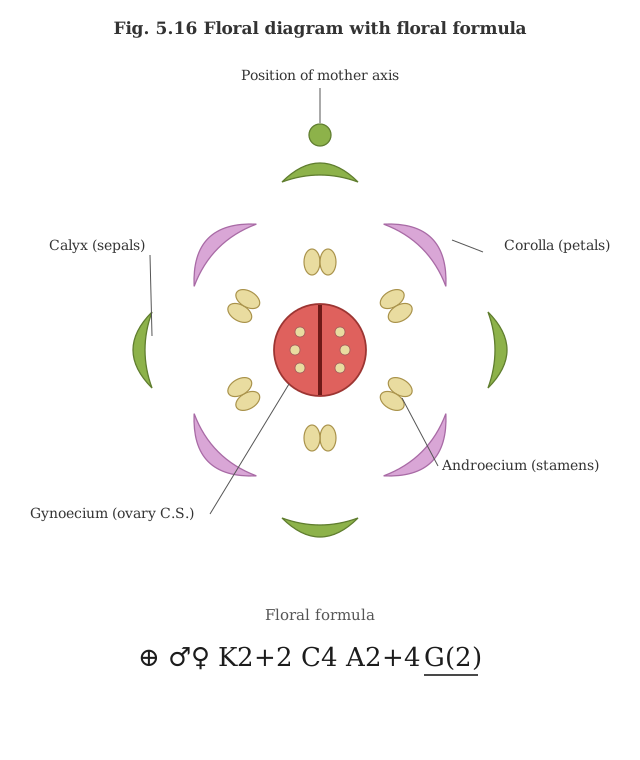
Drawn by us to help you understand the concept clearly, and verified to make sure it's accurate. For exams, practice from your NCERT textbook's own diagram.
This figure shows a floral diagram, a shorthand picture that records how a flower is built when seen from above. The parts are drawn as a set of concentric rings, each ring standing for one whorl of the flower: calyx, corolla, androecium and gynoecium from outside in. Symbols mark the number of members in each whorl, whether they are free or joined, and how they are placed relative to one another, while a small dot at the top represents the position of the mother axis. Read together with the written floral formula, the diagram giv …