Q.Out of benzene, m–dinitrobenzene and toluene which will undergo nitration most easily and why?
🔒You're viewing a preview — the full solution, concept, methods & PYQ mapping are locked.
🔒 Start your 14-day free trial to unlock the full solution →Concept understanding — Resonance Effects Comparison
Resonance Effects Comparison: The First Meeting
Imagine you're pushing a child on a swing. If you push at random moments, the swing jerks but never goes high. But if you push exactly when the swing is coming back toward you — matching its natural rhythm — each push adds energy, and the swing soars. That matching of your push to the swing's natural frequency is resonance.
Now, resonance isn't just for swings. It happens in electrical circuits, sound waves, bridges, and even atoms. The key idea is always the same: when the driving frequency matches the natural frequency, the response becomes maximum.
The Intuition First
Think of a system that can vibrate or oscillate — a pendulum, a guitar string, an electrical circuit with a capacitor and inductor. Every such system has a natural frequency at which it "likes" to oscillate. If you apply an external force (a push, a voltage, a sound wave) at that exact frequency, the system absorbs energy most efficiently. The amplitude of oscillation grows.
If you push at a frequency slightly different from the natural one, the system still responds, but less strongly. Far away from the natural frequency, the response is tiny.
Resonance is not about "breaking" things — it's about energy transfer efficiency. The dramatic effects (like a singer shattering a glass) happen because energy builds up over many cycles.
The Precise Statement
For any oscillatory system driven by a periodic force, the amplitude of the steady-state response depends on the driving frequency ω. The response is maximum when:
ωdriving=ωnatural
This is the resonance condition.
For a simple damped harmonic oscillator (mass m, spring constant k, damping coefficient b), the natural frequency is:
ω0=mk
And the amplitude A of the driven oscillation is:
A(ω)=(ω02−ω2)2+(bω/m)2F0/m
where F0 is the amplitude of the driving force.
Amax=bω0F0(at resonance, ω=ω0)
Notice: the maximum amplitude is inversely proportional to damping b. Less damping means sharper, taller resonance.
Comparing Resonance Effects: What Changes?
When you compare resonance effects across different systems, you look at three things:
- Sharpness of the peak — How quickly does the response drop off as you move away from resonance? This is measured by the quality factor Q:
Q=Δωω0
where Δω is the width of the resonance curve at half the maximum amplitude. High Q means a very sharp, narrow peak (low damping). Low Q means a broad, flat peak (high damping).
-
Peak height — The maximum amplitude at resonance. Higher Q gives a taller peak.
-
Resonance frequency shift — In some systems (like with strong damping), the actual peak occurs slightly below ω0. This shift is usually small but matters in precision applications.
For exams: When comparing two oscillators, always check damping first. The one with less damping has a higher and sharper resonance peak. The natural frequency itself depends only on k and m (or equivalent), not on damping.
A Concrete Comparison
Consider two pendulums:
- Pendulum A: light string, small bob, no air resistance (low damping)
- Pendulum B: heavy bob, thick string, in oil (high damping)
Both have the same length, so same natural frequency. But: …
The key idea is that electron-donating groups activate the benzene ring toward electrophilic substitution, while electron-withdrawing groups deactivate it.
Step 1 – Identify the substituent effect. Toluene has a methyl group (−CH3), which is electron-donating via hyperconjugation and inductive effect. Benzene has no substituent. m-Dinitrobenzene has two nitro groups (−NO2), which are strongly electron-withdrawing. …
The ease of nitration depends on how strongly the substituent already on the ring activates it toward electrophilic attack. Toluene has a strongly activating methyl group, benzene has no substituent, and m-dinitrobenzene has two strongly deactivating nitro groups. So toluene undergoes nitration most easily.
The core idea: activation vs. deactivation
Nitration is an electrophilic aromatic substitution reaction. The benzene ring acts as a nucleophile, attacking the nitronium ion (NO2+). Anything that increases the electron density on the ring makes it a better nucleophile — that speeds up the reaction. Anything that pulls electron density away slows it down.
Substituents already on the ring do one of two things:
- Activating groups (like −CH3) push electrons into the ring, making it more reactive than benzene itself.
- Deactivating groups (like −NO2) pull electrons out of the ring, making it less reactive.
The question gives us three compounds: benzene (no substituent), toluene (methyl group), and m-dinitrobenzene (two nitro groups). Let's compare them.
Step-by-step reasoning
1. Identify the substituent effect in each compound
- Benzene: No substituent. This is our baseline — its reactivity is the reference point.
- Toluene: The methyl group (−CH3) is an activating group. It donates electron density to the ring through the hyperconjugation and inductive effect (it's weakly electron-releasing). This makes the ring more electron-rich than benzene.
- m-Dinitrobenzene: Each nitro group (−NO2) is a strongly deactivating group. It pulls electron density away from the ring through both the inductive effect (electronegative nitrogen and oxygen) and the resonance effect (the nitro group has a positive nitrogen that can accept electron density from the ring). Two such groups make the ring extremely electron-poor.
A common mistake is to think that because m-dinitrobenzene already has nitro groups, it must be "used to" nitration and therefore reacts easily. In fact, the opposite is true: the nitro groups make further substitution very difficult. The second nitration of benzene (to give m-dinitrobenzene) is already much slower than the first; a third nitration is even harder.
2. Compare the electron density on the ring
The rate of electrophilic substitution depends directly on how much electron density the ring can offer to the attacking NO2+ ion.
- In toluene, the methyl group pushes electrons in, so the ring has higher electron density than benzene. The transition state for nitration is stabilised by the methyl group.
- In benzene, there is no extra push or pull — it's neutral.
- In m-dinitrobenzene, both nitro groups pull electrons out, so the ring has much lower electron density than benzene. The transition state is destabilised.
You can remember the order of reactivity for common substituents using the mnemonic: "Ortho-para directors are activators (except halogens), meta directors are deactivators." Methyl is an ortho-para director and an activator; nitro is a meta director and a deactivator. …
[!FORMULA] Among the given resonating structures of molecules negative mesomeric effect is represented by:
Showing the 12 most recent of 17 on this concept.
- TG EAPCET 2026Set eng-2026-05-10-AN1 markMCQQ.Consider the following Benzene diazonium chloride, Nitrobenzene, Pyridine, Aniline, Benzylamine, urea. How many of the above compounds are not suitable for the estimation of nitrogen by Kjeldahl’s method? (A) 3 (B) 2 (C) 4 (D) 1
›Reveal solutionSolution
Kjeldahl's method fails when nitrogen is in a ring, a nitro group, an azo group, or a diazonium group (it is not converted to (NH4)2SO4). Of the six, benzene diazonium chloride, nitrobenzene and pyridine are unsuitable — 3 compounds, option (A).
Concept
In Kjeldahl's method the sample is digested in hot concentrated H2SO4, converting amine/amide nitrogen to ammonium sulfate, which is then liberated as NH3 and estimated. Nitrogen held in an aromatic ring, or in −NO2, −N=N−, or −N2+ groups, is not converted and so cannot be estimated.
Solution — checking each compound
- Benzene diazonium chloride (C6H5N2+Cl−): diazonium nitrogen is lost as N2 — not suitable.
- Nitrobenzene (C6H5NO2): nitro nitrogen is not reduced to NH4+ — not suitable. …
- TG EAPCET 2026Set eng-2026-05-11-FN1 markMCQQ.The halogen compound which is least reactive towards nucleophilic substitution reactions is (A) 1-Chloro-4-nitrobenzene (benzene ring with −Cl and −NO2 para) (B) 1-Chloro-2,4-dinitrobenzene (C) 1-Chloro-3-nitrobenzene (benzene ring with −Cl and −NO2 meta) (D) 1-Chloro-2,4,6-trinitrobenzene
›Reveal solutionSolution
SNAr is accelerated by nitro groups ortho/para to the halogen. In 1-chloro-3-nitrobenzene the nitro group is meta, so it cannot stabilise the Meisenheimer intermediate by resonance — making it the least reactive, option (C).
The concept first
Aryl halides are normally very poor substrates for nucleophiles: the C–Cl carbon is sp2, the C–Cl bond has partial double-bond character from lone-pair donation, and the electron-rich π cloud repels an incoming anion. They react only when the ring is made electron-poor — the addition–elimination pathway called SNAr:
- Addition: the nucleophile attacks the C–Cl carbon, converting it to sp3 and generating a carbanion — the Meisenheimer complex.
- Elimination: Cl− departs and aromaticity is restored.
Step 1 is rate-determining, so anything that stabilises the carbanion speeds up the reaction.
Now the crucial geometric point. In that carbanion, the negative charge is delocalised by resonance onto the carbons that are ortho and para to the attacked carbon. Draw the resonance structures and you will see the charge appear at those three positions and never at the meta positions. Therefore:
a −NO2 group placed ortho or para to the halogen sits exactly where the charge goes, and can pull it right onto its own oxygens — enormous stabilisation. A −NO2 group placed meta sits where the charge never goes, and can offer only a feeble inductive pull.
Step-by-step through the options
(A) 1-Chloro-4-nitrobenzene (p-nitrochlorobenzene). The nitro group is para to Cl — perfectly placed. One such group already lets NaOH substitute the chlorine at 443 K (instead of the 623 K/300 atm needed for chlorobenzene itself). Activated.
(B) 1-Chloro-2,4-dinitrobenzene. Two nitro groups, one ortho and one para — both in charge-accepting positions. This compound reacts with NaOH at about 370 K. Strongly activated. …
- COMEDK 2026Set 2026-A1 markMCQQ.
[!FORMULA] Among the given resonating structures of molecules negative mesomeric effect is represented by:
(A) (B) (C) (D)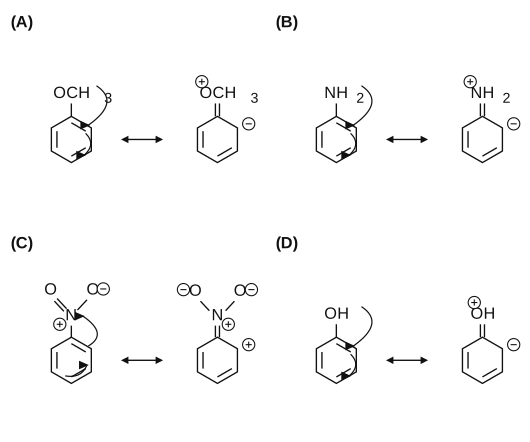
›Reveal solutionSolution
The negative mesomeric effect (–M) occurs when a substituent withdraws electron density from the ring via resonance, placing positive charge on the ring. Only the nitro group (–NO₂) does this; the other groups donate electrons (+M). Thus the correct option is (C).
Concept & Intuition
The mesomeric effect (or resonance effect) describes how a substituent on a conjugated system (like benzene) donates or withdraws electrons through π‑bond delocalisation.
- +M effect: The substituent pushes electrons into the ring, creating negative charge on the ring in resonance structures.
- –M effect: The substituent pulls electrons away from the ring, creating positive charge on the ring in resonance structures.
The key is to look at the direction of the curved arrows in the given resonance depictions:
- Arrows from the substituent into the ring → electron donation (+M).
- Arrows from the ring toward the substituent → electron withdrawal (–M).
Now examine each option.
-
Option (A): –OCH₃ (methoxy)
- The oxygen has lone pairs. Curved arrows start from oxygen’s lone pair and go into the ring.
- Result: Negative charge appears on the ring (e.g., at ortho/para positions).
- This is +M (electron donation). Not the answer.
-
Option (B): –NH₂ (amino)
- Nitrogen has a lone pair. Arrows go from nitrogen into the ring.
- Result: Negative charge appears on the ring.
- This is +M (electron donation). Not the answer.
-
Option (C): –NO₂ (nitro)
- The nitro group has a positively charged nitrogen and an oxygen with a negative charge. Arrows are drawn from the ring toward the nitro group.
- Result: Positive charge appears on the ring (e.g., at ortho/para positions).
- This is –M (electron withdrawal). This matches the question. …
- AP EAPCET 2025Set eng-2025-05-23-AN1 markMCQQ.The most reactive compound towards nucleophilic substitution with an aqueous NaOH is: structures of chlorine/nitro-substituted benzenes shown (A) Chlorobenzene: benzene ring with a single Cl substituent (B) 1-Chloro-2-nitrobenzene: benzene ring with Cl and one ortho NO2 substituent (C) 1-Chloro-2,4-dinitrobenzene: benzene ring with Cl, an ortho NO2, and a second NO2 para to the Cl (D) 1-Chloro-2,4,6-trinitrobenzene (picryl chloride): benzene ring with Cl and three NO2 groups at both ortho positions and the para position
›Reveal solutionSolution
This tests S_NAr reactivity trends: more NO2 groups ortho/para to the halogen means a more stabilised Meisenheimer intermediate and faster substitution. Answer: picryl chloride (D).
Concept and Intuition
Nucleophilic aromatic substitution on an activated aryl halide does not go through the carbocation-like mechanism of SN1/SN2 used for alkyl halides. Instead the nucleophile (OH−) first adds to the ring carbon bearing the halogen, forming a resonance-stabilised, negatively charged Meisenheimer complex, and only then does the halide leave. Because the negative charge in this intermediate is delocalised onto ring carbons ortho and para to the point of attack, an electron-withdrawing group (like NO2) sitting at one of those positions relative to the halogen can accept part of that negative charge directly through resonance (into its own N=O system), lowering the energy of the intermediate and hence the activation energy. A NO2 group meta to the halogen cannot conjugate with the developing negative charge in this way, so it only helps inductively, much less.
Step-by-Step Solution
- Chlorobenzene: no activating group at all — extremely unreactive to SNAr; aqueous NaOH does essentially nothing to it under normal conditions.
- 1-Chloro-2-nitrobenzene: one NO2 ortho to Cl — one resonance-stabilising group, reacts under forcing conditions.
- 1-Chloro-2,4-dinitrobenzene: NO2 ortho and para to Cl — two resonance-stabilising groups, reacts readily (this is the reagent behind Sanger's-reagent-type chemistry). …
- MHT-CET 2025Set pcm-2025-04-19-M1 markMCQQ.Identify the product formed from chlorobenzene on heating with conc. HNO3 in presence of conc. H2SO4. (A) Only 1-chloro-4-nitrobenzene (B) 1-chloro-2-nitrobenzene (C) Mixture of 1-chloro-4-nitrobenzene and 1-chloro-2-nitrobenzene (D) 2,4,6-trinitrochlorobenzene
›Reveal solutionSolution
-Cl is o,p-directing → mixture of para and ortho chloronitrobenzenes.
Although chlorine is weakly deactivating, it directs incoming electrophiles to the ortho and para positions. Nitration of chlorobenzene with conc. HNO3/conc. H2SO4 therefore gives a mixture of 1-chloro-4-nitrobenzene (para, major) and 1-chloro-2-nitrobenzene (orth …
- MHT-CET 2025Set pcm-2025-04-22-E1 markMCQQ.Which of the following has highest reactivity towards nucleophilic substitution reaction involving cleavage of C−Cl bond? (A) Chlorobenzene (B) p-Nitrochlorobenzene (C) 2,4-Dinitrochlorobenzene (D) 2,4,6-Trinitrochlorobenzene
›Reveal solutionSolution
The reactivity increases with the number of electron-withdrawing nitro groups that stabilize the Meisenheimer intermediate; the most reactive is 2,4,6-trinitrochlorobenzene, option (D).
Concept & Intuition
In nucleophilic aromatic substitution (SNAr), the rate-determining step is the attack of the nucleophile to form a negatively charged intermediate called the Meisenheimer complex. This intermediate is stabilized by electron-withdrawing groups (EWGs) that can delocalize the negative charge. Chlorobenzene has no such stabilization; adding nitro groups in the ortho and para positions dramatically increases reactivity because these groups can accept electron density via resonance. The more nitro groups, the more stable the intermediate, and the faster the reaction.
Step-by-step reasoning
-
Identify the reaction type
The question asks about nucleophilic substitution involving cleavage of the C–Cl bond. In aryl halides, this occurs via the addition-elimination (SNAr) mechanism, not SN1 or SN2. The key is the stability of the σ-complex (Meisenheimer intermediate).
-
Role of substituents
Electron-withdrawing groups (like –NO₂) at ortho and para positions relative to the leaving group stabilize the negative charge on the intermediate by resonance. Meta nitro groups are less effective because they cannot directly conjugate with the developing negative charge.
-
Analyze each option
- (A) Chlorobenzene: No nitro groups → no resonance stabilization of the intermediate. Lowest reactivity.
- (B) p-Nitrochlorobenzene: One nitro group at the para position → moderate stabilization. Reactivity is higher than chlorobenzene.
- (C) 2,4-Dinitrochlorobenzene: Two nitro groups (ortho and para) → strong stabilization. Much more reactive than (B). …
-
- MHT-CET 2025Set pcm-2025-04-23-E1 markMCQQ.Which of the following compounds has difficulty in breaking of C−X bond? (A) o-Nitrochlorobenzene (B) m-Nitrochlorobenzene (C) p-Nitrochlorobenzene (D) 2, 4, 6-trinitrochlorobenzene
›Reveal solutionSolution
The key idea is that electron-withdrawing groups (like nitro) at ortho and para positions stabilize the Meisenheimer intermediate in nucleophilic aromatic substitution, making C–X bond breaking easier; meta-nitro groups do not. Thus, m-nitrochlorobenzene has the most difficulty breaking the C–X bond.
The question asks which compound has difficulty in breaking the C–X bond. This is about nucleophilic aromatic substitution (SNAr). In such reactions, the rate-determining step is often the formation of a negatively charged intermediate (Meisenheimer complex). Electron-withdrawing groups (EWGs) like –NO₂ stabilize this intermediate by delocalizing the negative charge, making bond breaking easier. The key: only ortho and para nitro groups can directly conjugate with the negative charge on the ring; a meta nitro group cannot.
Let’s examine each option:
-
o-Nitrochlorobenzene (A) – The nitro group is ortho to chlorine. It can withdraw electron density by resonance and induction, stabilizing the intermediate. C–X bond breaks relatively easily.
-
m-Nitrochlorobenzene (B) – The nitro group is meta to chlorine. Here, resonance withdrawal cannot directly stabilize the negative charge on the carbon bearing the leaving group. Only inductive withdrawal operates, which is much weaker. Thus, the intermediate is less stabilized, and the C–X bond is hardest to break.
-
p-Nitrochlorobenzene (C) – The nitro group is para. Resonance stabilization is strong (like ortho), so bond breaking is easy. …
-
- MHT-CET 2025Set pcm-2025-04-26-M1 markMCQQ.Identify the product when chlorobenzene is heated with nitrating mixture. (A) Only 1-chloro-4-nitrobenzene (B) Only 1-chloro-2-nitrobenzene (C) Mixture of 1-chloro-2-nitrobenzene and 1-chloro-4-nitrobenzene (D) 2,4,6-trinitrochlorobenzene
›Reveal solutionSolution
Chlorobenzene undergoes electrophilic aromatic substitution with the nitrating mixture; the chlorine atom is ortho/para-directing but deactivating, so the major product is a mixture of ortho and para isomers — specifically 1-chloro-2-nitrobenzene and 1-chloro-4-nitrobenzene.
The key here is understanding how substituents already on a benzene ring influence where a new group (like –NO₂) attaches. Chlorine is a curious case: it withdraws electrons inductively (making the ring less reactive overall) but donates electrons through resonance (which activates the ortho and para positions). The net effect? The ring is deactivated compared to benzene, but the orientation is still ortho/para.
Why not meta?
The resonance structures of chlorobenzene place partial negative charge on the ortho and para carbons, making them more nucleophilic. The nitronium ion (NO₂⁺) from the nitrating mixture (HNO₃ + H₂SO₄) attacks those positions preferentially. Meta attack would require breaking this resonance stabilization, so it’s disfavored.
Why not trinitration?
The nitro group is strongly deactivating and meta-directing. Once one nitro group is attached, the ring becomes so electron-poor that further nitration requires much harsher conditions. Under typical nitrating mixture conditions (moderate temperature), only mononitration occurs.
Now, let’s walk through the reasoning step by step.
-
Identify the reagent and reaction type
The “nitrating mixture” is concentrated HNO₃ and H₂SO₄. This generates the nitronium ion (NO₂⁺), a strong electrophile. The reaction is electrophilic aromatic substitution (EAS).
-
Analyze the directing effect of chlorine
Chlorine has a lone pair that can be donated into the ring by resonance, stabilizing the intermediate carbocation when attack occurs at ortho or para positions. Inductive withdrawal slightly deactivates the ring, but the resonance effect dominates the position of attack. Thus, chlorine is an ortho/para director.
-
Consider the deactivating nature
Because chlorine is inductively electron-withdrawing, the overall rate of nitration is slower than for benzene. However, the ortho and para positions are still more reactive than the meta position. So the product is a mixture of ortho and para isomers.
-
Predict the major product distribution …
-
- WBJEE 2025Set chem-20251 markMCQQ.Increasing order of the nucleophilic substitution of following compounds is: I. chlorobenzene; II. 4-chloroanisole (p-Cl-C6H4-OCH3); III. 4-chloronitrobenzene (p-Cl-C6H4-NO2); IV. 2,4-dinitrochlorobenzene (A) I<III<II<IV (B) II<I<III<IV (C) II<III<I<IV (D) IV<III<II<I
›Reveal solutionSolution
Nucleophilic aromatic substitution is accelerated by electron-withdrawing groups (they stabilise the Meisenheimer intermediate) and slowed by electron-donating groups.
- II. 4-Chloroanisole: −OCH3 is electron-donating, deactivates NAS — slowest.
- I. Chlorobenzene: no activating group — next.
- III. 4-Chloronitrobenzene: one −NO2 (strong EWG, ortho/para to leaving group) — activated. …
- COMEDK 2024Set 2024-A1 markMCQQ.Which of the following carbanions is the least stable? (A) (CH3)2CH− (B) C6H5− (C) C6H5CH2− (D) CH2=CHCH2−
›Reveal solutionSolution
The key idea is that carbanion stability increases with greater delocalisation of the negative charge. The least stable carbanion is the one with the least resonance stabilisation — here, the simple alkyl carbanion (A).
Concept & Intuition
A carbanion is a carbon atom bearing a negative charge and a lone pair. Its stability depends on how well that negative charge can be spread out (delocalised). Delocalisation lowers the energy of the ion. Factors that help: resonance with adjacent π-systems, inductive effects from electron-withdrawing groups, and the hybridisation of the charged carbon (more s-character stabilises the lone pair). Here, we compare four candidates — one is a simple alkyl carbanion with no resonance, while the others have aromatic rings or allylic systems that can delocalise the charge. The one with the least delocalisation will be the least stable.
Step-by-step reasoning
-
Identify the structure of each carbanion
- (A) (CH3)2CH−: isopropyl carbanion. The negative carbon is sp³-hybridised, bonded to two methyl groups and one hydrogen. No π-system nearby — the charge is localised on that carbon.
- (B) C6H5−: phenyl carbanion. The negative carbon is part of the benzene ring (sp²-hybridised). The lone pair is in an sp² orbital, which has more s-character (33%) than sp³ (25%), making it more stable. Also, the negative charge can be delocalised into the aromatic ring via resonance.
- (C) C6H5CH2−: benzyl carbanion. The negative carbon is sp³-hybridised but directly attached to a benzene ring. The lone pair can overlap with the π-system of the ring, giving extensive resonance delocalisation (the charge can be spread onto ortho and para positions).
- (D) CH2=CHCH2−: allyl carbanion. The negative carbon is sp³-hybridised but adjacent to a C=C double bond. The lone pair can delocalise into the π-bond, giving two resonance structures: CH2=CH−CH2−⟷−CH2−CH=CH2.
-
Compare resonance stabilisation
- (A) has no resonance — the charge sits entirely on one carbon. This is the least stabilising situation.
- (D) has resonance over two carbons (allylic system).
- (C) has resonance over the entire benzene ring (seven resonance contributors, including the ring). …
-
- MHT-CET 2024Set pcm-2024-05-03-M1 markMCQQ.Which of the following compounds has difficulty in breaking the C−Cl bond? (A) o-Nitrochlorobenzene (B) m-Nitrochlorobenzene (C) p-Nitrochlorobenzene (D) 2,4,6-trinitrochlorobenzene
›Reveal solutionSolution
A meta -NO2 cannot stabilize the negative charge on the C-Cl carbon, so m-nitrochlorobenzene is hardest to break.
Nucleophilic aromatic substitution (breaking the C−Cl bond) is accelerated by electron-withdrawing −NO2 groups located ortho or para to the chlorine, because their resonance stabilizes the Meisenheimer intermediate (the negative charge lands directly on the carbon that held Cl). A −NO2 at the meta position cannot deliver this resonan …
- WBJEE 2024Set chem-20241 markMCQQ.Toluene reacts with mixed acid at 25∘C to produce (A) nearly equal amounts of o- and m-nitrotoluene (B) p-nitrotoluene (only) (C) predominantly o-nitrotoluene and p-nitrotoluene (D) 2,4,6-trinitrotoluene (only)
›Reveal solutionSolution
Methyl is an activating, ortho/para-directing group ⇒ predominantly o- and p-nitrotoluene.
Toluene undergoes electrophilic aromatic nitration with mixed acid (HNO3/H2SO4) generating NO2+. The methyl group donates electron density (hyperconjugation/+I), activating the ring and directing the electrophile to the ortho and para positions. At 25∘C only mononitration occurs, so a mixtu …
🎓Unlock everything free for 14 days
- ✓Full step-by-step solutions
- ✓Concept-first explanations
- ✓Methods, shortcuts & mistakes
- ✓PYQ mapping + timed mock tests
Full access for 14 days. No credit card required.