Chemistry · Ch 1 — Some Basic Concepts of Chemistry
Classification of Matter
Classification of Matter
Classification of Matter
At the macroscopic level — the level we can see and handle — matter is first divided into two broad categories: pure substances and mixtures. This classification, which you first encountered in Class IX, is shown in Figure 1.2 of the textbook.
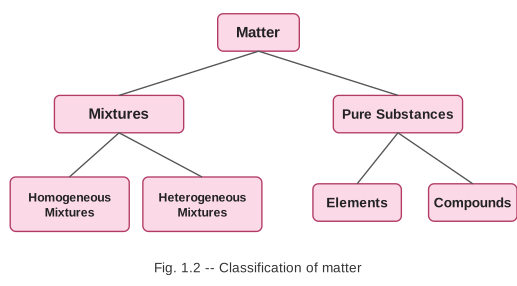
Fig. 1.2 lays out the classification described in the surrounding text as a single tree: matter first splits into mixtures and pure substances; mixtures split further into homogeneous and heterogeneous; pure substances split further into elements and compounds. Reading the diagram top to bottom mirrors exactl …
A pure substance is one in which all constituent particles are identical in chemical nature. Every particle of a pure substance has the same composition and the same set of properties. Copper, silver, gold, water, and glucose are examples. Glucose, for instance, contains carbon, hydrogen, and oxygen in a fixed ratio, and every particle of glucose has that same composition.
A mixture, by contrast, contains two or more different kinds of particles. These particles come from two or more pure substances that are physically mixed together. The pure substances that form a mixture are called its components. The key point is that the components can be present in any ratio — the composition of a mixture is variable. Sugar solution in water, air, and tea are all mixtures.
The composition of a mixture is variable; the composition of a pure substance is fixed. This is the fundamental distinction between the two.
Homogeneous and Heterogeneous Mixtures
Mixtures are further classified based on the uniformity of their composition.
A homogeneous mixture is one in which the components are completely mixed with each other. The particles of the different components are uniformly distributed throughout the bulk of the mixture, so the composition is the same at every point. You cannot see the separate components, even with a microscope. Sugar solution and air are homogeneous mixtures.
A heterogeneous mixture is one in which the composition is not uniform throughout. Different regions of the mixture have different compositions, and sometimes the different components are visible to the naked eye. A mixture of salt and sugar, or grains mixed with stones, are heterogeneous mixtures.
To decide whether a mixture is homogeneous or heterogeneous, ask: "Does every spoonful have the same composition as every other spoonful?" If yes, it is homogeneous. If no, it is heterogeneous.
Separating Mixtures
The components of a mixture can be separated by physical methods. Because the components are only physically mixed — not chemically combined — you can use techniques that exploit differences in their physical properties. Common methods include:
- Simple hand-picking
- Filtration
- Crystallisation
- Distillation
Pure Substances: Elements and Compounds
Pure substances have a fixed composition, and their constituents cannot be separated by simple physical methods. Pure substances are further classified into elements and compounds.
An element is a pure substance whose particles consist of only one type of atom. These particles may exist as individual atoms or as molecules. Sodium, copper, silver, hydrogen, and oxygen are examples of elements. All atoms of a given element are of one type, but atoms of different elements are different in nature.
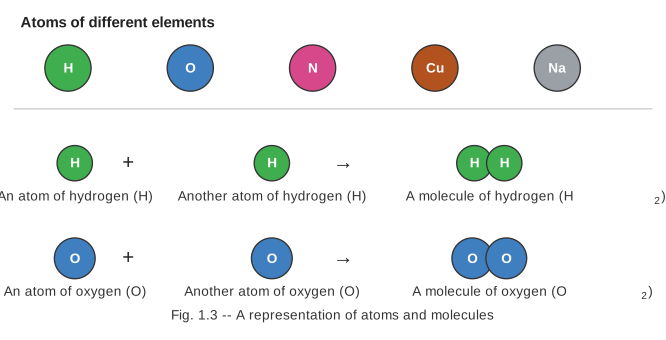
Some elements, such as sodium or copper, have atoms as their constituent particles. In other elements, the constituent particles are molecules formed by two or more atoms of the same element. For example, hydrogen gas (), nitrogen gas (), and oxygen gas () consist of diatomic molecules — two atoms of the same element chemically bonded together.
Drawn by us to help you understand the concept clearly, and verified to make sure it's accurate. For exams, practice from your NCERT textbook's own diagram.
Fig. 1.3 makes the atom/molecule distinction concrete. The top row shows single atoms of five different elements -- each a distinct type of particle. The two rows below show what happens when identical atoms combine: two separate hydrogen atoms come together to form one hydrogen molecule (H2), and two separate oxygen atoms come together to form one oxygen molecule (O2). This is exactly the diatomic molecule behavio …
A compound is a pure substance formed when two or more elements combine chemically in a fixed and definite ratio by mass. This ratio is characteristic of that particular compound. The properties of a compound are completely different from the properties of its constituent elements.
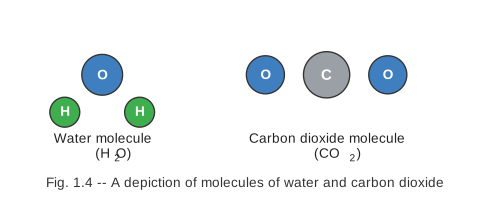
Consider water (). Hydrogen and oxygen are both gases at room temperature. Hydrogen burns with a pop sound; oxygen supports combustion. Yet when they combine in the fixed ratio of 2:1 by number of atoms (or 1:8 by mass), the resulting compound is a liquid that is used as a fire extinguisher. The compound has properties that neither element possesses.
Drawn by us to help you understand the concept clearly, and verified to make sure it's accurate. For exams, practice from your NCERT textbook's own diagram.
Fig. 1.4 shows the molecular make-up of two familiar compounds. A water molecule (H2O) has two hydrogen atoms attached to a single, central oxygen atom. A carbon dioxide molecule (CO2) has one carbon atom in the centre with an oxygen atom bonded on each side. Both are compounds formed from different elements combining in a fixed, definite …
…